
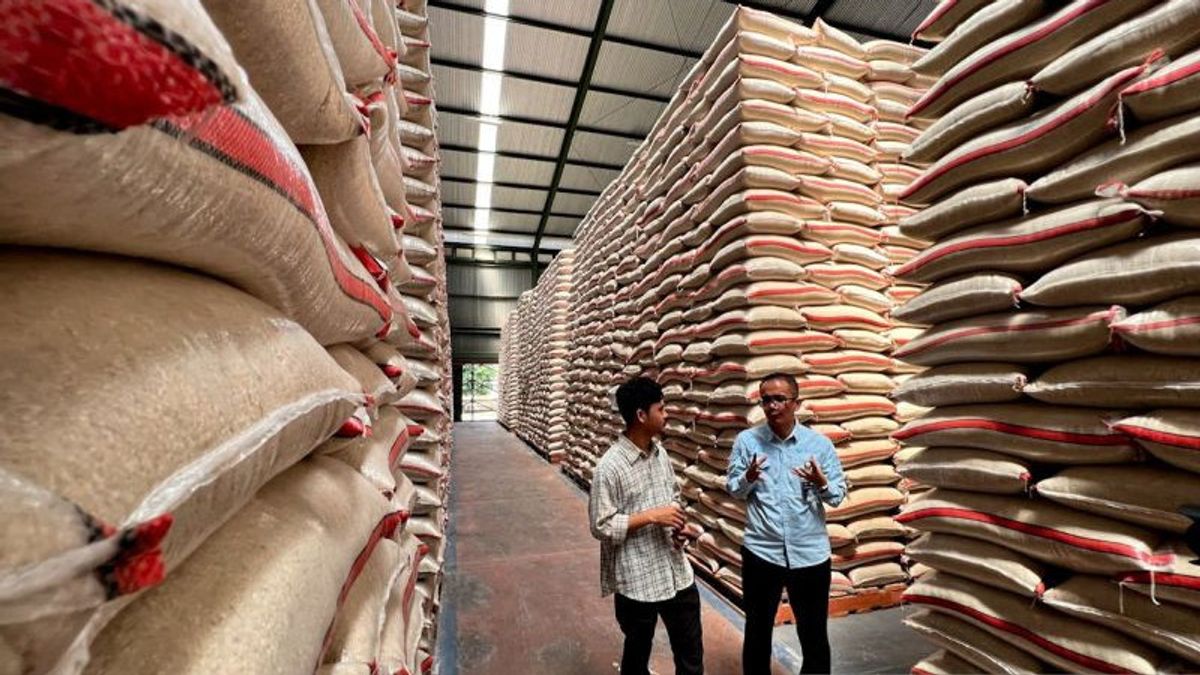


JAKARTA - Deputy for Food Availability and Stabilization of the National Food Agency (Bapanas) I Gusti Ketut Astawa revealed three indicators that made Indonesia achieve rice self-sufficiency with the highest stock in history.
Ketut said that the three indicators were first that Indonesia did not import rice in 2025; second, production far exceeded consumption; and third, Bulog stocks were relatively high, more than 3 million tons at the end of the year.
"This means that these three sides show that we can declare that our position is self-sufficient," said Ketut, quoted by ANTARA, Tuesday, January 6.
According to Ketut, this is also based on the provisions of the Food and Agriculture Organization (FAO), which states that if a country continues to import but below 10 percent of the needs, the nation can still be said to be self-sufficient.
"Moreover, now the President (Prabowo Subianto) and the Head of Bapanas (Andi Amran Sulaiman) have clearly said that there is no import of rice for consumption. So of course with this, if you can say it, this is the direction of self-sufficiency," said Ketut.
According to him, the vision of food self-sufficiency carried by President Prabowo has begun to materialize in the first year of his administration.
The need for rice consumption as a strategic staple food for the Indonesian people has been able to be met from the supply of the hard work of Indonesian farmers themselves. There is no import throughout 2025.
Regarding this, Bapanas supports the achievement of self-sufficiency that has been achieved in 2025. The self-sufficiency indicator for rice is contained in the National Food Balance Projection 2025 which is processed by Bapanas together with the Central Statistics Agency (BPS), the Ministry of Agriculture, the Ministry of Trade, and other related ministries/institutions.
"If we look at the data from BPS, our rice production is more than 34 million tons in 2025. Meanwhile, our needs are almost 31 million tons. We have a surplus of 3 million tons. That alone indicates that we are self-sufficient," he explained.
The surplus in question is the difference between the production and consumption of rice nationally for 2025. The rice surplus calculated by Bapanas for 2025 is 3.52 million tons.
The figure comes from the production of rice throughout 2025 at 34.71 million tons which has exceeded the annual rice consumption needs at 31.19 million tons.
This consumption requirement also includes the need for rice for the Free Nutritious Meal (MBG) program in 2025.
It is known that thanks to the surplus of production against rice consumption, the rice stock at the beginning of 2026 reached 12.529 million tons.
This figure includes the Government Rice Reserve (CBP) stock of Perum Bulog which is 3.248 million tons. The rest is spread in the community to distributors.
"The distribution is in the community, in traders, in distributors. That way, we need about 2.5 million tons every month. So with the 12.5 million tons, our strength is very strong to maintain food security," he said.
"Not to mention later in January and February (2026) production (rice). March and April are the harvest season. This indicates that we will be even stronger in 2026," continued Ketut.
He added that the availability of rice indicates that Indonesia is in a safe position.
Previously, the Head of Bapanas and Minister of Agriculture Andi Amran Sulaiman was optimistic that rice stocks in 2026 were very safe.
He also emphasized that there should be no business actors in the food sector who play prices above the provisions.
"Our rice stock is very safe. Without imports, our stock (CBP) is more than 3 million tons. That is the highest in history. Our rice is surplus," said Amran.
"So there is no problem until Ramadan (2026) and no one should play with prices. If anyone violates, we will act together with the Food Task Force of the National Police," added Amran.
The English, Chinese, Japanese, Arabic, and French versions are automatically generated by the AI. So there may still be inaccuracies in translating, please always see Indonesian as our main language. (system supported by DigitalSiber.id)


