

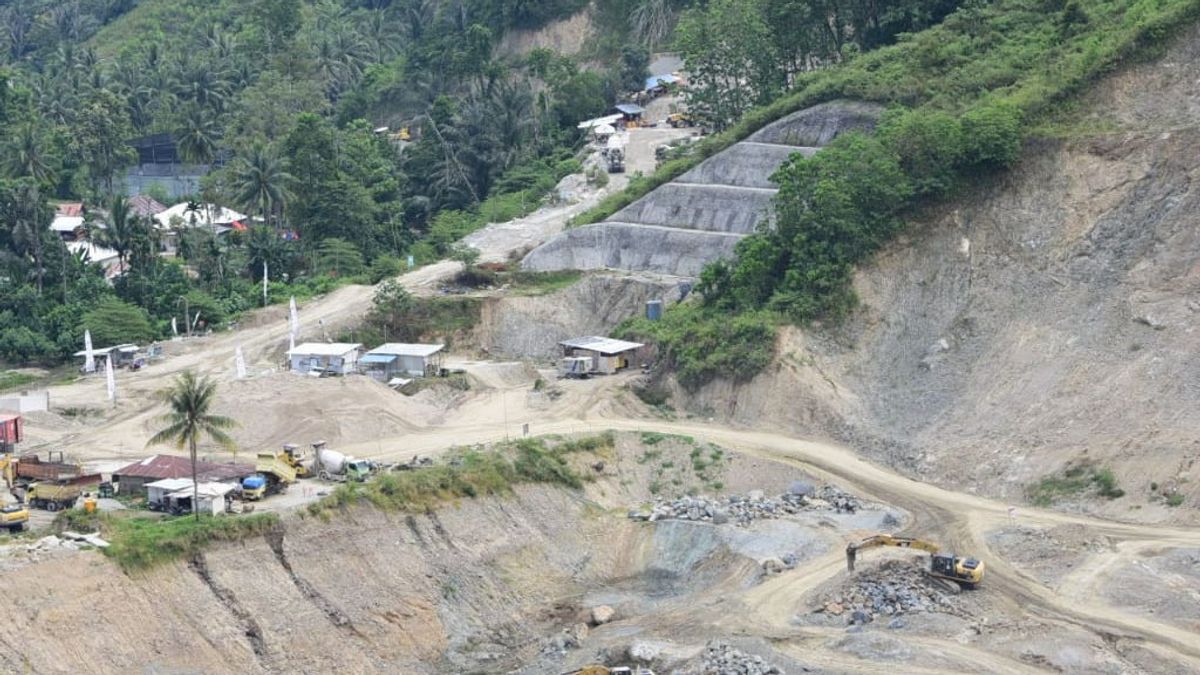


JAKARTA - Chairman of Commission V DPR RI Lasarus highlighted the progress of the construction of the Tiga Dihaji Dam in South Ogan Komering Ulu (OKU) Regency, South Sumatra Province. The reason is, the dam construction is known to have been delayed from the set target.
Reading the findings of the Supreme Audit Agency (BPK) of the Republic of Indonesia, Lasarus said, the construction of the Tiga Dihaji Dam was delayed to 9 years. Initially, the project, which was built since 2018, was targeted for completion in 2023.
"In the BPK RI report, it is stated that the completion of the construction of the Tiga Dihaji Dam will take longer than originally planned for 6 years, from 2018 to 2023, to 9 years, so from 2018 to 2026," said Lasarus at the Commission V Working Meeting of the DPR RI together with the Ministry of Public Works at the Parliament Complex, Senayan, Jakarta, Wednesday, November 26.
For this reason, Lasarus asked for an explanation from the Minister of Public Works, Dody Hanggodo, regarding this matter. The PDIP legislator also asked Minister Dody to provide an explanation regarding BPK's findings that the use of dams as an energy source was not optimal.
In addition, BPK also found indications of weaknesses in planning and technical studies as well as aspects of monitoring and evaluation of dam construction that have not been maximized.
"From the points of BPK's findings and recommendations, it leads to the need for a new blueprint from the government or review from the existing master plan regarding the use of dams as a source of electricity," he said.
Furthermore, Commission V asked the Ministry of Public Works to conduct an internal evaluation and improve the management of the ministry.
"The Ministry of Public Works should also improve governance with management, finance and assets, including audits, reviews, evaluations and more stringent and detailed monitoring to create a transparent, accountable and effective bureaucracy," he said.
Previously, the Ministry of Public Works targeted 15 dams that were in the construction stage and their irrigation networks could be completed before 2029. The existence of the irrigation route is expected to boost productivity and welfare of farmers.
Minister Dody emphasized the importance of integration of dam and irrigation construction.
SEE ALSO:
-
 | EKONOMI
Terpanjang di RI, Pembangunan Jembatan Kaca Bendungan Sukamahi Rampung Pertengahan 2026
26 November 2025, 16:39

"The construction of the dam must be accompanied by the construction of connectivity channels and rehabilitation of irrigation networks. With the irrigation supply continuing, it is hoped that water can flow to the fields. So that farmer productivity also increases, farmers are more prosperous," said Dody in his official statement, written Tuesday, September 30.
A total of 15 dams are projected to irrigate an irrigation area of 184,515 hectares. With reliable water supply, the planting area is estimated to increase from 277,775 hectares to 483,163 hectares.
The availability of irrigation water from the 15 dams will also change the planting pattern of farmers who previously depended on rain, so that the Plantation Index (IP) rose from 150 percent to 262 percent.
This means that the harvest scale, which usually increases once a year, to 2-3 times a year. As a result, harvest productivity is projected to increase from 1,403,300 tons/ha to 2,343,289 tons/ha.
The English, Chinese, Japanese, Arabic, and French versions are automatically generated by the AI. So there may still be inaccuracies in translating, please always see Indonesian as our main language. (system supported by DigitalSiber.id)


