


JAKARTA - In the midst of the increasingly inclusive dynamics of the Indonesian capital market, crowdfunding (SCF) securities increasingly occupy strategic positions as alternative routes of non-bank funding for micro, small and medium enterprises (MSMEs).
With a digital, transparent, and friendly mechanism for MSMEs, SCF is considered a mini-IPO' that not only provides access to capital, but also prepares business actors to advance to higher funding in the future.
Capital Market Observer Reydi Octa views crowdfunding as an effective bridge between the capital market and the MSME sector.
"Effective bridges to connect MSMEs and capital markets, so that MSMEs can be prepared in terms of governance, administration to rise to a higher level later for larger financing," he told VOI, Monday, November 17.
He said the potential for SCF is very large and many quality MSMEs actually have a growth opportunity, but limited access to capital.
Reydi emphasized that the SCF scheme allows for the formation of an investor community that is ready to finance quality businesses that previously had difficulty accessing capital.
Despite its great potential, Reydi reminded that there are big challenges such as risk default, transparency of financial reports, and the need for post-defense investor protection.
He emphasized that the synergy of capital market institutions between the OJK, the Self-Regulatory Organization (SRO), and other institutions is very important in facilitating trade and strengthening investor confidence.
Reydi gave an example, OJK tightens SCF surveillance standards, SRO provides stock exchange-like platforms for small-scale, and online platforms for facilitating pre- and post-financing transactions.
In addition, he assessed that SCF's integration opportunities with other capital market instruments are very open, such as mutual funds specifically for MSMEs, or even RDPT-like instruments containing bonds from the issuance of SCF, so that investor funds can be more structured and sustainable.
Furthermore, he conveyed that the role of retail investors is considered very vital, because the more investors involved, the smaller the risk burden that must be borne by individuals.
In addition, according to him, investor confidence must be maintained, so that education and transparency are the key factors so that retail investors are willing to become recurring investors in various MSME projects.
Reydi emphasized that crowdfunding can also be a motor for regional economic equality, so the importance of massive socialization to all regions is so that the quality of MSME information is evenly distributed and can start access to funding through SCF.
"SCF can help MSMEs in each region to develop and increase the economic level of the local area," he said.
He added that the funding will be able to create a multiplier effect for the people's economy, such as increasing production capacity, absorbing labor, and encouraging people's purchasing power.
"This has an impact on increasing the purchasing power of the local community, with different MSME sectors, this will complement and provide a faster effect on regional progress," he explained.
From the regulatory side, Reydi assessed that the existing regulations were adequate, but still needed improvement, especially regarding policies if MSMEs experienced defaults, with continued regulations that would strengthen public trust in SCF.
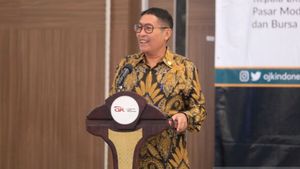
In line with that, Deputy Commissioner for Capital Market Investment Management and OJK Securities, Eddy Manindo Harahap, said that SCF is now increasingly being taken into account as an alternative funding for MSMEs.
"Security crowdfunding has also increased, indeed it is relatively small but the growth is indeed good," he said at the Media Gathering Capital Market Journalist Workshop, Saturday, November 15.
He explained that there are 18 SCF organizers who have obtained OJK permits, and the number of issuers of securities and emission values continues to grow from year to year.
Based on OJK data, as of June 11, 2025, the value of SCF emissions reached IDR 1.74 trillion from 929 securities publishers. This figure increased compared to 2024 of IDR 1.36 trillion with 713 publishers, and from 2023 it was IDR 1.04 trillion with 465 publishers.
Eddy assessed that although SCF was still in its early stages, this scheme gave new hope to MSMEs that needed financing outside of banks.
"So if there are MSME entrepreneurs who need funds, now this is one of the outlets from other outlets that he can take to get funding assistance. Now SCF is one of them, but of course it must follow the provisions for obtaining an applicable SCF," he explained.
He added that because this industry is still new, the number of organizers is still limited and OJK continues to provide guidance so that its industrial foundations are stronger.
"We do a lot of coaching to the organizers first. Because there really needs to be reinforcement there first," he said.
President Director of the Indonesian Central Securities Depository (KSEI) Samsul Hidayat, also sees SCF as a funding option that is increasingly in demand by small and medium enterprises.
Samsul hopes that SCF will become a new source of energy for MSMEs to develop, as well as become the initial door to a larger capital market.
"Hopefully this SCF can provide a kind of new energy, for MSMEs for small and medium companies to be able to move and one of the real things is that the SCF capital market is expected to be the forerunner of the company that will have an IPO in the future, even though it is still far away," he said.
SEE ALSO:
-
 | EKONOMI
OJK Beberkan Arus Modal Asing Masih Keluar Capai Rp41,79 Triliun hingga Oktober 2025
07 November 2025, 17:41 -
 | EKONOMI
Minat Investor Asing Menguat, Inflow Capai Rp10,96 Triliun di Agustus 2025
04 September 2025, 11:21

Although the maximum SCF funding limit is around Rp. 10 billion, he said that most new publishers were able to collect Rp. 500 million to Rp. 1 billion.
However, Samsul explained that the amount still plays an important role for MSMEs that require funding.
Samsul emphasized that in the end the presence of SCF was part of efforts to strengthen the people's economy in Indonesia.
According to him, with stable growth and high interest in MSMEs, SCF is believed to have the potential to become one of the pillars of important funding in the national ecosystem.
The English, Chinese, Japanese, Arabic, and French versions are automatically generated by the AI. So there may still be inaccuracies in translating, please always see Indonesian as our main language. (system supported by DigitalSiber.id)


