

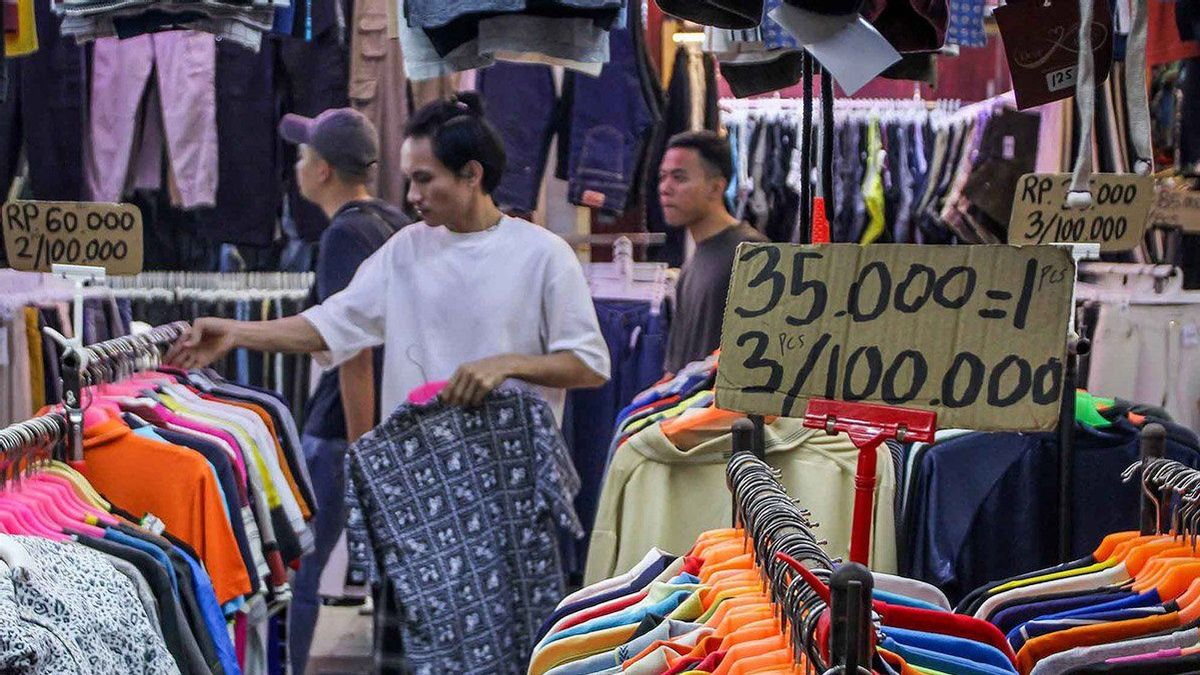


JAKARTA - Thrifting traders have asked the government to compile a clear and measurable roadmap after the ban on importing illegal used clothes, so that business actors can adapt and carry out their economic activities.
"We hope that the government will give the opportunity through a measurable restriction scheme and clear rules of the game," said Trifting business activist from the Oscar Pendong National Concerned People's Movement (GRPB) as reported by ANTARA, Monday, November 3.
Oscar emphasized that Thrifting business actors are not anti-local, but part of the MSME ecosystem which has been living on the sale of suitable clothing.
He said, many Thrifting traders also sell local products that are not widely known to the public.
"We are ready to cooperate with local producers. In fact, many Thrifting traders also sell local products that have not been widely known by the public," he said, during a meeting with the Ministry of MSMEs in Jakarta.
Traders, he continued, asked the government not to take steps to completely prohibit the practice of selling suitable clothes without a clear roadmap.
If in the future stricter restrictions are needed, they hope that policies will be implemented in stages so that business actors have room to adapt and do not experience sudden closures.
He also encourages transparent arrangements related to Thrifting activities so that traders can pay taxes and contribute to state revenues.
According to him, one container of imported clothing that is legally arranged and in accordance with the provisions has the potential to generate hundreds of millions of rupiah in revenue at the business level.
Responding to these concerns, Deputy for Small Business at the Ministry of MSMEs Temmy Satya Permana encouraged the rebranding of Pasar Senen, which has been known as a center for selling used imported goods, so that it can transform into a local product center.
He also encouraged Thrifting traders to start switching to trade quality domestic products.
They are basically MSME entrepreneurs that we need to develop and empower. They are actually ready to cooperate with local brands," said Temmy.
Citing GRPB data, Temmy said there were around 984,000 Thrifting traders throughout Indonesia.
This figure reflects a significant economic scale if the ecosystem is orderly organized and directed to strengthen local products and compliance with regulations.
He said his ministry still supports efforts to control illegal imports, especially used clothes.
However, the government also needs to present a solution so that traders can continue to run their businesses in an orderly and empowered manner.
SEE ALSO:
-
 | EKONOMI
Harga Batu Bara Periode Pertama November Turun jadi 103,75 Dolar AS
03 November 2025, 23:27 -
 | EKONOMI
Satgas Cs-137 Sebut Paparan Radioaktif pada Kontainer Cengkeh Relatif Kecil
03 November 2025, 23:11 -
 | EKONOMI
Menkop Ferry Ungkap Modernisasi Kopdes Merah Putih Kunci Tarik Minat Anak Muda
03 November 2025, 22:53
Kementerian UMKM menegaskan komitmen untuk mengawal transformasi Pasar Senen melalui kemitraan yang adil, pembinaan kapasitas usaha, peningkatan kualitas kurasi produk, serta penguatan akses pembiayaan dan pemasaran.
Pendekatan ini menempatkan perlindungan konsumen, pemberantasan impor ilegal, dan pemberdayaan UMKM sebagai satu tarikan napas kebijakan.
Melalui langkah transformatif dan kolaboratif, Pasar Senen diharapkan menjadi etalase kebanggaan produk Indonesia yang tertib, sehat, kompetitif, dan menyejahterakan.
SEE ALSO:
-
| EKONOMI
Harga Batu Bara Periode Pertama November Turun jadi 103,75 Dolar AS
03 November 2025, 23:27 -
| EKONOMI
Satgas Cs-137 Sebut Paparan Radioaktif pada Kontainer Cengkeh Relatif Kecil
03 November 2025, 23:11 -
| EKONOMI
Menkop Ferry Ungkap Modernisasi Kopdes Merah Putih Kunci Tarik Minat Anak Muda
03 November 2025, 22:53
The Ministry of MSMEs affirms its commitment to overseeing the transformation of Pasar Senen through fair partnerships, business capacity development, improving product curation quality, and strengthening access to financing and marketing.
This approach places consumer protection, eradication of illegal imports, and empowerment of MSMEs as a policy breath.
Through transformative and collaborative steps, Pasar Senen is expected to be a storefront for the pride of Indonesian products that are orderly, healthy, competitive, and prosperous.
The English, Chinese, Japanese, Arabic, and French versions are automatically generated by the AI. So there may still be inaccuracies in translating, please always see Indonesian as our main language. (system supported by DigitalSiber.id)


