

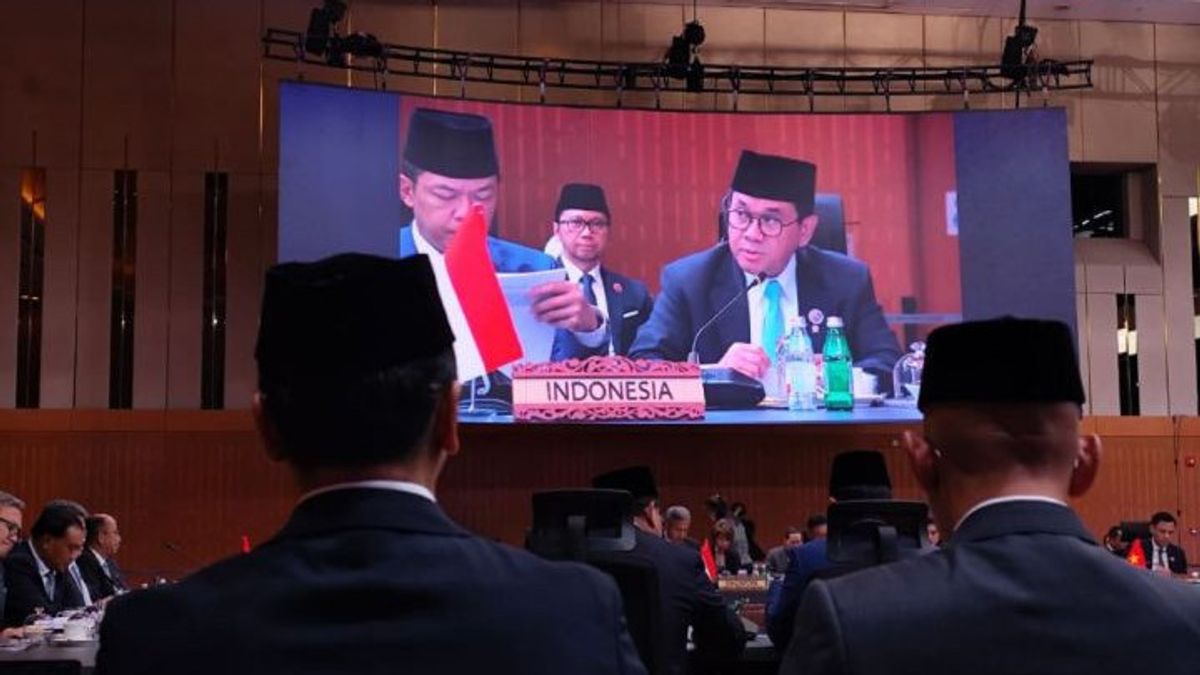


JAKARTA - Minister of Trade (Mendag) Budi Santoso emphasized the importance of strengthening coordination across pillars of the economy and security in the face of increasingly complex global geoeconomic and geopolitical dynamics.
According to Budi, this step needs to be taken so that ASEAN remains responsive, adaptive, and responsive to global changes.
This statement was made by Budi Santoso at the ASEAN Minister of Foreign Affairs and Minister of Economics Meeting (ASEAN Joint Foreign and Economic Ministers Meeting) on the sidelines of the 47th ASEAN Summit series in Kuala Lumpur, Malaysia, Saturday, October 25.
"The meeting of the Minister of Foreign Affairs and the ASEAN economy is a strategic momentum to strengthen collaboration between the two pillars, as well as an opportunity to review the ASEAN mechanisms and institutions in implementing various collective initiatives," Budi said in an official statement, Sunday, October 26.
In the forum, Budi also highlighted the importance of deepening and expanding economic partnerships through an accession process to complement the benefits of the Regional Comprehensive Economic Partnership (RCEP).
He emphasized that RCEP is an important milestone for regional economic integration and opens up inclusive and sustainable growth opportunities in the Asia-Pacific region.
SEE ALSO:
-
 | EKONOMI
Dorong Produktivitas Petani, PTBA Bangun Dua PLTS Irigasi di Muara Enim
26 Oktober 2025, 16:41 -
 | EKONOMI
Cara Bank Jakarta Dorong Transaksi Nontunai lewat Kreatif dan Inklusif
26 Oktober 2025, 11:45

In addition, Budi added, ASEAN also needs to encourage the utilization and modernization of the ASEAN Plus One FTA free trade agreement to expand market access, strengthen supply chains, and encourage innovation in the region.
The ASEAN is currently negotiating the ASEAN State of the FTA and Indonesia hopes that this process can be completed by 2026. In the future, ASEAN will also need to explore new cooperation with other strategic partners such as the European Union and the Gulf Regional Cooperation Council (GCC) to strengthen regional economic diversification," he explained.
Budi said ASEAN's ministers at the meeting also welcomed reports and recommendations in the 2025 ASEAN Geoeconomics Report (AGR) compiled by the ASEAN Geoeconomics Task Force (AGTF). The report is considered successful in providing a strategic direction for strengthening ASEAN's collective steps in the future, including the AGTF's institutionalization plan to ensure the sustainability of cross-pillar dialogue.
"Indonesia plays an active role in the process of compiling this report and we are proud because the report reflects the understanding and mutual agreement between ASEAN countries about how to build regional economic resilience while keeping ASEAN open and externally oriented," said Budi.
Budi emphasized that Indonesia is committed to continuing to strengthen cross-pillar coordination in ASEAN and following up on the recommendations produced, so that this regional organization is more prepared to face changes in the global landscape.
The English, Chinese, Japanese, Arabic, and French versions are automatically generated by the AI. So there may still be inaccuracies in translating, please always see Indonesian as our main language. (system supported by DigitalSiber.id)


