

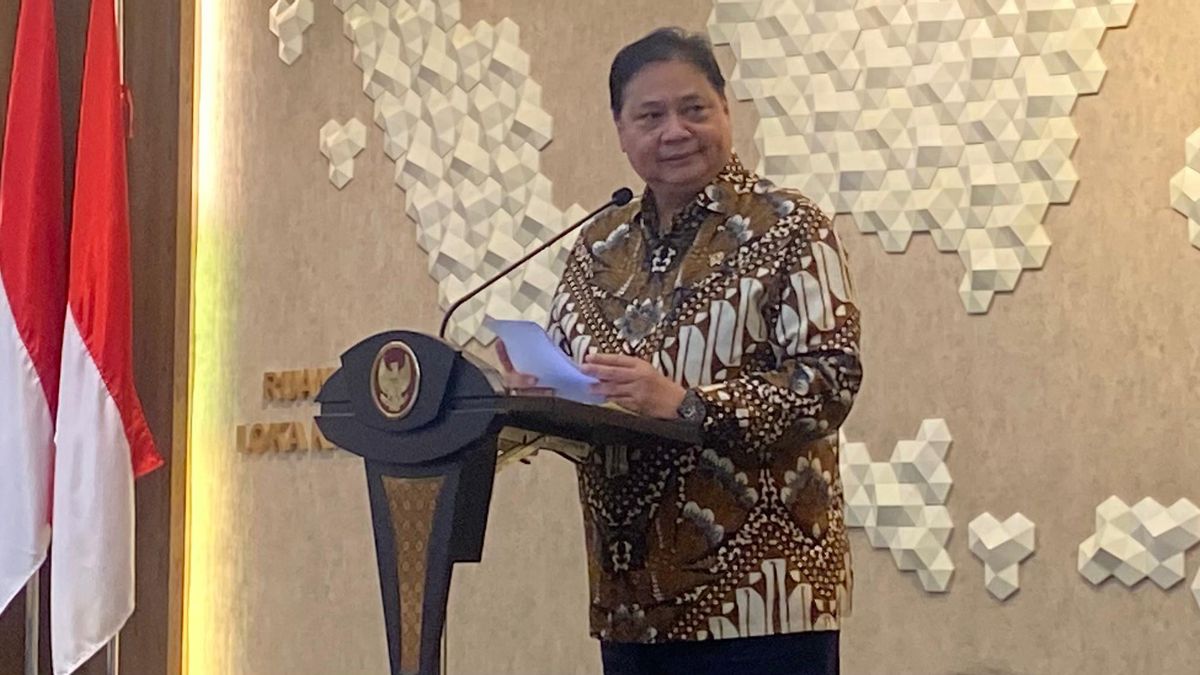


Coordinating Minister for Economic Affairs Airlangga Hartarto conveyed that in a meeting with the Indonesian Economist Alliance (AEI), various proposals and notes related to government programs were discussed.
He explained that the discussion included programs targeting the middle class and President Prabowo Subianto's flagship programs, such as Free Nutrition Food (MBG) and the Red and White Cooperative.
"Earlier, we also explained that government programs are of concern rather than the Economic Alliance which is of concern and are related to programs targeting the middle class, then also related to the President's flagship programs, both MBG and red and white cooperatives," he told the media crew, Monday, August 29.
Regarding the request for termination of the MBG program due to the rampant poisoning cases requested by AEI, Airlangga emphasized that the MBG program would continue.
"No, no, no. We will continue," he said.
He added that the MBG program will continue because President Prabowo has provided detailed and technical directions in a meeting with a number of ministers of the Red and White Cabinet.
"Yes, yesterday the President closed things up and yesterday the Coordinating Minister for Food had explained it to the media," he added.
Previously, the Indonesian Economist Alliance (AEI) visited the Coordinating Minister for Economic Affairs, Airlangga Hartarto, to convey a request that the Free Nutrition Food (MBG) program be temporarily suspended.
AEI representative Lili Yan Ing also highlighted the need to stop inappropriate budget allocations, including significantly reducing state spending on populist programs such as the Free Nutrition Food Program (MBG).
According to him, although this program aims to overcome triple burden of malnutrition, namely stunting, obesity, and micro nutritional malnutrition, the government still needs to develop policies based on evidence, taking into account target recipients and implementations that are in accordance with the diversity of local conditions in Indonesia.
He added that the change in the MBG scheme from a universal one to a targeted and targeted program will help improve budget allocation while increasing the effectiveness of the use of public funds.
Lili also revealed that her party was disappointed with the MBG program design which was considered less proportional in terms of budget sharing.
"We convey that our disappointment, in our opinion, the first allocation of MBG is disproportionate," said Lili to the media crew at the Coordinating Ministry for the Economy Office, Monday, September 29.
However, he acknowledged that the MBG program is part of a political promise that has good intentions in improving the quality of children's health and human resources in Indonesia.
However, according to him, there are a number of important things that need to be addressed before this program is widely implemented.
Based on data from the National Socio-Economic Survey (SUSENAS), Lili explained that of the approximately 80 million students, only 1 percent or about 800,000 students claimed to have never eaten, and 4 percent or about 3.5 million students stated that they had a lack of food intake.
He conveyed that from rough calculations, if each student receives assistance of Rp. 10,000 per day for 20 days a month for a full year, the maximum budget required is only around Rp. 8 trillion.
Lili highlighted three important points that the government needs to pay attention to before continuing this program nationally.
First, piloting is carried out in areas that do have high demand, especially those inhabited by lower middle-income people.
SEE ALSO:
-
 | EKONOMI
Anggaran MBG Rp335 Triliun, Aliansi Ekonom Ungkap Ada Potensi Crowding Out
29 September 2025, 20:05 -
 | EKONOMI
Darurat Ekonomi, AEI Desak Perbaikan Tata Kelola dan Penghentian Program Populis
29 September 2025, 18:25

Kedua, melibatkan berbagai pemangku kepentingan, seperti orang tua murid, guru, serta masyarakat sekitar sekolah dalam pelaksanaan program agar lebih partisipatif.
Ketiga, pentingnya evaluasi program dengan prosedur operasional yang jelas, agar transparansi dan akuntabilitas bisa dijaga.
"Makanya kami menekankan mengapa perlu ada pemberhentian saat ini juga karena kami melihat tiga hal yang kami sampaikan itu tidak dilaksanakan dengan baik," jelasnya.
"Jangan sampai ada korban, nyawa ini adalah masa depan bangsa dan saya yakin kita semua mempertanggungjawabkan akan dari setiap nyawa adik-adik anak-anak kita," tambahnya.
SEE ALSO:
-
| EKONOMI
Anggaran MBG Rp335 Triliun, Aliansi Ekonom Ungkap Ada Potensi Crowding Out
29 September 2025, 20:05 -
| EKONOMI
Darurat Ekonomi, AEI Desak Perbaikan Tata Kelola dan Penghentian Program Populis
29 September 2025, 18:25
Second, involving various stakeholders, such as parents, teachers, and the community around the school in implementing programs to make them more participatory.
Third, the importance of program evaluation with clear operational procedures, so that transparency and accountability can be maintained.
"That's why we emphasize why there needs to be a dismissal right now because we see that the three things we conveyed were not carried out properly," he explained.
"Don't let there be casualties, life is the future of the nation and I'm sure we all account for the lives of our children's brothers and sisters," he added.
The English, Chinese, Japanese, Arabic, and French versions are automatically generated by the AI. So there may still be inaccuracies in translating, please always see Indonesian as our main language. (system supported by DigitalSiber.id)


