

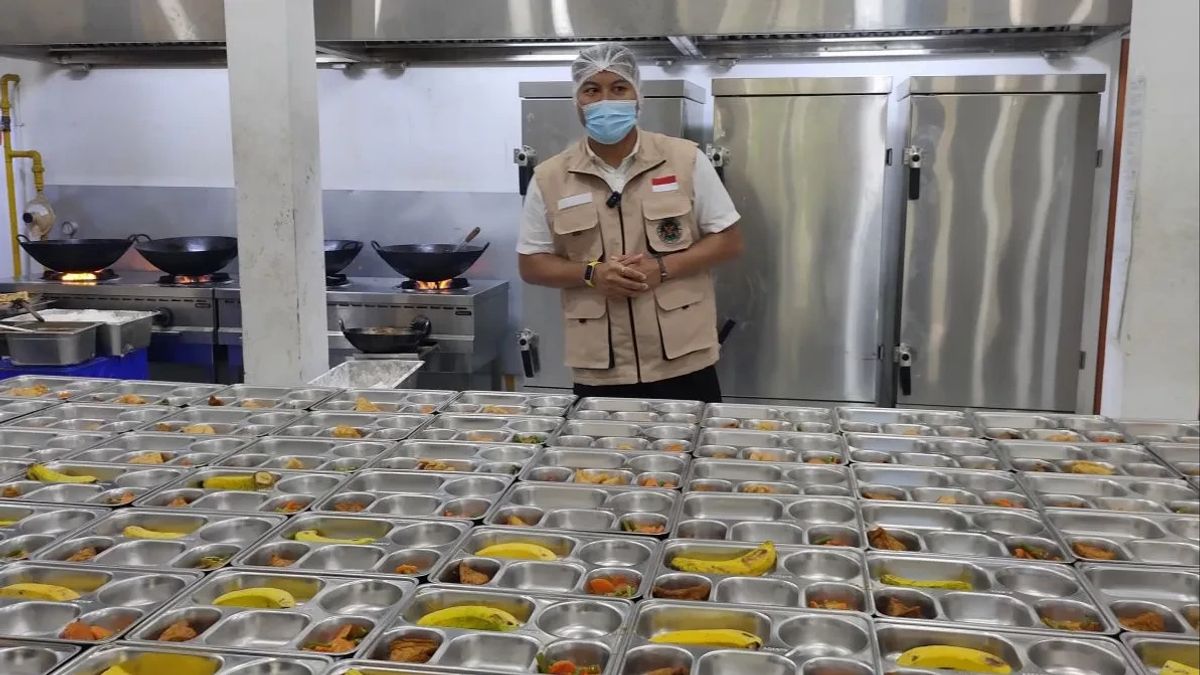


Minister of Health Budi Gunadi Sadikin ensured that the standardization process of the Nutrition Fulfillment Service Unit (SPPG) would be tightened. This step was taken in the aftermath of the many cases of food poisoning in the Free Nutrition Food (MBG) program.
In addition, Budi said that his party together with the National Nutrition Agency (BGN) would also tighten the control process of raw materials used until the presentation process for beneficiaries or students.
"We were with the National Nutrition Agency (BGN) to control the process from the preparation. Starting from the selection of food, then processing the food, then what kind of presentation," he said at the Ministry of Health, Jakarta, Sunday, September 28.
Budi admitted that most of the SPPG also did not have a Hygienic and Sanitation Decent Certificate (SLHS). Even so, he said he had not received the complete data.
"I know most of it is still in process. The incomplete data is in me," he said.
Previously, the Coordinating Minister for Food Affairs Zulkifli Hasan emphasized that a number of SPPGs providing problematic MBGs would be temporarily closed.
Zulhas, as Zulkifli is familiarly called, said that this closure was in the context of evaluation and investigation after the proliferation of poisoned children after eating food from the MBG program.
The problematic SPPG is temporarily closed for evaluation and investigation. So the problem is temporarily closing the evaluation and investigation," he said at a press conference at the Ministry of Health, Jakarta, Sunday, September 28.
SEE ALSO:
-
 | EKONOMI
Kasus Keracunan MBG Melonjak, Zulhas Ingatkan: Jangan Anggap Hanya Statistik
28 September 2025, 18:55 -
 | EKONOMI
Menko Zulhas: SPPG Bermasalah Ditutup Sementara untuk Evaluasi dan Investigasi
28 September 2025, 18:45 -
 | EKONOMI
Marak Kasus Keracunan MBG, Pemerintah Wajibkan Seluruh SPPG Punya SLHS
28 September 2025, 18:30
According to Zulhas, the evaluation carried out is related to discipline, quality, cooking skills as well as sanitation aspects. In addition, sterilization of eating utensils, improvement of waste flow, and sanitation will also be an evaluation material.
In the future, continued Zulhas, evaluations will also be carried out in all SPPGs, not only those with problems.
"Everything was evaluated and investigated, but there were some that I said that I received attention to the quality of water and the flow of waste," he explained.
In addition, said Zulhas, all SPPGs that provide MBG are also required to have a Sanitation Higiene Certificate (SHLS).
Meanwhile, based on data from the National Nutrition Agency (BGN), currently there are 9,533 SPPGs spread across a number of Indonesian regions. Even so, it is not yet known how many SPPGs already have the SHLS.
"Indeed, a Certificate of Higiene Sanitation is a requirement, but after the end of the incident now it gets special attention. Every SPPG must have a SLHS," said Zulhas.
Zulhas emphasized that the safety of children consuming MBG is the government's top priority. Therefore, continued Zulhas, all SPPGs must have SLHS.
"It will be checked. If this is not the case, it will happen again, it will happen again. The safety of our children is a top priority, SLHS is mandatory for all SPPGs," he said.
The English, Chinese, Japanese, Arabic, and French versions are automatically generated by the AI. So there may still be inaccuracies in translating, please always see Indonesian as our main language. (system supported by DigitalSiber.id)
Most Popular Tags
#Prabowo Subianto #donald trump #Febrie Adriansyah #8791 #giias 2026Popular


