

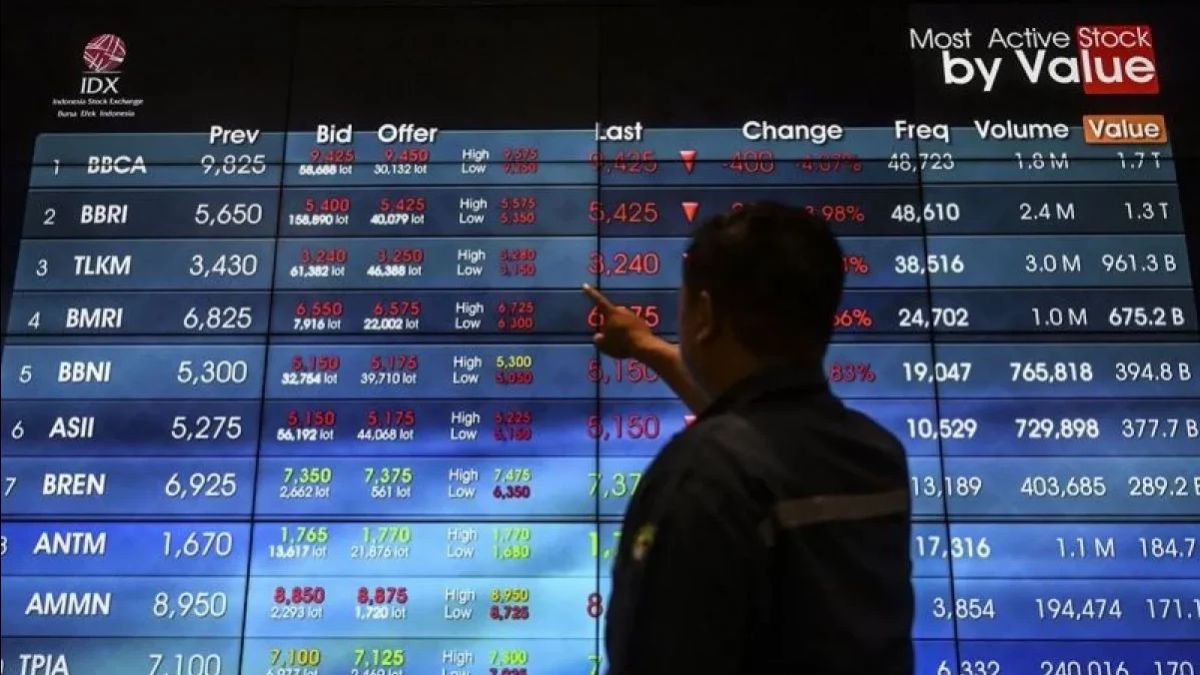


JAKARTA - Shares of members of the Association of State-Owned Banks (Himbara) simultaneously strengthened along with reports of an injection of funds of Rp200 trillion from the government.
The trade on Thursday, September 12, showed the accumulation of purchases by foreign investors against a number of state-owned banking shares.
Data from RTI Business noted that shares of PT Bank Rakyat Indonesia (Persero) Tbk (BBRI) won a net foreign buy worth IDR 315.44 billion last Thursday.
At the close of trading session I Friday, September 13, 2025, BBRI shares rose 1.47 percent to IDR 4,140 per share.
The same thing happened to the shares of PT Bank Negara Indonesia (Persero) Tbk (BBNI), posting a net foreign buy purchase of IDR 21.62 billion on Thursday, September 11.
However, at the close of trading session I on Friday, September 12, BBNI's share price increased by 1.13 percent to the level of IDR 4,470 per share.
Meanwhile, PT Bank Tabungan Negara (Persero) Tbk (BBTN) recorded the largest net foreign buy among other Himbara shares, reaching Rp755.57 billion.
BBTN shares also rose 1.11 percent to a price of IDR 1,370 per share at the close of trading session I Friday, September 12.
On the other hand, shares of PT Bank Mandiri (Persero) Tbk (BMRI) recorded a net foreign sell of IDR 461.21 billion on Thursday, September 11.
BMRI also showed a positive trend with an increase of 0.67 percent to the level of IDR 4,510 per share.
Next, shares of PT Bank Syariah Indonesia Tbk (BRIS) recorded a net foreign sell of IDR 2.96 billion on Thursday, September 11.
Meanwhile, BRIS also showed a positive trend with an increase of 1.50 percent to the level of IDR 2,700 per share.
Previously, the Minister of Finance (Menkeu) Purbaya Yudhi Sadive reminded that state deposits amounting to Rp200 trillion which will be transferred from Bank Indonesia (BI) to national banks should not be used to buy Rupiah Securities of Bank Indonesia (SRBI) or Government Securities (SBN).
"We have spoken with the bank not to buy SRBI or SBN," he told the media crew after a Working Meeting (Raker) with Commission XI of the Indonesian House of Representatives, Thursday, September 11.
He stressed that its use was fully handed over to the bank, as long as its goal was to strengthen liquidity in the national financial system.
"(The designation) likes the bank. The important thing is that we have liquidity into the system," he said.
The funds come from the More Budget Balance (SAL) and the Remaining Budget Financing (SiLPA) which was previously placed in BI.
The initial placement of these funds is aimed at strengthening the liquidity base, including encouraging the circulation of primary money (M0) in the economy.
He added that this fund is expected to be disbursed immediately by banks in the form of credit or financing to support economic growth.
"If you put it in a safe, it's a loss for him. For example, he doesn't put it in BI anymore, does he lose, right? He will be forced to distribute it in the form of credit," he said.
SEE ALSO:
-
 | EKONOMI
Catat! Tol Tempino–Simpang Ness Siap Dioperasikan Gratis Mulai 14 September
12 September 2025, 14:31 -
 | EKONOMI
BNI Sambut Positif Penempatan Dana Cadangan Pemerintah Rp200 Triliun
12 September 2025, 12:10 -
 | EKONOMI
Insentif Mobil Listrik Impor Tak Diperpanjang, Produsen Diminta Bangun Pabrik di RI
12 September 2025, 11:50
Purbaya menjelaskan, kebijakan ini bertujuan mendorong mekanisme pasar agar berjalan dalam mendorong perekonomian.
"Jadi yang kita paksa adalah diberi bahan bakar supaya market mechanism berjalan sehingga mereka terpaksa menyalurkan, bukan terpaksa, yang biasanya tadi santai-santai, terpaksa berpikir lebih keras sedikit," tegasnya.
Ia juga memastikan akan memantau langsung perkembangan penempatan dana tersebut, yang mulai dilakukan mulai besok melalui skema penjaminan.
"Yang jelas itu kan percobaan pertama. Taruh segitu dulu dan kita lihat dalam waktu seminggu, dua minggu, tiga minggu, seperti apa dampaknya ke ekonomi. Kalau kurang, tambah lagi," tuturnya.
Menurut Purbaya, hingga saat ini, total dana kas negara yang masih tersimpan di BI mencapai sekitar Rp440 triliun dan akan terus dimanfaatkan secara bertahap untuk mendukung likuiditas dan menjaga stabilitas sistem keuangan.
"Daripada nongkrong aja. Tapi nanti kalau kurang kita bisa tambah lagi, kan uang kita tambah terus kan, masuk ada pajak segala macem masuk lagi ke sistem. Tapi yang kita jaga adalah jangan sampai kalau kita terbitin bond, kalau kita menarik pajak, sistemnya kering," ujarnya.
SEE ALSO:
-
| EKONOMI
Catat! Tol Tempino–Simpang Ness Siap Dioperasikan Gratis Mulai 14 September
12 September 2025, 14:31 -
| EKONOMI
BNI Sambut Positif Penempatan Dana Cadangan Pemerintah Rp200 Triliun
12 September 2025, 12:10 -
| EKONOMI
Insentif Mobil Listrik Impor Tak Diperpanjang, Produsen Diminta Bangun Pabrik di RI
12 September 2025, 11:50
Purbaya explained that this policy aims to encourage market mechanisms to run in encouraging the economy.
"So what we force is to be given fuel so that the market mechanism runs so that they are forced to distribute, not forced, which is usually relaxed, forced to think a little harder," he said.
He also ensured that he would directly monitor the progress of the placement of the funds, which will begin tomorrow through the guarantee scheme.
"What is clear is that it was the first attempt. Put it that way first and we'll see within a week, two weeks, three weeks, what the impact will be on the economy. If it's not enough, add more," he said.
According to Purbaya, until now, the total state cash funds that are still stored in BI have reached around Rp440 trillion and will continue to be used gradually to support liquidity and maintain financial system stability.
"Instead of hanging out. But later if we don't get enough, we can add more money, we will continue to add more money, there is a tax for everything that goes back into the system. But what we are guarding is not to let us issue bonds, if we collect taxes, the system is dry," he said.
The English, Chinese, Japanese, Arabic, and French versions are automatically generated by the AI. So there may still be inaccuracies in translating, please always see Indonesian as our main language. (system supported by DigitalSiber.id)
Most Popular Tags
#Prabowo Subianto #donald trump #2026 World Cup #venezuela #konflik timur tengahPopular


