

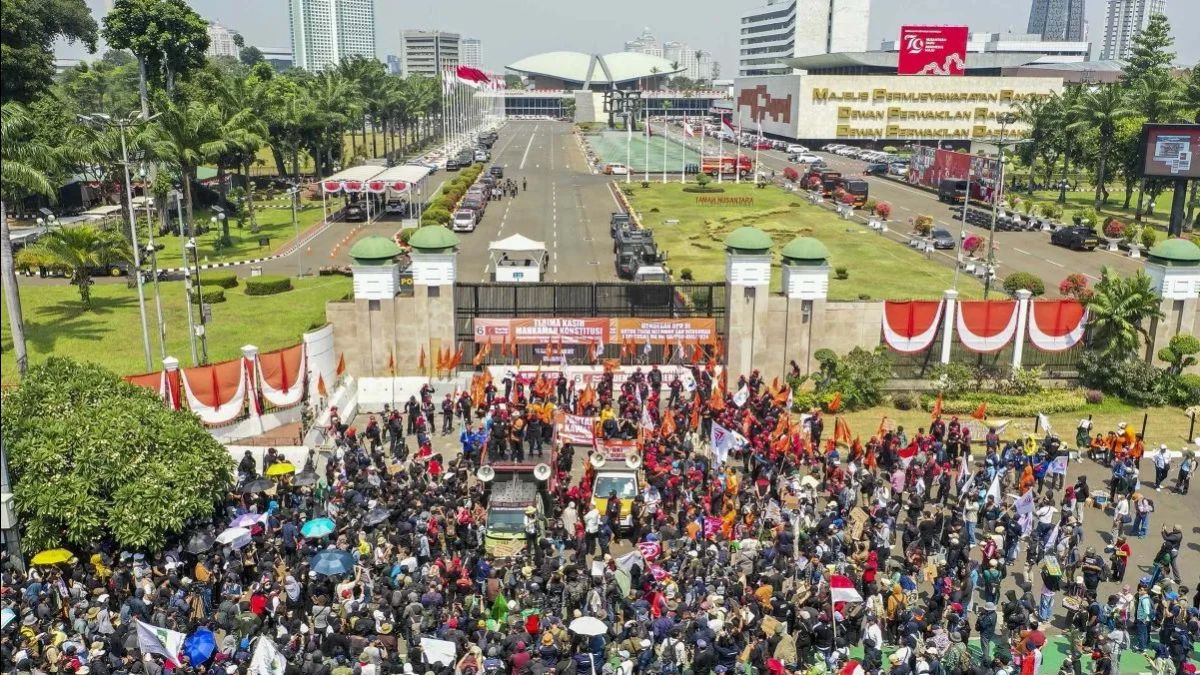


JAKARTA - Executive Director of the Center of Reform on Economics (Core) Indonesia Mohammad Faisal assessed that the recent massive demonstration was due to disappointment from the lower middle class.
"We really understand that demonstrations that have resulted in chaos and looting at this time are an accumulation of disappointment, anger and frustration among community groups, especially the lower middle class," said Faisal in an online public discussion entitled "Indonesia at Intersection: Inequality, Fiscal Reform and the Future of the Economy", Monday, September 1.
According to the Think Tank Institute, there is a root of fundamental problems related to the livelihood of welfare and justice that the government has not handled properly.
"And this is a fire in a husk that will easily ignite the emotions of the community if there are or are ridden by provocative actions," he said.
Faisal said that currently the Indonesian economy is facing a number of obstacles.
First, the economic inequality in Indonesia is still very wide.
"Although the number of people below the poverty line tends to decrease and according to the latest data released by BPS in March 2025 it reached 24 million people, but the number of people around the poverty line, if we take the threshold under per capita expenditure per month below Rp1 million, the number reaches no less than 100 million people," said Faisal.
In fact, he said, this figure has reached more than a third of the total population of Indonesia.
"And this has not considered the middle class whose purchasing power has also decreased at this time," he explained.
Second, although based on BPS data, the open unemployment rate in Indonesia has decreased, said Faisal, most of those who work are listed as informal workers whose percentage has increased to close to 60 percent.
"In line with that, the number of people working part-time and half-employed has also increased much greater than people working full-time," added Faisal.
This is exacerbated by the increasing number of layoffs.
"This is the latest data we have seen from the Ministry of Manpower, for the period January to July 2025 the number of layoffs has reached more than 43,500 people, an increase of 150 percent compared to the same period last year," he explained.
As for the income side, continued Faisal, the real wages of workers also do not increase, it even tends to weaken.
"In February 2025, we saw how the growth of real wages for workers only grew 1.9 percent, very thin. This is year on year growth. Well, if we compare it with last August, last year, this has even decreased by 4.8 percent," he said.
The third or last obstacle is Core highlighting the savings level side of people in Indonesia. According to Faisal, the trend of saving middle class people also continues to decline.
"People's relationship in banks, which is 99 percent worth less than Rp. 100 million, the average balance is persistent from before the pandemic until now, only the average balance is Rp. 1 million. This is below Rp. 100 million, which has a proportion of 99 percent to the total," he explained.
However, he continued, people's savings above Rp2 billion have increased. "Well, on the other hand, savings whose value is above Rp2 billion, this proportion is at least a few percent of the total savings holders, the average balance has increased. So, there is widening inequality here," he said.
He considered that this was also exacerbated by the tendency of the lower class to borrow in order to meet consumptive needs.
"Well, this can be seen from the increase in peer to peer loans, especially for consumption needs," he said.
SEE ALSO:
-
 | EKONOMI
Pemerintah Siapkan Langkah Strategis Dorong Daya Beli dan Konsumsi di Semester II-2025
01 September 2025, 15:05 -
 | EKONOMI
Airlangga Ungkap Pemerintah Tetap Prioritaskan Isu Ketenagakerjaan di Tengah Dinamika
01 September 2025, 15:27 -
 | EKONOMI
Fluktuasi Pasar Dinilai Wajar, BEI Optimistis Investor Asing akan Kembali
01 September 2025, 14:03

Faisal meminta agar pemerintah bisa mengambil upaya-upaya konkret untuk menyelesaikan sejumlah kendala tersebut.
"Core ingin menyampaikan atau meminta agar para pejabat publik dan elit politik untuk peka terhadap kondisi yang dihadapi masyarakat pada saat sekarang dan melakukan langkah-langkah konkret," pungkasnya.
SEE ALSO:
-
| EKONOMI
Pemerintah Siapkan Langkah Strategis Dorong Daya Beli dan Konsumsi di Semester II-2025
01 September 2025, 15:05 -
| EKONOMI
Airlangga Ungkap Pemerintah Tetap Prioritaskan Isu Ketenagakerjaan di Tengah Dinamika
01 September 2025, 15:27 -
| EKONOMI
Fluktuasi Pasar Dinilai Wajar, BEI Optimistis Investor Asing akan Kembali
01 September 2025, 14:03
Faisal asked the government to take concrete efforts to resolve a number of these obstacles.
"Core wants to convey or ask public officials and political elites to be sensitive to the conditions faced by the community at this time and take concrete steps," he concluded.
The English, Chinese, Japanese, Arabic, and French versions are automatically generated by the AI. So there may still be inaccuracies in translating, please always see Indonesian as our main language. (system supported by DigitalSiber.id)
Most Popular Tags
#Prabowo Subianto #donald trump #Febrie Adriansyah #8791 #giias 2026Popular


