

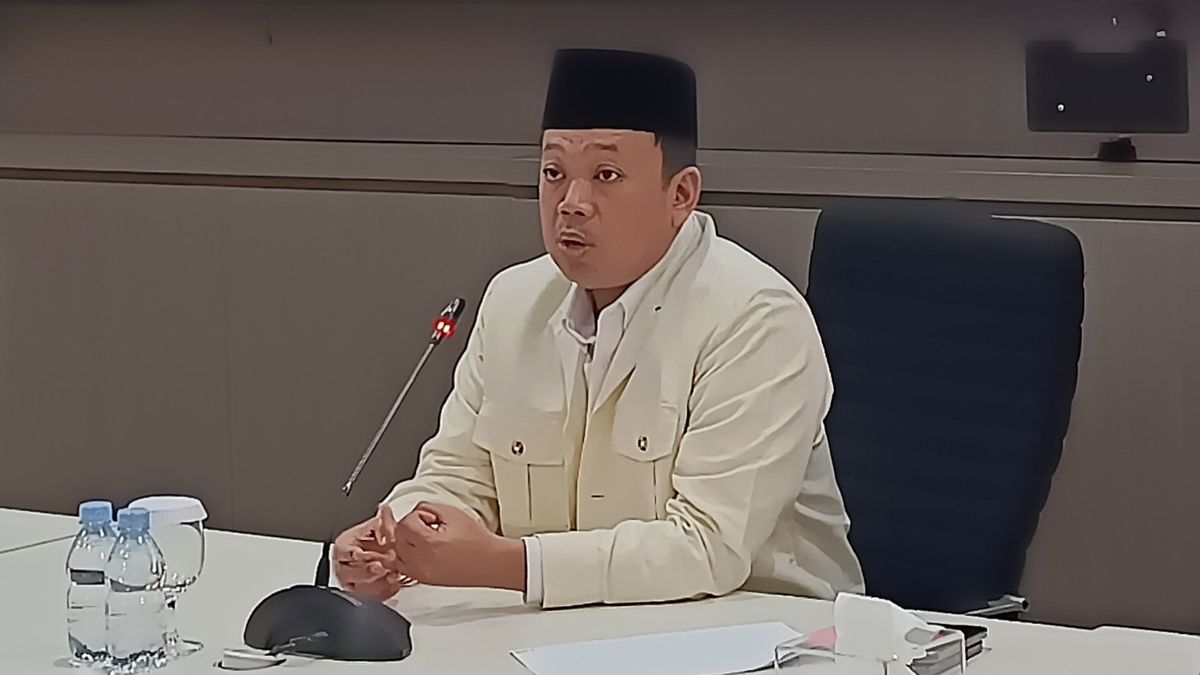


JAKARTA - Minister of Agrarian Affairs and Spatial Planning/Head of the National Land Agency (ATR/BPN), Nusron Wahid, emphasized that the policy to regulate abandoned land will not target privately owned land.
He assured that productive rice fields, yards, and inherited land owned by residents, especially those with Freehold Certificates (SHM), are safe.
"So (the regulation of abandoned land) does not target private land, private rice fields, yards, or inherited land, especially those with freehold certificates or use rights," Nusron emphasized in a press conference at his office on Tuesday, August 12.
According to Nusron, the target of the regulation is large-scale HGU (Usage Rights) and HGB (Usage Rights) holdings covering millions of hectares, but not being utilized according to their intended purpose. This situation is believed to hamper equitable access and land use for the community.
HGU is known to be the right to cultivate land directly controlled by the state for agricultural, plantation, fishery, or livestock purposes for a maximum period of 35 years. This type of land can be extended and renewed for a total of 95 years. HGU is a use permit, not an ownership right. Therefore, upon expiration, the land reverts to the state.
"This solely targets millions of hectares of land with HGU and HGB status, which are idle, unused, and unproductive," he said.
Meanwhile, HGB is the right to construct and own buildings on land controlled by the state or land owned by others for a maximum period of 30 years and can be extended and renewed for a total of 80 years. Like HGU, HGB is not a land ownership right, but rather a conditional right of use granted by the state or based on an agreement with the landowner.
The regulation of abandoned land is carried out based on Government Regulation (PP) Number 21 of 2020 concerning the Regulation of Abandoned Areas and Land. This regulation authorizes the government to identify, designate, and reclaim land that is not utilized according to its intended purpose within a specified period.
The cleared land will be returned to productive use, including through the Agrarian Reform program, as mandated by Presidential Regulation (Perpres) Number 86 of 2018 and Law Number 5 of 1960 concerning Basic Agrarian Regulations (UUPA). This land can be allocated to smallholder farmers, farmer groups, cooperatives, and community-based productive businesses.
"I believe this is something we can utilize for strategic government programs that impact the people's welfare. These include agrarian reform, smallholder agriculture, food security, affordable housing, and land provision for public purposes, such as public schools, community health centers, and so on," Nusron concluded.
The English, Chinese, Japanese, Arabic, and French versions are automatically generated by the AI. So there may still be inaccuracies in translating, please always see Indonesian as our main language. (system supported by DigitalSiber.id)


