



JAKARTA - The Ministry of Maritime Affairs and Fisheries (KKP) is developing the Kamal Muara National Mangrove Area in North Jakarta as an effort to maintain coastal ecosystems and handle marine plastic waste.
The Director General of Marine Management of the KKP Koswara said that the area has an area of 56 hectares which will later be built as a nursery center, ecotourism center, ecoeduwisata and network culture laboratory.
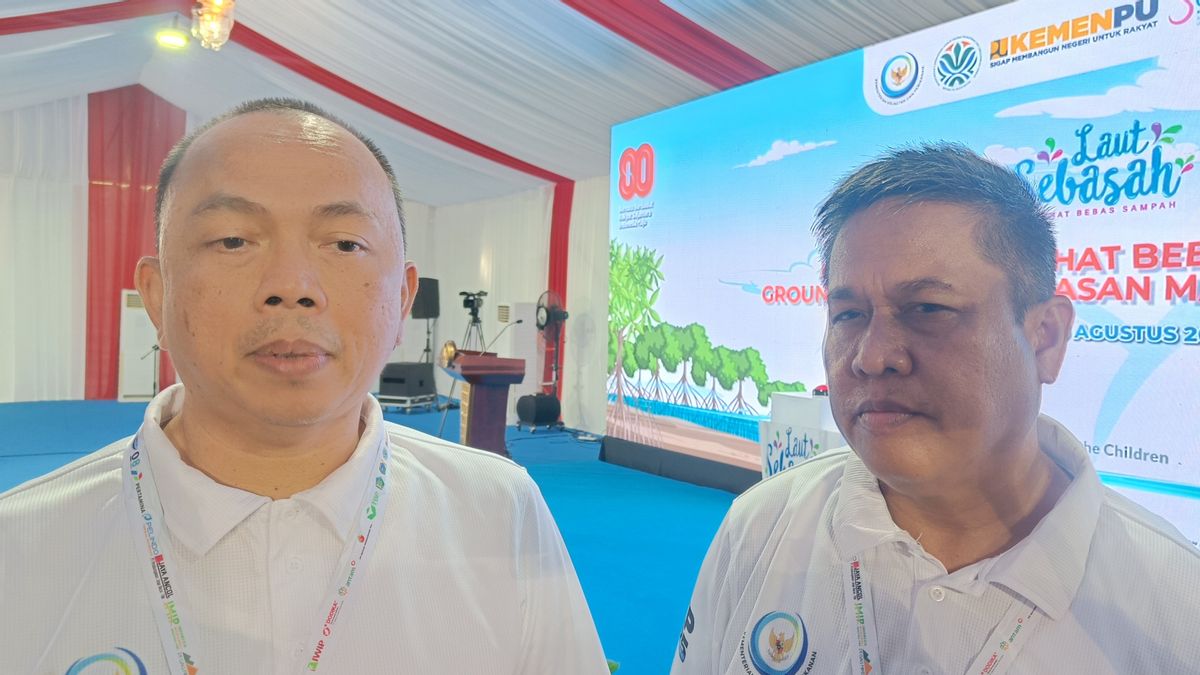
"In Indonesia, there are 202 types of mangroves. We just got 22 types of mangroves and the rest are still scattered throughout Indonesia. The current stage is the planting of 22 types of mangroves, in the future we will add them until all types of mangroves are here," said Koswara when met after the Kick-off of the Sehat Securities Free of Waste (Sewet Sea) and Groundbreaking for the Development of Kamal Muara National Mangrove Area at Kamal Muara Sports Hall, Penjaringan, North Jakarta, Wednesday, August 6th.
"So, if we have a coastal rehabilitation program for mangrove development, the nursery is all here, adapted to the needs in the field as to what," he continued.
It is known, mangroves are typical coastal vegetation with a unique morphology with a silverware system that is able to adapt in the ups and downs, especially in mud or sandy mud substrates.
As one of the main coastal ecosystems besides coral reefs and seagrass, mangroves have an important role in maintaining coastal stability, as a habitat for marine biota as well as carbon absorbers and natural protectors of abrasion.
Based on the national mangrove map in 2024, the total mangrove area in Indonesia was recorded at 3,440,464 hectares, making Indonesia the country with the largest mangrove ecosystem in the world.
In this initial development, his party planted 40,000 Rhizophora Muchorata (red/black mangrove seedlings) which are known to be adaptive and have a high ecological role.
The development of Kamal Muara National Mangrove Area is planned to take place in the period 2025-2029 with a collaborative and participatory approach.
The area is expected to provide tangible benefits for the surrounding community economically, socially and environmentally as well as to be an example of the practice of resilient and adaptive coastal management of climate change and the threat of marine debris.
The English, Chinese, Japanese, Arabic, and French versions are automatically generated by the AI. So there may still be inaccuracies in translating, please always see Indonesian as our main language. (system supported by DigitalSiber.id)


