


Head of the National Food Agency (Bapanas), Arief Prasetyo Adi, said that there are several characteristics of rice that the government and law enforcement officials will take firm action against.
This is in response to the rise of mixed rice circulating in the market.
He said mixing is only allowed if it is in accordance with the provisions of the quality and volume classes included in the packaging label.
"So some of the practices that will be dealt with in the future, the first is premium rice according to the writing on the label, but it contains medium rice. Then the mixing does not match the quality class," Arief explained in his statement, Thursday, July 24.
"Then the other is severe reduction. If you reduce the weight, then mix it with no quality, what is paid by consumers is not in accordance with the contents in it," he continued.
In particular, he emphasized that mixing involving Stableized Rice Supply and Food Prices (SPHP) which is part of government intervention is an act that violates the provisions.
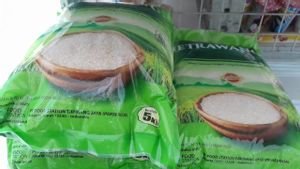
"Then if for example what is mixed is SPHP rice, the government's intervention program from the assignment of the National Food Agency to Bulog, it is not allowed, it is clearly a violation. The 5 kilograms of SPHP rice must actually reach the community in full with the price set by the government," said Arief.
Arief explained that the classification of rice quality has been regulated in the National Food Agency Regulation Number 2 of 2023. In the regulation, it is stated that premium rice must meet specifications such as broken grains of a maximum of 15 percent, menir a maximum of 0.5 percent, and damaged/purity/red grains a maximum of 1 percent.
Therefore, he reminded all extortion business actors, especially rice mills and producers, to conduct self-evaluation of the suitability between product content and packaging labels.
"Therefore, we all have to do self-correction, starting from the rice milling we have to see what the specifications of the product are, whether it is in accordance with what is stated in the packaging label or not. So what is in the packaging label, that's the content. Don't let its contents not match the existing label," he said.
He added that labels on rice packaging must contain a number of important information such as classification, type, trade name, mixed composition, clean weight, name of producer, origin of rice, quality class, expiration date, to the highest retail price (HET).
"In a package, there is a labelling system. It must be written whatever the contents are. If the packaging is rice, there must be information on what type of rice and what is mixed, how much percent. However, the mixed rice is not in accordance with the rules and labeling regulations, then reduces the scales, agreeing that it is a violation," added Arief.
He also reminded the importance of calibration and regular re-re-calibration of rice scales, to ensure that the net weight included does not deviate from the actual content.
Meanwhile, for the supervision of SPHP rice, Arief continued, Perum Bulog already has Technical Guidelines (Juknis) which can be used as a guideline.
Juknis tersebut telah mengatur jenis outlet distribusi beras SPHP yang diperbolehkan dan perlu verifikasi outlet sebelum disalurkan beras SPHP.
SEE ALSO:


Pemerintah terus memastikan keakuratan penyaluran beras subsidi ini agar benar-benar dapat tersampaikan ke masyarakat yang paling membutuhkan.
Hari ini, Satgas Pangan Polri telah menyatakan peningkatan status perkara dugaan beras oplosan dari penyelidikan menjadi penyidikan.
Sebanyak 201 ton beras disita beserta dokumen yang digunakan untuk memuluskan penjualan beras oplosan demi meraup keuntungan besar.
Adapun pasal yang dikenakan bagi produsen beras apabila terbukti mengoplos beras yakni Undang-Undang (UU) Perlindungan Konsumen dan UU Tindak Pidana Pencucian Uang (TPPU) dengan menjalani hukuman penjara 20 tahun serta denda maksimal Rp 10 miliar.
SEE ALSO:
The government continues to ensure the accuracy of the distribution of subsidized rice so that it can really be conveyed to people who need it the most.
Today, the National Police's Food Task Force has stated an increase in the status of the case of alleged mixed rice from investigation to investigation.
A total of 201 tons of rice were confiscated along with documents used to smooth the sale of mixed rice in order to reap large profits.
The articles imposed on rice producers if proven to have mixed rice are the Consumer Protection Law and the Money Laundering Crime Law (TPPU) by serving a 20-year prison sentence and a maximum fine of IDR 10 billion.
The English, Chinese, Japanese, Arabic, and French versions are automatically generated by the AI. So there may still be inaccuracies in translating, please always see Indonesian as our main language. (system supported by DigitalSiber.id)
Popular


