

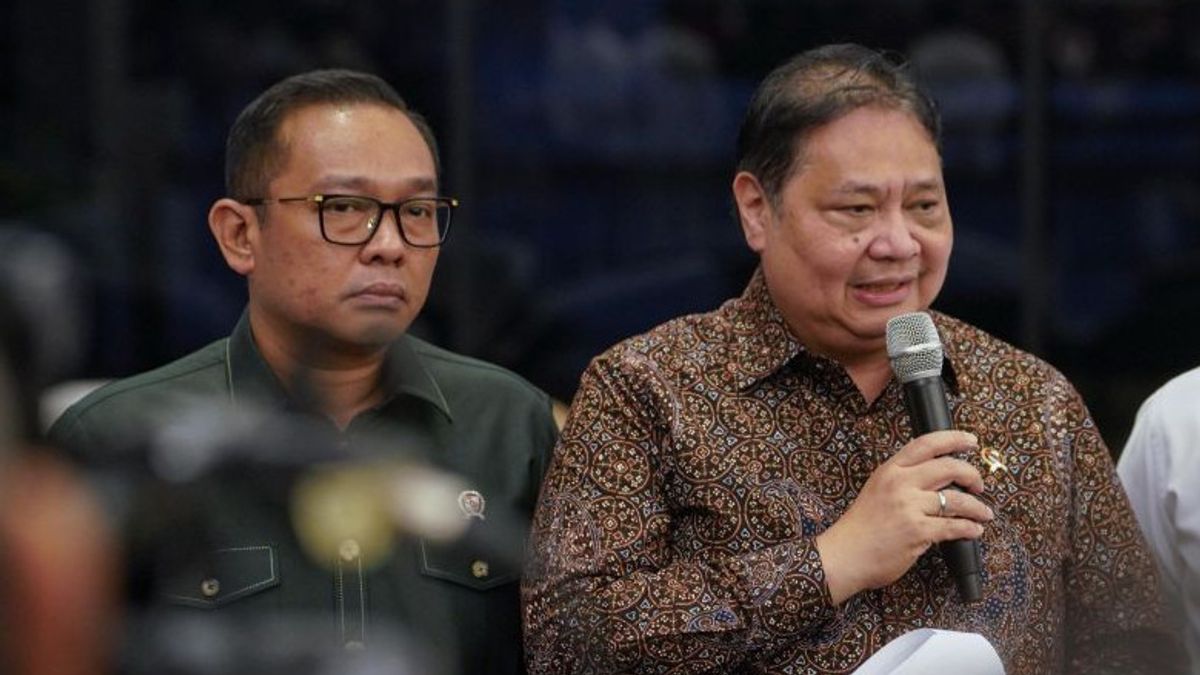


Coordinating Minister for Economic Affairs Airlangga Hartarto emphasized that the purchase of a number of products from the US that will be carried out by the Government in the framework of the latest trade agreement will not have a negative impact on Indonesia's trade balance.
According to him, this is because basically the purchase of a number of these products is needed by Indonesia, and so far it has been imported from several countries, so that only the source shift of the country of origin of imports is made.
He conveyed that a number of these commodities, including agricultural products such as wheat and soyabean, to energy products.
Airlangga said that the successfully agreed reduction in the resiprocal rate also provided strategic benefits for Indonesia, especially in maintaining economic growth, food security, and stability in the labor sector by protecting up to 1 million workers who depend on the labor-intensive industrial sector.
In addition, he conveyed that the competitiveness of Indonesian products in the global market, such as palm oil, is also getting stronger because it is increasingly in demand in the US and European markets.
I said that if this is not given, Indonesia is competitive, 1 million people will lose their jobs. So America wants to be Indonesia's partner, the third largest democratic country and the largest economy in Southeast Asia," explained Airlangga in his statement, Tuesday, July 22.
Airlangga added that Indonesia was included in the first group of countries to reach an agreement with the US, so that the tariff provisions planned to take effect from August 1 would no longer apply to Indonesia.
He said the implementation of the new tariff of 19 percent would be officially set at the Joint Statement.
Airlangga said that the tariff imposed on Indonesia was the lowest number among other ASEAN regional countries, as well as a number of competing countries for export commodities.
"Well, if we look at these figures, they are the lowest number compared to other ASEAN countries, where Vietnam and the Philippines are currently 20 percent, Malaysia and Brunei are 25 percent, then Cambodia 36 percent and Myanmar-Laos by 40 percent. , Thailand is also 36 percent. Compared to competitors for textile products, we also see that like Bangladesh, 35 percent, Sri Lanka 30 percent, Pakistan 29 percent and India 27 percent, "he said.
Furthermore, Airlangga explained that related to the general import rate (MFN) in Indonesia, the structure of the MFN Import Duty Tariff applied by Indonesia based on BTKI (Indonesian Customs Rate Book) 2022 is the total number of HS tariff posts as much as 11,555 tariff posts, the number of tariff posts with import duties (BM) 0 percent as much as 1,347 HS or 11.7 percent, and the number of tariff posts with Import Duty (BM) 5 percent as much as 5,448 HS or 47.1 percent.
"Well, with the agreement, our America expands to a majority of 0 percent and we have given this to another CEPA, whether it's with the ASEAN-FTA, whether it's with the ASEAN-China FTA, then also with the IEU-CEPA, then with Canada, with Australia, New Zealand, with Japan, that's all we've also given the majority close to 0," he said.
SEE ALSO:
-
 | EKONOMI
Harbour Energy Hengkang, Perusahaan Migas Rusia Ini Tetap Garap Blok Tuna
22 Juli 2025, 14:05
SEE ALSO:
-
| EKONOMI
Harbour Energy Hengkang, Perusahaan Migas Rusia Ini Tetap Garap Blok Tuna
22 Juli 2025, 14:05
Airlangga said that in addition to agreeing on a reduction in tariffs, the two countries have also resolved various non-tariff barriers (non-tariff barriers), which are challenges in the smooth running of trade between countries.
He added that this would also be further explained in the official joint statement which would be announced as a follow-up to the tariff agreement.
The English, Chinese, Japanese, Arabic, and French versions are automatically generated by the AI. So there may still be inaccuracies in translating, please always see Indonesian as our main language. (system supported by DigitalSiber.id)
Most Popular Tags
#Prabowo Subianto #donald trump #2026 World Cup #venezuela #konflik timur tengahPopular


