

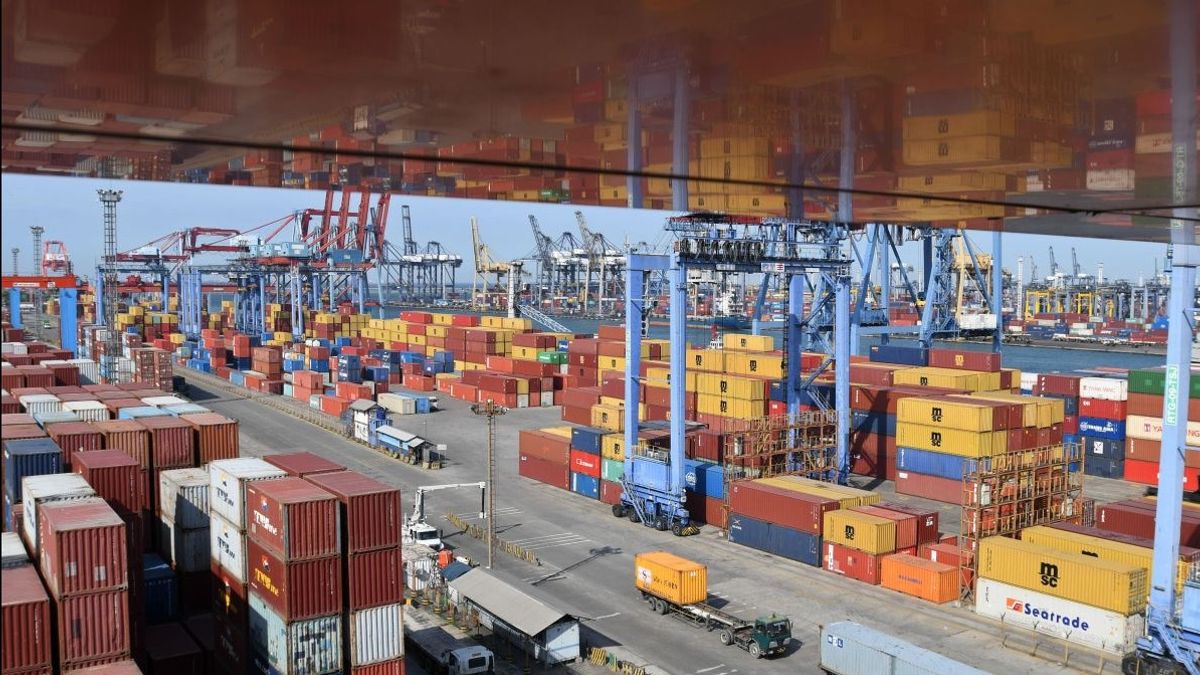


JAKARTA - Director of the Indonesia-China Center of Economic and Law Studies (Celios), M. Zulfikar, highlighted inequality in the trade agreement between Indonesia and the United States (US).
He said, even though Indonesia's export rates to the US had been lowered to 19 percent, US products actually entered Indonesia at a rate of 0 percent. This condition will pose a fairly serious long-term risk to the national trade balance.
"Indonesia's export rate to the United States is 19 percent, while US products receive a 0 percent tariff, potentially posing a serious risk to Indonesia's trade balance," he told VOI, Wednesday, July 16.
On the one hand, he continued, there are indeed advantages for several leading commodities such as footwear, finished clothes, crude palm oil or CPO, and rubber. But when compared to Vietnam, which has succeeded in reducing export rates from 46 percent to 20 percent, Indonesia's position looks less than optimal.
"When compared, the decline in Vietnam's export rates from 46 percent to 20 percent is much more significant than Indonesia, which only fell from 32 percent to 19 percent. This shows that Vietnam's negotiating position is much more effective, and Indonesia should be able to encourage a more optimal reduction in tariffs," said Zulfikar.
He considered that Indonesia's negotiating position had not been maximized in pushing for a more significant reduction in export rates. On the other hand, Indonesia has actually opened up massive import opportunities from the US, especially in the strategic sector.
Zulfikar said that the oil and gas, electronics, aircraft parts, seremia (including wheat), and pharmaceutical sectors would flood the domestic market. By 2024 alone, it has reached 5.37 billion US dollars or around Rp. 87.3 trillion.
The potential for this increase in imports is considered to be able to further widen the oil and gas trade deficit and reduce the rupiah exchange rate.
"This will burden the structure of energy subsidies in the 2026 RAPBN. The government has indeed proposed an allocation of energy subsidies of IDR 203.4 trillion, but this figure is estimated to be insufficient. The projected real needs can reach IDR 300 320 trillion, especially because dependence on imports of fuel and LPG continues to increase," he said.
Furthermore, Celios warned that this trade agreement has the potential to force Indonesia to buy oil and LPG from Uncle Sam's country at a higher price than the current market price run by Pertamina.
SEE ALSO:
-
 | EKONOMI
Trump Pangkas Tarif Impor dari RI 19 Persen, Prabowo Ungkap Belum Puas
16 Juli 2025, 19:04

If this happens, this will become a long-term burden for the state budget and disrupt fiscal stability. "This is certainly a problem if Indonesia is bound to a long-term detrimental agreement. Therefore, the energy transition is not only important, but urgent," said Zulfikar.
On the food side, according to Zulfikar, tariff liberalization also has an impact on national food security and sovereignty. "With a rate of 0 percent, US wheat products get big profits in the Indonesian market. Consumers may enjoy cheaper grain-based product prices, such as instant noodles and bread, but local food producers have the potential to be negatively affected," he said.
Previously, the President of the US, Donald Trump, cut Indonesia's import rate by 19 percent. Meanwhile, exports from the US to Indonesia will not be taxed. In addition, Indonesia is also committed to investing in a number of American products.
"Indonesia will pay the United States a 19 percent tariff for all the goods they export to us, while US exports to Indonesia will be free of tariff barriers and non-tariffs," Trump wrote via the @realDonaldTrump account on Truth Social social media.
The English, Chinese, Japanese, Arabic, and French versions are automatically generated by the AI. So there may still be inaccuracies in translating, please always see Indonesian as our main language. (system supported by DigitalSiber.id)
Most Popular Tags
#Prabowo Subianto #donald trump #firearm #8791 #giias 2026Popular


