
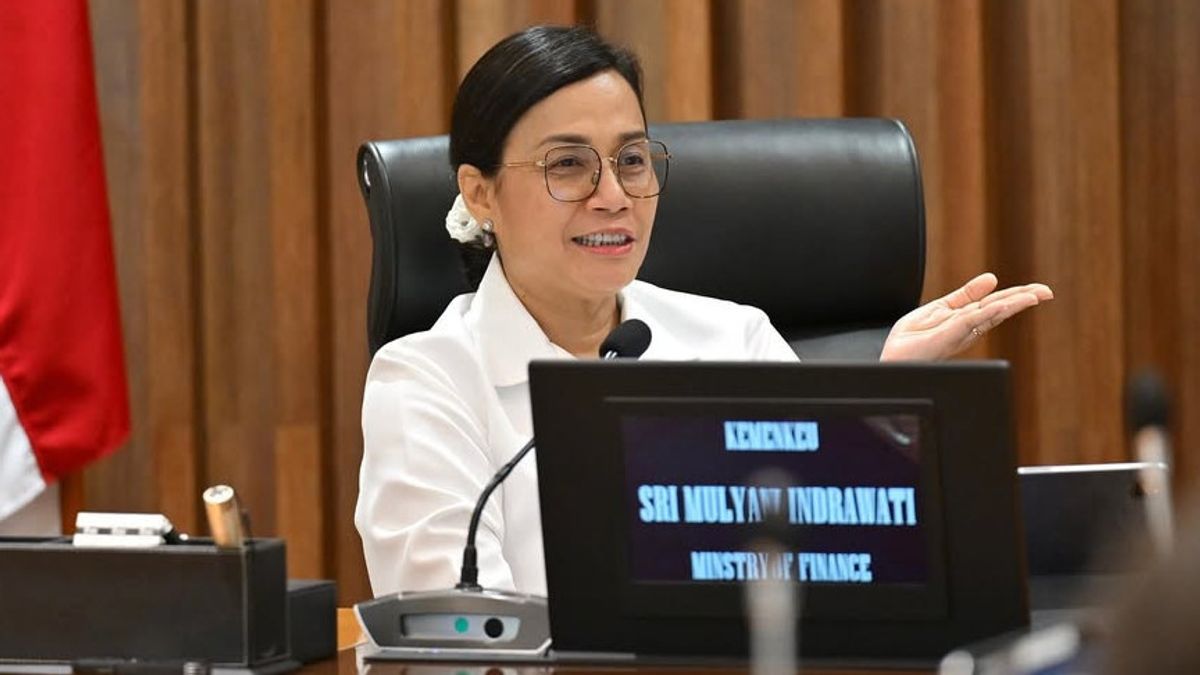


JAKARTA - Indonesian Finance Minister Sri Mulyani Indrawati revealed a number of government strategies to pursue the 5.2-5.8 percent economic growth target by 2026.
In a working meeting (raker) with Commission XI of the DPR RI in Jakarta, Thursday, July 3, he said this strategy included strengthening in terms of demand and supply, to increasing investment and exports.
In terms of demand, his party is committed to maintaining people's purchasing power through inflation control and strengthening various priority programs. Some of the programs in question include Food Barns, People's Schools, Red and White Cooperatives, as well as free nutritious eating programs (MBG).
On the investment side, Sri Mulyani highlighted the important role of the Danantara Investment Management Agency (BPI) in accelerating investment in strategic sectors, especially those with high added value.
The role of the Danantara will greatly determine whether our investment increases, because Danantara is state-signed. If you are dominant without being able to attract (investors), then what happens is crowding out. If Danantara's investment is able to attract the private sector, then Danantara can become a catalyst. So, this is something that needs to be conveyed. We have communicated continuously with the Danantara team," he explained, quoted by Antara.
Another strategy that is also a priority is to increase exports through activation of downstreaming and diversification of export products and markets.
The government will continue to encourage the processing of raw commodities into added value products, including nickel, copper, bauxite, and production of electric vehicles.
Meanwhile, in terms of supply, strengthening the supply chain and downstreaming of the agricultural sector are key. The Minister of Finance hopes that the MBG and biodiesel B40 programs will be able to boost productivity and added value of this sector.
In addition, National Strategic Projects (PSN) such as housing development, school revitalization, and waste management into energy (waste to energy) are also prioritized to support medium-term economic growth.
Furthermore, the State Treasurer said that the growth targets of key sectors had also been set. The agricultural sector is targeted to grow 5.9-6.5 percent, manufacturing 4.7-5.3 percent, trade 5.1-5.7 percent, and construction 5.2-5.4 percent.
Meanwhile, in terms of expenditure, household consumption is expected to grow 5.0-5.5 percent, Gross Fixed Capital Formation (PMTB) 5.0-5.9 percent, and exports 5.8-6.5 percent.
"Strategic sectors continue to be encouraged. If we look at the economic growth that we will accelerate, it is close to 8 percent, then the challenge is how the trajectory can be supported crediblely," said the Minister of Finance.
SEE ALSO:

As for the Macroeconomic Framework and the 2026 Fiscal Policy Principles (KEM-PPKF), state revenues are projected at 11.71-12.22 percent of GDP, with state spending around 14.19-14.75 percent of GDP.
The budget deficit is estimated to be in the range of 2.48-2.53 percent of GDP.
"We must continue to support the development agenda optimally. There are eight strategic areas, namely food security, energy, free nutritious food, education programs, health programs, village development, cooperatives and MSMEs, and finally, increasing investment and global trade," said the Minister of Finance.
The English, Chinese, Japanese, Arabic, and French versions are automatically generated by the AI. So there may still be inaccuracies in translating, please always see Indonesian as our main language. (system supported by DigitalSiber.id)
Most Popular Tags
#Prabowo Subianto #donald trump #2026 World Cup #Febrie Adriansyah #8791Popular


