

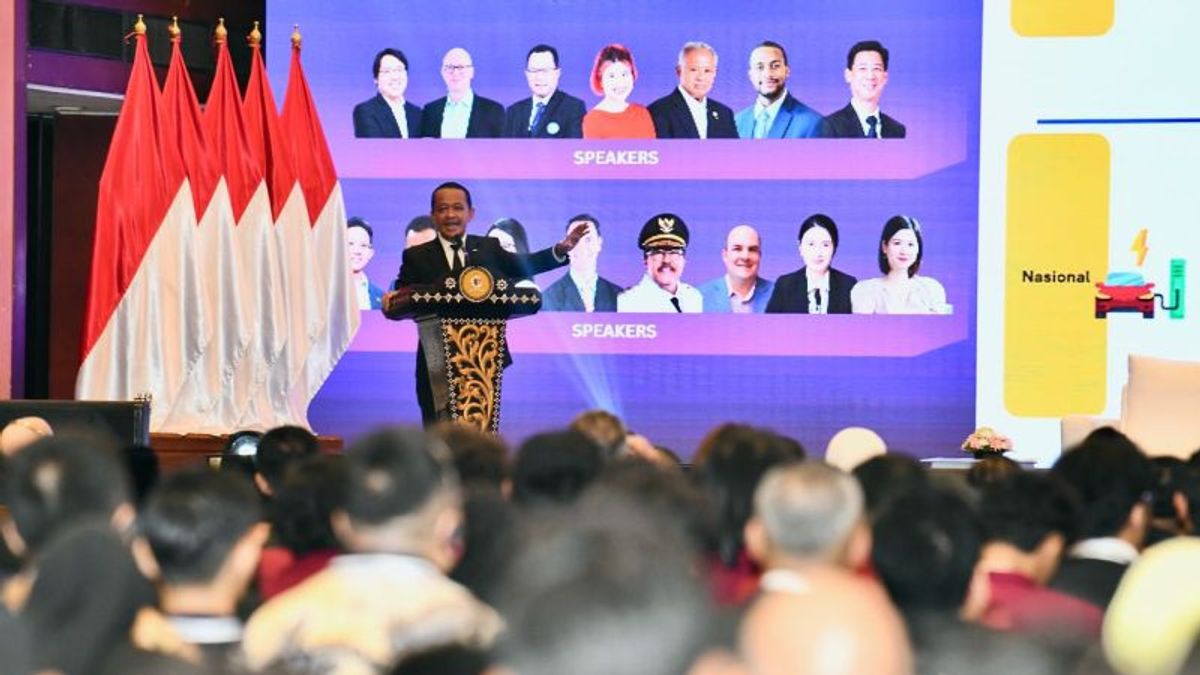


JAKARTA - Minister of Energy and Mineral Resources (ESDM) Bahlil Lahadalia said geopolitical tensions in the Middle East, particularly the conflict between Israel and Iran and the potential closure of the Strait of Hormuz, are a serious concern of the Indonesian government. Because, it can have a significant impact on world oil prices.
"In the context of oil, when the Strait of Hormuz is closed, it will have an impact on increasing world oil prices," said Minister Bahlil, quoted from the Liputan6 YouTube account, Wednesday, June 25.
According to him, if the Strait of Hormuz is closed, world oil prices have the potential to soar above the assumption that the State Revenue and Expenditure Budget (APBN) is 82 USD per barrel, although the current price is still under control, which is below 80 USD per barrel.
To deal with the potential increase in global oil prices, Bahlil said that the government has prepared a number of strategic steps, one of which is increasing domestic oil production (lifting).
He admitted that Indonesia's oil lifting has tended to decline since 2008, but the government is determined to reverse this trend.
"Mr. Prabowo's order to us is how we optimize the increase in lifting. Our wells are almost around 40 thousand wells. Of that number there are 16-17 thousand productive and others yet. There are idle wells and various things," said Bahlil.
The idle well well, in the context of the oil and gas industry, is a well-welling that was previously active in production but is currently no longer in use or its operations have been temporarily suspended.
This well may still have the potential to be reproduced, or has been suspended for various reasons such as technical problems, the economy, or changes to the company's strategy.
Various efforts will be made to achieve the lift target that has been set.
Minister Bahlil explained that the Ministry of Energy and Mineral Resources will evaluate the performance of Cooperation Contract Contractors (KKKS) and give strong warnings to parties who do not optimize the production of wells that are ready. In fact, the government does not rule out taking over wells that are not well managed so that they can be offered to other more competent investors.
In addition, the use of technology is also the key in efforts to increase oil production. Bahlil gave an example of the Enhanced Oil Recovery (EOR) technology which is expected to increase the productivity of old wells in Indonesia.
"One of the technologies we have developed now is EOR. This is in order to increase our lifting productivity," Bahlil explained.
SEE ALSO:
-
 | BERITA
Komandan Pasukan Quds IRGC Muncul ke Publik Usai Diberitakan Tewas Terbunuh
25 Juni 2025, 09:15 -
 | BERITA
Netanyahu Deklarasikan Kemenangan, Israel Singkirkan Ancaman Nuklir Iran
25 Juni 2025, 08:53

Several EOR projects have shown positive results, such as additional production in Natuna and Cepu. Minister Bahlil also emphasized the importance of building energy resilience from within the country.
According to him, relying too much on global supplies full of uncertainty can cause vulnerability.
"We have mapped with several friends from the KKKS. For example, say yesterday we got 20 thousand barrels at Natuna who owns Medco. We are again God willing, on June 26, there will be another 30 thousand barrels of addition to ExxonMobil's Cepu. So slowly we will reach our oil lifting," said Bahlil.
The English, Chinese, Japanese, Arabic, and French versions are automatically generated by the AI. So there may still be inaccuracies in translating, please always see Indonesian as our main language. (system supported by DigitalSiber.id)
Most Popular Tags
#Prabowo Subianto #donald trump #firearm #8791 #giias 2026Popular


