

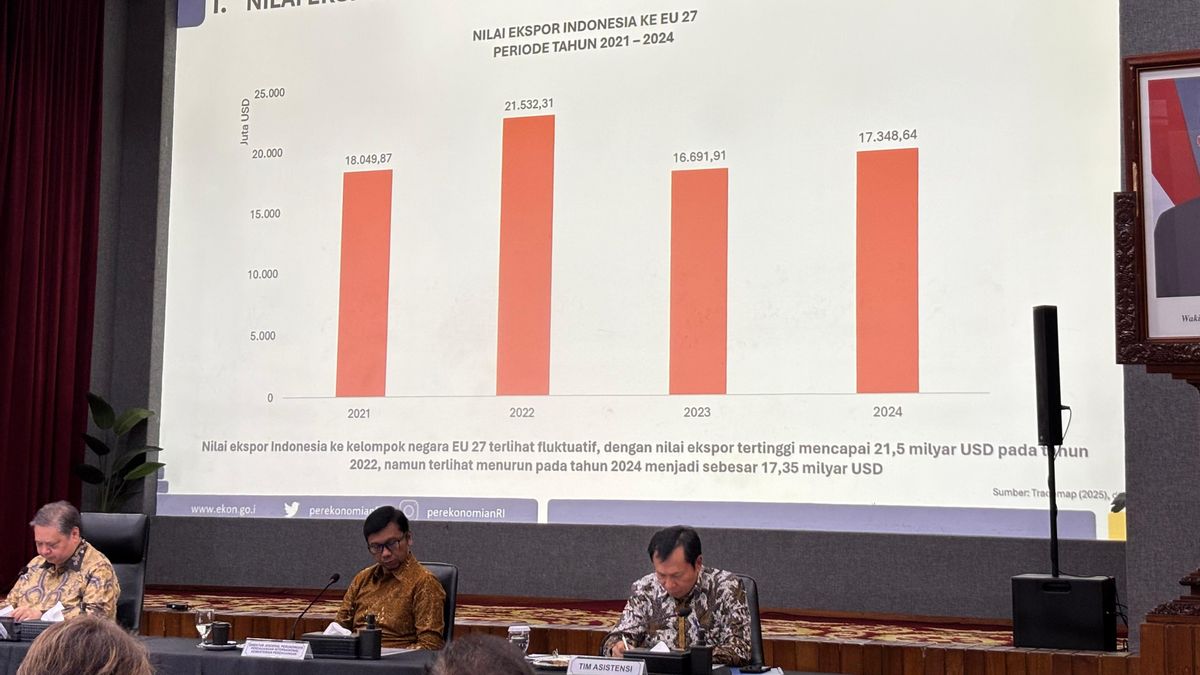


The government targets the implementation of the Indonesia-European Union Comprehensive Economic Partnership Agreement (IEU-CEPA), which can take effect in the fourth quarter of 2026 or no later than the first quarter of 2027.
"So, the most ambitious scenario, this is already entry-to-force (EIF) at the end of next year, it is very ambitious, or at least in the first quarter of 2027," said Director General of International Trade Negotiations of the Ministry of Trade, Djatmiko Bris Witjaksono, at the office of the Coordinating Ministry for Economic Affairs, Friday, June 13.
Djatmiko explained that the initiation of the IEU-CEPA agreement began in 2009 through the establishment of Vision Group (VG) as a form of initial commitment between the Indonesian government and the European Union, then in 2011, the government conducted a study to recommend the results of VG work.
Furthermore, in the era of President Joko Widodo's 2016 administration, IEU-CEPA negotiations were initiated through an initial meeting with the European Union.
He added that the negotiation process ran in 19 rounds from 2017 to 2024, with the final round completed in July 2024 in Bogor, Indonesia.
"From July until now the meeting took place at a very, very limited level, because most of the negotiators' work groups have been completed," continued Djatmiko.
However, according to him, there are still several unfinished working groups, especially those related to the goods, services, and investment sectors, as well as several other chapters such as trade and sustainable growth that need to be completed.
"Well, this is a timeline or timeline, and later now until July we are targeting to complete the entire tax," he explained.
Djatmiko said that currently the progress has reached around 90 to 95 percent, but there are still several small points that have not been agreed upon (open bracket), but with directions from the two ministers and a common understanding, the negotiations team from Indonesia and the European Union agreed that all tax issues would be resolved by the end of July.
"So this is not Indonesia's position, but a common position. So we have agreed," he said.
Djatmiko said that between July and September 2025, the negotiating team from Indonesia and the European Union targeted the completion of the legal editing process or the final adjustment of the agreement documents.
According to him, after the process is complete, each party will proceed to the stage of completing domestic procedures.
SEE ALSO:
-
 | EKONOMI
SketchUp 2025, Tawarkan Fitur Baru dan AI Eksplorasi Desain Lebih Luas
11 Juni 2025, 17:31

He said that the process in Indonesia was relatively short, which was around 12 months, while the European Union took longer, between 1012 months, because it had to go through the translation process and approval of 27 member states.
Djatmiko said the procedure was expected by the IEU-CEPA to be completed in the first quarter of 2026 or the second quarter of 2026.
"Then the signing can be carried out in the second quarter or third quarter of next year, after which it enters the ratification stage," he said.
According to him, the ratification process in Indonesia can take longer because it requires the approval of the DPR, which has a working period and a trial schedule that must be adjusted and the results of the ratification process can be in the form of laws or presidential regulations.
"It was approximately 10 to 12 months. Because, in the DPR, they have a working period, the working day is different from us," he concluded.
The English, Chinese, Japanese, Arabic, and French versions are automatically generated by the AI. So there may still be inaccuracies in translating, please always see Indonesian as our main language. (system supported by DigitalSiber.id)


