


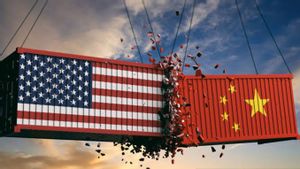
JAKARTA - The trade conflict between the two largest economic powers in the world, namely the United States and China, is considered not only to have a domestic impact but also to have an impact on developing countries, especially those in the supply chain of China or the US, has been affected.
"The world trade volume is slowing down, commodity prices are volatile, and global uncertainty is increasing. This makes it difficult for the economic recovery of South countries that are still grappling with the impact of the pandemic and debt crisis," said Economic Observer from Andalas University (Unand) Syafruddin Karimi in a statement, Tuesday, May 13.
Syafruddin said that tariffs are not only domestic policies but also a signal to the world whether these two great powers are able to resolve differences rationally and fairly, or instead impose will through threats and retaliation.
According to him, prolonged tensions will only strengthen the deglobalization trend and endanger the world's mutually dependent economic order.
He conveyed that the application of tariffs made the price of imported goods soar where the US recorded a surge in cost of living after the tariffs imposed on China since the Trump administration.
"The price of household equipment, building materials, and food has increased. Inflation that should be controlled through monetary policy is actually exacerbated by tariff-based fiscal policies," he said.
Meanwhile, China was also hit indirectly when exports fell due to US rates, domestic producers began to reduce production and terminate employment.
"Household revenue decreases, consumption weakens, and deflation pressure deepens. This cycle complicates the government's efforts to restore growth," he explained.
According to him, tariff wars have actually exacerbated macroeconomic imbalances in both countries and the increase in prices in the US and deflation in China is not a separate phenomenon.
"Both have roots in protectionist policies that create global economic tensions," he added.
Syafruddin conveyed that the changing tariff policy from year to year has made the business world lose a stable foothold and investors are reluctant to commit long-term because they are worried that the rules could change depending on who is in power.
In addition, he said that global entrepreneurship was a victim of this tension, because it had to continuously adapt logistics, price and distribution strategies.
"In the US, many small and medium-sized companies that depend on supplies from China are forced to close their businesses because they are unable to bear the tariff burden. In China, exporters also lose market orientation," he said.
SEE ALSO:

According to him, this uncertainty does not support post-pandemic recovery, it actually slows down the adaptation process to global change.
He said that market confidence and financial system stability require varying policy consistency and tariffs such as tit-for-tat games only result in confusion, not protection.
"States with open economies such as the US and China need predictability to keep the investment climate healthy," he added.
The English, Chinese, Japanese, Arabic, and French versions are automatically generated by the AI. So there may still be inaccuracies in translating, please always see Indonesian as our main language. (system supported by DigitalSiber.id)


