
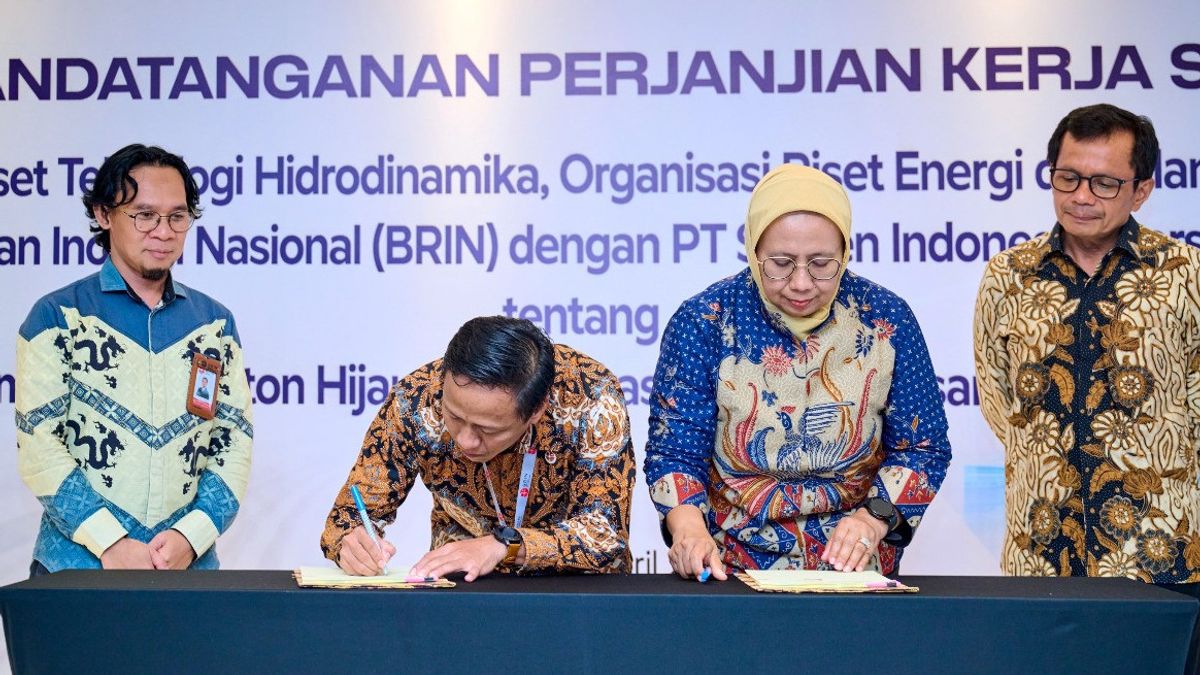


JAKARTA - PT Semen Indonesia (Persero) Tbk (SIG) and the National Research and Innovation Agency (BRIN) signed a Green Concrete Development Cooperation for Coastal and Marine Area Infrastructure.
The signing was carried out by the Director of Operations for SIG, Reni Wulandari and the Head of the BRIN Hydrodynamics Research Center, Teguh Muttaqie at The East Building, Jakarta, on Wednesday, April 30.
GIS President Director, Donny Arsal said, in the midst of intense competition, GIS always maintains its commitment to producing environmentally friendly building materials which are part of the Company's consistent decarbonization efforts.
Through the use of raw materials and alternative fuels, energy efficiency, and the use of renewable energy, currently GIS green cement is lower in carbon emissions by up to 38 percent compared to conventional cement. After successfully producing green cement for coastal areas, this collaboration with BRIN has realized the SIG's intention to expand development in the production of green concrete for coastal areas.
"We have collaborated with BRIN for various applied research activities, and now we are working together again in the development of green concrete to support the development of coastal and marine infrastructure. Hopefully this effort can support the government's development program through the use of reliable and environmentally friendly products," said Donny Arsal, in his statement, Friday, May 9.
Low-carbon building materials are increasingly needed in the urgency of handling the impacts of climate change and sustainable development needs. This is also in line with the vision of Asta Cita Presiden Prabowo Subianto to continue infrastructure development. In extreme environments such as coastal and sea areas, concrete structures are at risk of more easily porous.
The collaboration between SIG and BRIN aims to produce concrete with high resistance to sulfate, including waves, tides, and corrosion due to ion chloride. This concrete will have a special formulation for the marine environment with increased density, durability and a concrete layer period, thereby reducing maintenance and sturdy costs in the long term.
SIG Operations Director, Reni Wulandari said, in this research, SIG and BRIN will develop green concrete products that have high resilience in extreme environments such as coastal areas by paying attention to aspects of coastal infrastructure and the specificity of the raw materials used, so that they are superior to conventional concrete. In addition to high quality, the concrete from this development is also more environmentally friendly because it uses low-carbon materials.
"We hope that the results of this research will be a solution to construction needs in coastal areas, especially those that have experienced an increase in water level. Therefore, we collaborated with BRIN to accelerate with thorough research to produce high-quality concrete products but still pay attention to sustainability aspects," said Reni Wulandari.
Head of the BRIN Energy and Manufacturing Research Organization, Cuk Supriyadi Ali Nandar welcomed the GIS initiative to collaborate in the development of green concrete for infrastructure in coastal and marine areas. This green concrete is expected to be more environmentally friendly than conventional concrete because it is lower in emissions, produced with more efficient energy, but still of high quality.
SEE ALSO:

BRIN and GIS have the same vision to advance the nation and state. Indonesia is an archipelagic country, so this collaboration is a contribution to protect the beaches from abrasion by providing a layer of protection. Together with SIG, BRIN will create a protective layer using environmentally friendly concrete technology without neglecting quality and in accordance with the designation in Indonesian territory," said Cuk Supriyadi Ali Nandar.
Meanwhile, the Head of the BRIN Hydrodynamics Technology Research Center, Teguh Muttaqie, explained that in this collaboration BRIN and GIS will formulate new materials, for example waste materials such as fly ash and nickel slag, in the composition of green concrete so as to create a new design that can be used for embankment projects, port infrastructure and other coastal areas.
Conventional concrete requires a lot of energy that has an impact on climate change. I believe GIS has a strategy and initiative to contribute to sustainable development in Indonesia, by implementing clean and green technology. This synergy is a real step towards a lower future of carbon, cleaner and more sustainable," said Teguh Muttaqie.
The English, Chinese, Japanese, Arabic, and French versions are automatically generated by the AI. So there may still be inaccuracies in translating, please always see Indonesian as our main language. (system supported by DigitalSiber.id)
Most Popular Tags
#Prabowo Subianto #donald trump #Febrie Adriansyah #8791 #giias 2026Popular


