

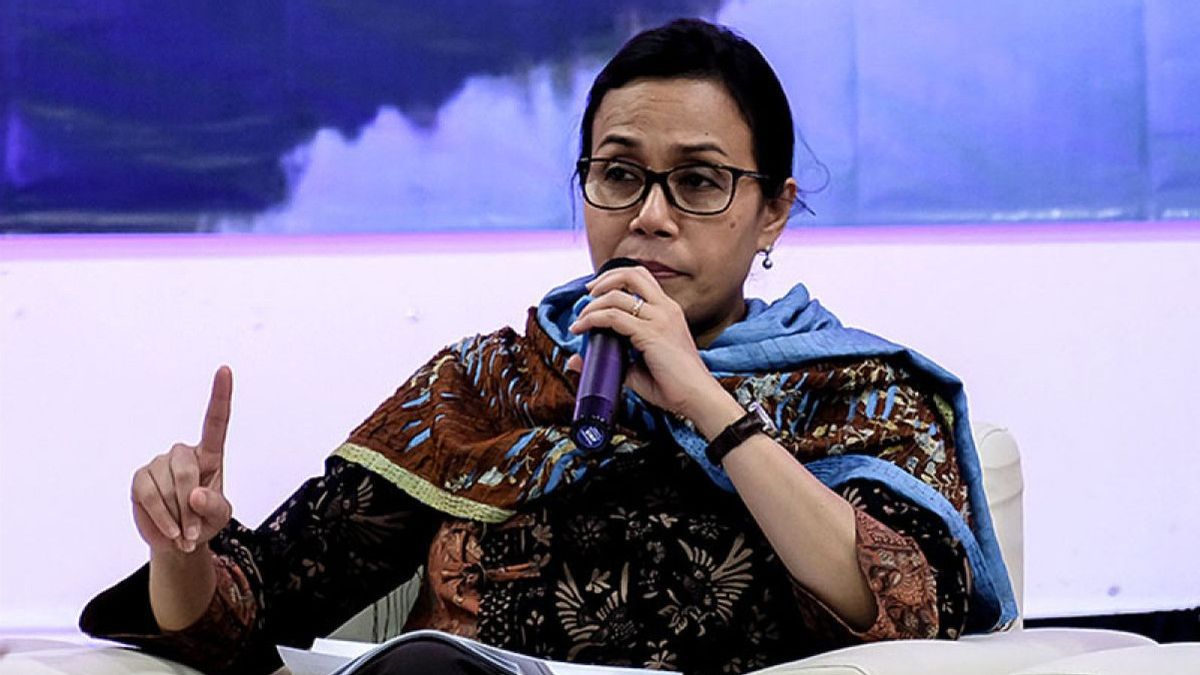


JAKARTA - Minister of Finance (Menkeu) Sri Mulyani Indrawati opened her voice regarding the decline in the projection of the International Monetary Fund (IMF) for global economic growth.
The International Monetary Fund (IMF) estimates that global economic growth will slow down for 2025 to 2.8 percent, down from the previous estimate of 3.3 percent.
Sri Mulyani said that the decline in economic projection was due to the direct impact of the escalation of tariff wars.
"So the increase in tariffs by the United States has caused retaliation or then decreased activity from trade between countries and that is a direct impact," he said at the Press Conference of the Financial System Stability Committee (KSSK), Thursday, April 24.
In addition, Sri Mulyani conveyed that the reciprocal tariff policy by the US also had an indirect impact, namely in the form of supply chain disruption, increasing uncertainty in trade and investment, as well as worsening sentiment from business actors towards global economic prospects.
Sri Mulyani explained, in the April 2025 edition of the World Economic Outlook (WEO) it showed corrections to the projected economic growth in various countries.
For example, Thailand's economic growth was corrected to fall by 1.1 percent, Vietnam by 0.9 percent, the Philippines by 0.6 percent, and Mexico by 1.7 percent. Indonesia also experienced a projected correction to economic growth in 2025 to 4.7 percent, down 0.4 percent from its previous projections.
However, Sri Mulyani explained, corrections to Indonesia are still lower than other countries that have international trade exposure and greater economic relations with the US.
"The worsening impact of tariff wars is increasingly felt with China's move to announce retaliation even though more countries are responding to US reciprocal tariff policies through diplomacy or negotiations," he said.
Sri Mulyani said this tension exacerbated trade relations between the US and China, which has increased fares by more than 100 percent, which risk triggering an increase in inflation and a decline in economic growth, particularly in the US.
"The next development of the US Government, President Donald Trump, has postponed the implementation of the 90-day reciprocal tariff for countries that do not retalize but against these countries, the universal basic tariff of 10 percent remains in effect," he said.
As for the midst of these tensions, China's economy still shows solid growth in the first quarter of 2025, even exceeding the expectations of most economists.
However, in the future, this growth is expected to be affected by the increasing trade tension.
Facing this dynamic, Sri Mulyani said that Indonesia will continue to increase awareness of the development of the global economy.
In addition, he said the government would actively carry out initial mitigation through negotiations and communications with the US Government, as well as continuing the deregulation according to President Prabowo's directives, including removing non-tariff barriers between ministries and institutions.
SEE ALSO:

Sri Mulyani added that the government will also continue to strengthen domestic demand through coordinated and in line fiscal and monetary policies.
"In line with Indonesia, it is estimated that it can control the negative impact of global uncertainty and maintain financial system stability and maintain the momentum of economic growth," he added.
The English, Chinese, Japanese, Arabic, and French versions are automatically generated by the AI. So there may still be inaccuracies in translating, please always see Indonesian as our main language. (system supported by DigitalSiber.id)
Most Popular Tags
#Prabowo Subianto #donald trump #2026 World Cup #Febrie Adriansyah #8791Popular


