

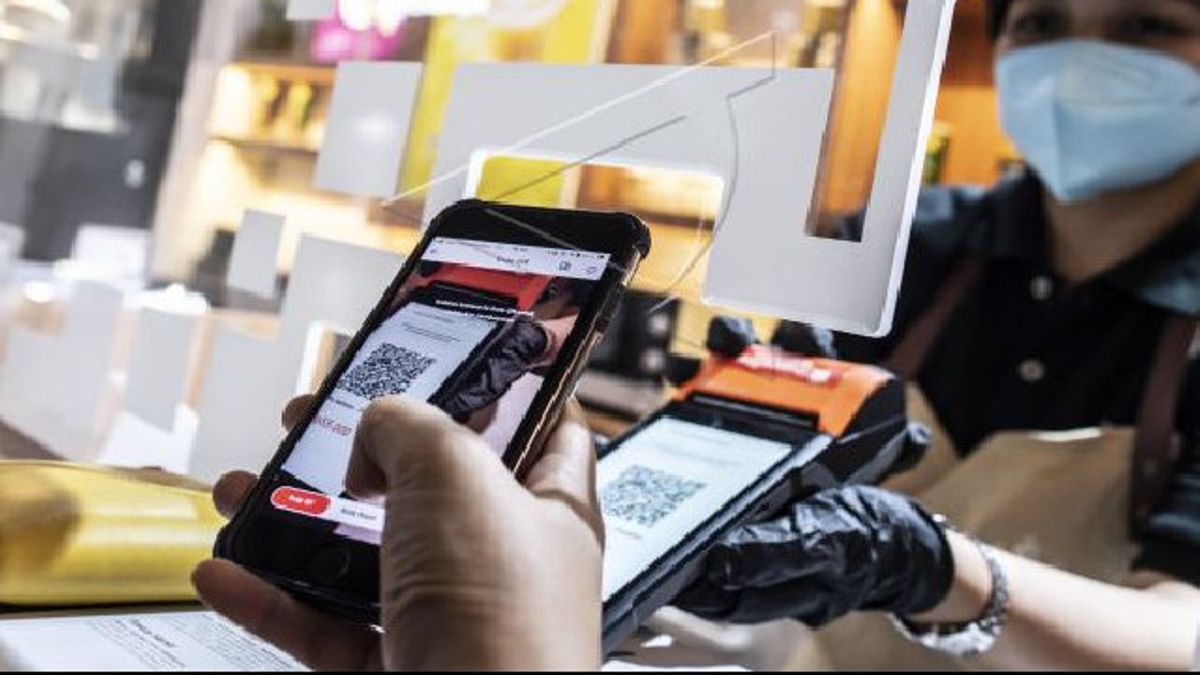


JAKARTA The United States (US) government highlighted a number of policies of Indonesia's domestic payment system, including the Quick Response Code Indonesian Standard (QRIS) and the National Payment Gate (GPN), in a series of negotiations regarding the import rates imposed on Indonesian products.
Coordinating Minister for Economic Affairs Airlangga Hartarto said that the Indonesian government had responded to the attention of the US side by holding cross-institutional coordination, including the Financial Services Authority (OJK) and Bank Indonesia (BI). This step was taken to answer Uncle Sam's country's concerns about the domestic payment mechanism which is considered too closed for foreign business actors.
"We have discussed with the OJK and also BI regarding the payment system (payment) which is of concern to the American side," Airlangga said in a press conference broadcast on the Coordinating Ministry for the Economy's YouTube channel, quoted on Saturday, April 19, 2025.
QRIS and GPN have been part of a national strategy in strengthening payment system sovereignty and encouraging the efficiency of digital transactions in Indonesia. However, the US considers that the implementation of the system can hinder the involvement of foreign companies in Indonesia's financial sector and payment services.
In addition to the payment system, the Domestic Component Level (TKDN) policy is also in the main spotlight in the import rate negotiations. The US government considers the TKDN policies implemented in various sectors, including technology and infrastructure products, as trade barriers.
Responding to this, Airlangga revealed that President-elect Prabowo Subianto had given directions to evaluate the TKDN format to be more flexible and incentive-oriented, not limiting.
"In a meeting with the President, it has been requested that the TKDN format be improved to be intensive-based, to be more adaptive and continue to support industrial competitiveness," said Airlangga.
He added that the US asked for clarity regarding some products that are technically not included in the context of exports-imports, but are still affected by local regulations. One example is data center facilities, which often face the obligation to place servers in the country.
"Of course from America there is a demand for certain products that are practically non-import-export in nature, for example such as data centers," he explained.
Based on information released through the official White House (Whitehouse.gov) website, local content policies such as TKDN are one of the reasons the US imposes reciprocal rates on Indonesia. The tariff reached up to 32 percent of a number of commodities from Indonesia.
As a step in economic diplomacy, Indonesia and the US have agreed to open up space for negotiations for 60 days. These negotiations aim to formulate a joint solution that supports the creation of a fair, open and balanced trading system between the two countries.
SEE ALSO:



The Indonesian government, said Airlangga, will continue to encourage constructive and transparent dialogue in the negotiation process, while maintaining national interests, especially in the protection of domestic industry and digital sovereignty.
"Indonesia remains open to cooperating in the framework of strategic partnerships, but in principle it must be won-win," said Airlangga.
The English, Chinese, Japanese, Arabic, and French versions are automatically generated by the AI. So there may still be inaccuracies in translating, please always see Indonesian as our main language. (system supported by DigitalSiber.id)
Most Popular Tags
#Prabowo Subianto #donald trump #firearm #8791 #giias 2026Popular


