

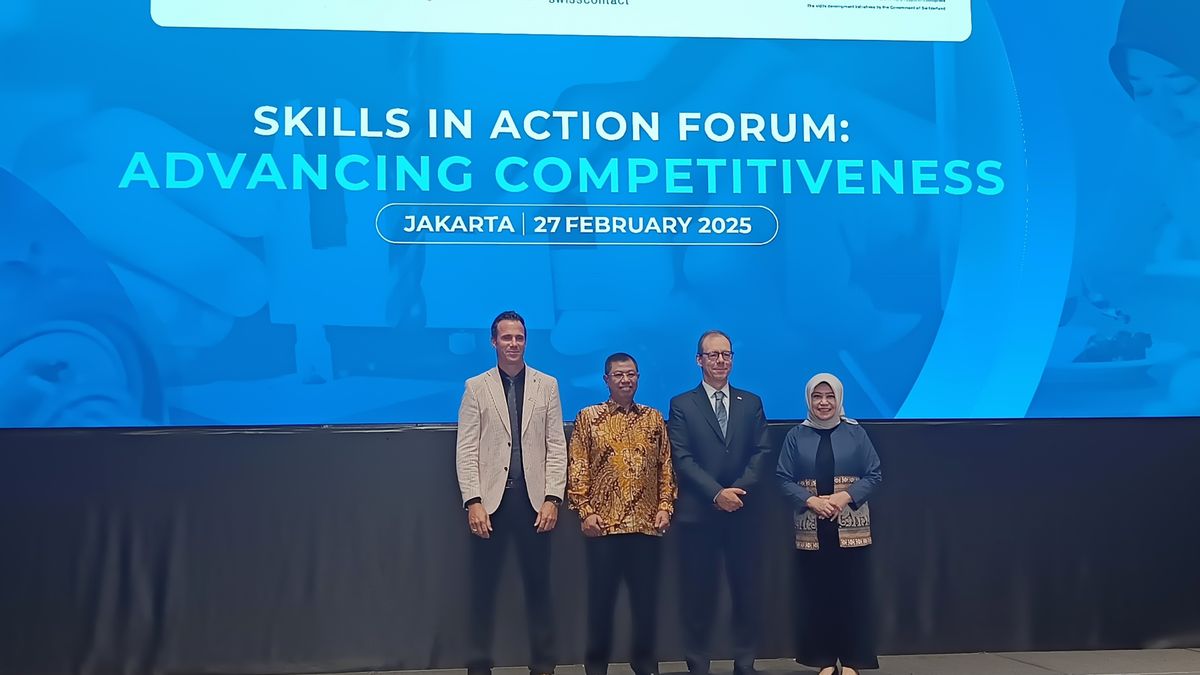


JAKARTA - Adequate infrastructure and superior human resources (HR) are the two main pillars that must be fulfilled to welcome Indonesia Gold 2045.
The Processing Industry is expected to be a pillar of development to realize this vision.
The Ministry of Industry (Kemenperin) is well aware of the importance of the role of human resources in realizing a strong and competitive industry.
For this reason, the Ministry of Industry through the Industrial Human Resources Development Agency (BPSDMI) continues to strengthen and develop vocational education and training programs to produce competent and global competitive human resources.
One of the things that has been done by the Ministry of Industry's BPSDMI is to collaborate with the Swiss Government for the implementation of vocational education and training.
"The Swiss government through the State Secretariat for Economic Affairs (SECO) has been our strategic partner since 2018 through the Skill for Competitiveness (S4C) program with the implementation of the Swisscontact Indonesia agency," said Head of BPSDMI Masrokhan at the Skills In Action Forum: Advancing Competitiveness in 2025 at the Danareksa Tower Building, Jakarta, Thursday, February 27.
Masrokhan explained that the program had been implemented through two phases, with the first phase having been completed in 2022 which was extended until 2024 due to the COVID-19 pandemic.
At that time, he said, BPSDMI had implemented two main programs, including school development and strengthening the system in the four youngest education units of the Ministry of Industry since 2018.
The four educational units are Morowali Industrial Polytechnic, Kendal Industrial Polytechnic, Bantaeng Industrial Community Academy and Banten Petrochemical Industrial Polytechnic.
He assessed that many programs have been carried out together, including the preparation of strategic plans for education development, accreditation assistance, Development a Curriculum (DACUM) which was developed into Industrial Based Curriculum (IBC), Career Development Center (CDC), K3, structured pre-constructed, Project Based Learning (PBL), In company trainer (ICT), Master ICT and so on.
"These programs have provided good benefits to education and industry," said Masrokhan.
SEE ALSO:
-
 | EKONOMI
Taufiek Bawazier Dilantik jadi Direktur Jenderal IKFT, Fokus Penguatan Industri Tekstil
13 Januari 2025, 19:31 -
 | EKONOMI
RI-Swiss Perkuat Komitmen Pengembangan SDM Industri di Ajang Idutex 2024
12 Oktober 2024, 10:05
Furthermore, Masrokhan expressed his gratitude to the Swiss Ambassador to Indonesia and the Swiss State Secretariat for Economic Affairs (SECO) for supporting the development of a global standard education system at four vocational universities of the Ministry of Industry.
"I hope that this cooperation in the second phase can be improved and expanded to all educational units," he said.
Meanwhile, Swiss Ambassador to Indonesia, Timor-Leste and ASEAN Olivier Zehnder said that his party welcomed the cooperation that had been established.
According to Olivier, vocational training is a model for human resource development that has been carried out in Switzerland and also many other countries on the European continent.
Thus, he said, his party could provide an overview of how the Indonesian government allows its younger generation to find jobs according to their existing capabilities and qualifications.
"We don't just need competitiveness, we also need young people to find certain jobs (related to economic needs) and they can be integrated as quickly as possible into the economy," he said.
The English, Chinese, Japanese, Arabic, and French versions are automatically generated by the AI. So there may still be inaccuracies in translating, please always see Indonesian as our main language. (system supported by DigitalSiber.id)
Most Popular Tags
#Prabowo Subianto #donald trump #2026 World Cup #Febrie Adriansyah #8791Popular


