


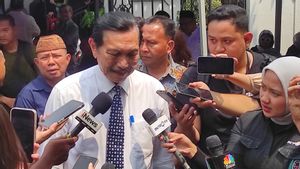
JAKARTA - Chairman of the National Economic Council (DEN) Luhut Binsar Pandjaitan expressed his belief that Indonesia could go to Indonesia Gold and achieve economic growth of 7-8 percent on the condition that there are strong leaders, provide good examples, and consistency in policy.
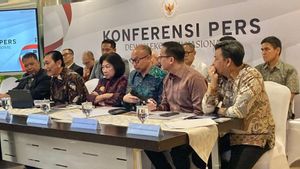
"I was asked to provide challenges and hopes to oversee national development towards Indonesia Gold, actually many people ask whether or not, but more and more days I come here, I see more and more sure that we can do that," he said at the event to navigate the global economy, the strategy for 2025, Wednesday, January 15.
He mentioned that from his past experience to achieve economic growth of 7-8 percent which is targeted by the Government to be achieved with the condition that there is consistency in policy.
"Because we have seen the pattern, so my experience is 3 times the Coordinating Minister and the chief of staff of the president and how many positions have made this nation possible. As long as there are strong leaders and provide good examples and also our consistency. If you look at the slide, this is a slide. It's easy, right, we have to grow 7-8 percent," he explained.
Luhut said that national development requires economic equality, including economic development in villages, and can be realized through village funds that have been circulating since ten years ago and the numbers continue to increase.
"Because we actually see how we build Indonesia. Because there must be equity, there must be an economy in rural areas. Well, with village funds only, we have already reached Rp1.1 billion per fund in the rotating village since 10 years ago. That's an increase," he explained.
According to him, in encouraging economic turnover, one example is the program of providing nutritious food and Government Technology (GovTech), which will increase state revenue.
"Now there is a nutritious meal, now we want to make The GovTech, make it more well-organized. We calculate, yes, there are funds circulating in the village of Rp. 8 billion-Rp. 9 billion per year, this is a big number, so it rotates in one village. That will make, I mentioned earlier, equity, reducing stunting, reducing poverty. Yes, this is running." he said.
In addition, Luhut also mentioned criticism from the World Bank regarding Indonesia's tax collection which was considered bad. He responded that currently Indonesia's tax collection is better, namely utilizing technology to increase state revenue.
"Secondly, when the World Bank came to my office three weeks ago, he gave a presentation saying that Indonesia is one of the countries with the worst tax collections. We were equated with Nigeria at that time. I was a bit offended too. How come? I went to Nigeria twice, then finally I told him, we wanted to make GovTech," he said.
In addition, Luhut also explained that Indonesia is currently creating an Inter-Ministerial / Institutional Mineral and Coal Information System (Simbara). According to him, the system can increase state revenue by around 30-40 percent, by reducing tax inefficient and increasing transparency.
"Well, we organize all of this, we order all of these problems, identify all of these problems. Therefore, the World Bank said, eh, if you can collect taxes properly below, you will be able to get 6.4 percent of your GDP. That's equivalent to approximately Rp. 1,500 trillion," he explained.
SEE ALSO:
Luhut then discussed the importance of technology in the future economy, including the use of GovTech and AI, and reminded them to be careful in criticizing policies that have just been implemented, because the positive impact takes time to see.
"Actually, don't be quick to criticize, wait to see first. We sometimes pretend to know, even though when he was an official, he was also a thief. So, we'll just have to wait and see," he said.
On the other hand, he also talked about the importance of regulatory consistency and policies in Indonesia, so that this country can compete at the global level, especially in facing geopolitical and economic challenges in the world.
Luhut also emphasized the importance of not relying on any major country, but prioritizing national interests. With appropriate policies and consistent leadership, Indonesia is expected to continue to grow and become a more attractive investment destination for the international community.
The English, Chinese, Japanese, Arabic, and French versions are automatically generated by the AI. So there may still be inaccuracies in translating, please always see Indonesian as our main language. (system supported by DigitalSiber.id)
Most Popular Tags
#Prabowo Subianto #donald trump #firearm #8791 #giias 2026Popular


