
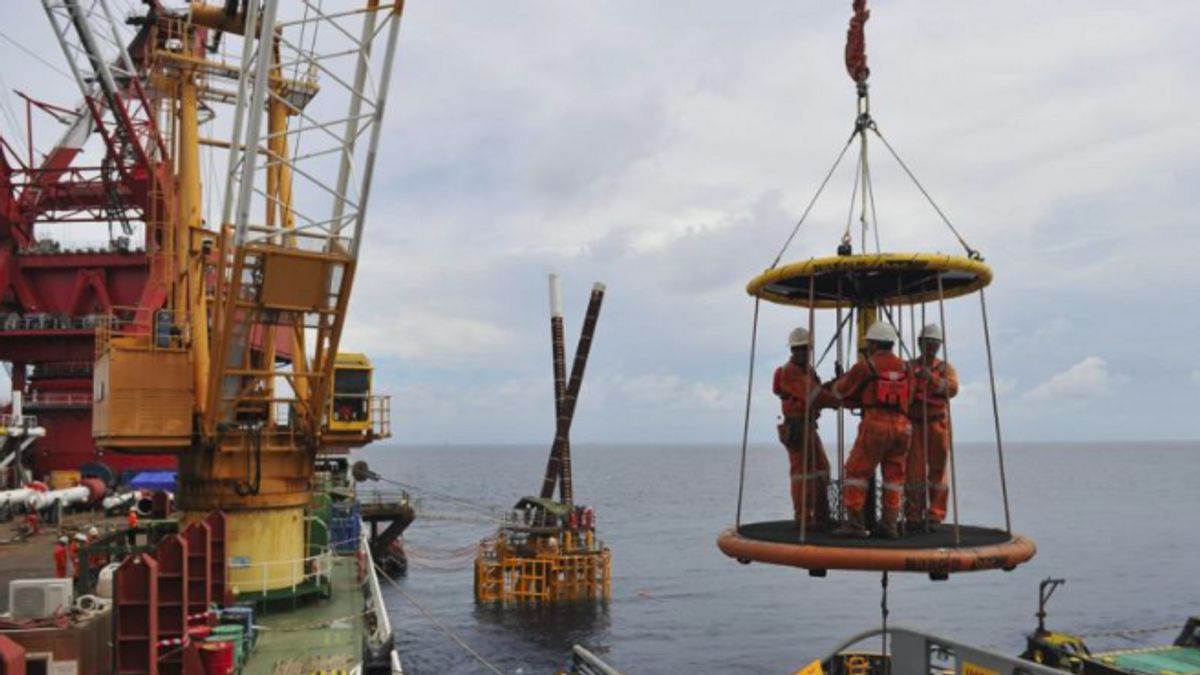


JAKARTA - Minister of Energy and Mineral Resources (ESDM), Bahlil Lahadalia, emphasized that the upstream oil and gas sector plays an important role in achieving the energy self-sufficiency target in accordance with the Astacita program promoted by President Prabowo Subianto.
According to Bahlil, the success of self-sufficiency in energy depends on increasing oil and gas production which is carried out continuously and optimally.
"One strategy that can be taken is to reactivate idle wells or those that are currently not operating," Bahlil said in a statement in Jakarta, Sunday.
He explained that oil and gas wells that have long been inactive have great potential to support the increase in national oil and gas lifting.
"Idle wells keep a great opportunity to add national oil and gas lifting, and we're targeting an upgrade from there," he said.
Currently, Indonesia has a total of 44,985 oil and gas wells. Of these, 16,433 active wells produce oil and gas, while 16,990 wells are in idle status and do not produce. The rest, as many as 11,562 wells have other statuss such as abanded, injection, or dry-hole.
VOIR éGALEMENT:
-
 | EKONOMI
Celios: PPN jadi 12 Persen Bakal Berdampak pada Kinerja E-commerce
19 Desember 2024, 20:44 -
 | EKONOMI
Pengusaha Beberkan Sejumlah Penghambat Pertumbuhan Ekonomi Indonesia
19 Desember 2024, 20:33
Bahlil detailed further, from these idle wells, 4,993 do not have hydrocarbon potential (HC), 4,495 have HC potential, and 7,502 others are still in the study stage.
He also stated that the reactivation of oil and gas wells that were not active could return Indonesia's oil production to more than 1.5 million barrels per day, as it was achieved in 1997.
In the past, in 1997, our situation was much different. We were able to export up to 1 million barrels per day. But now, the conditions are reversed, with Indonesia importing 1 million barrels per day," he said.
The current average domestic oil demand reaches 1.6 million barrels per day, so increasing oil and gas lifting is one of the strategic steps taken by the Ministry of Energy and Mineral Resources to narrow the gap between domestic demand and oil and gas production.
This step, continued Bahlil, is part of a great effort to realize energy self-sufficiency in Indonesia.
The English, Chinese, Japanese, Arabic, and French versions are automatically generated by the AI. So there may still be inaccuracies in translating, please always see Indonesian as our main language. (system supported by DigitalSiber.id)


