

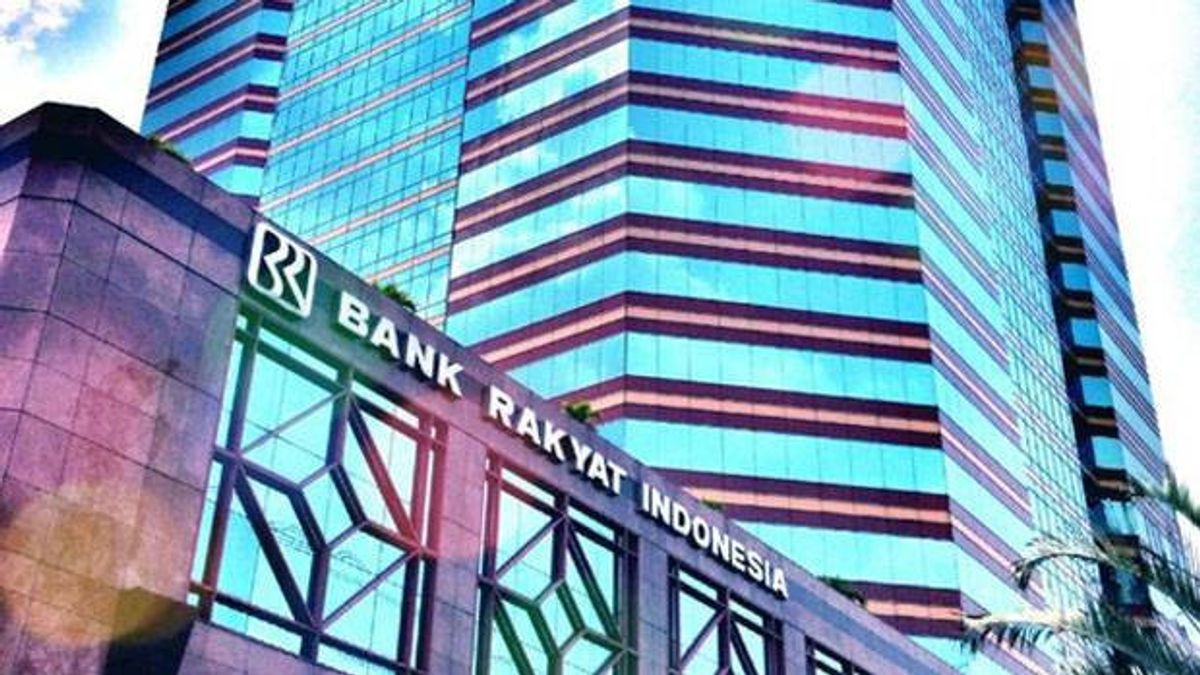


JAKARTA - PT Bank Rakyat Indonesia (Persero) Tbk has succeeded in increasing its sustainable financing portfolio (sustainable financing).
Until the end of the first quarter of 2024, BRI's sustainable financing portfolio reached IDR 787.9 trillion, or equivalent to 66.2 percent of the total loans disbursed and BRI's government bond investment portfolio.
BRI's Director of Compliance A. Solichin Lutfiyanto said that as support for the government's green economy program, the company continues to be committed to implementing sustainable finance through the implementation of Environmental, Social, and Governance (ESG). He explained that the distribution of sustainable loans was recorded to have grown double digits, namely 10.8 percent on an annual basis (yoy) from the same period last year, amounting to Rp710.9 trillion.
"Distributing sustainable credit, BRI continues to focus on lending to the MSME sector, which reaches IDR 700.1 trillion," said Solichin, Tuesday, May 14.
Then followed by financing to the green sector worth Rp. 83.1 trillion, consisting of lending to the biological natural resource management sector and the use of environmentally friendly land worth Rp. 54.84 trillion, green transportation of Rp. 11.78 trillion, renewable energy of Rp. 6.29 trillion, and other Environmentally Introspective Business Activities (KUBL) sectors of Rp. 10.17 trillion.
BRI also has an ESG-based government bond investment portfolio worth IDR 4.7 trillion.
Not only in terms of financing, BRI also continues to seek ESG-based funding. Noted, in the first quarter of 2024, BRI posted a total outstanding bond of IDR 37.2 trillion, including BRI's Green Bond worth IDR 13.5 trillion which was launched in stages in 2022, 2023, and 2024.
In addition, BRI also received funding through Sustainability-Linked Loans and Inclusiveness-based Securities.
The raising of funds and lending to the green sector is one of BRI's efforts to achieve the net zero emission (NZE) target in 2050. BRI took various initiatives, starting from calculating greenhouse gas emissions for Scope 1, Scope 2, Scope 3, which refers to international standards.
BRI's score 3 emissions also include financial emissions, namely indirect emissions originating from companies that receive financing from BRI.
In terms of operations, BRI also carries out operational eco-efficiency programs aimed at reducing company emissions sourced from operational activities, through the use of 119 eco-friendly cars and 150 electric motors as office operational vehicles, as well as solar panel installations in 93 work units as alternative low-energy emissions.
Not only in the business environment and office operations, BRI is also trying to expand resilience efforts towards climate change by involving customers and the community through the BRI Plant initiative.
Programs involving customers, BRILiaN Village, and this large community have succeeded in planting 904,196 trees and reaching 2,593 villages throughout Indonesia with the potential for carbon dioxide absorption reaching 780,606 kgCO2e.
SEE ALSO:


Through environmental initiatives, BRI also contributes to the achievement of the Sustainable Development Goals (SDGs), especially goals No. 1 Without Poverty; No. 7 Clean and Affordable Energy; No. 8 Decent Works and Economic Growth; No. 10 Lack of Gap; No. 12 Responsible Consumptions and Production; and No. 13 Handling Climate Change.
The English, Chinese, Japanese, Arabic, and French versions are automatically generated by the AI. So there may still be inaccuracies in translating, please always see Indonesian as our main language. (system supported by DigitalSiber.id)


