
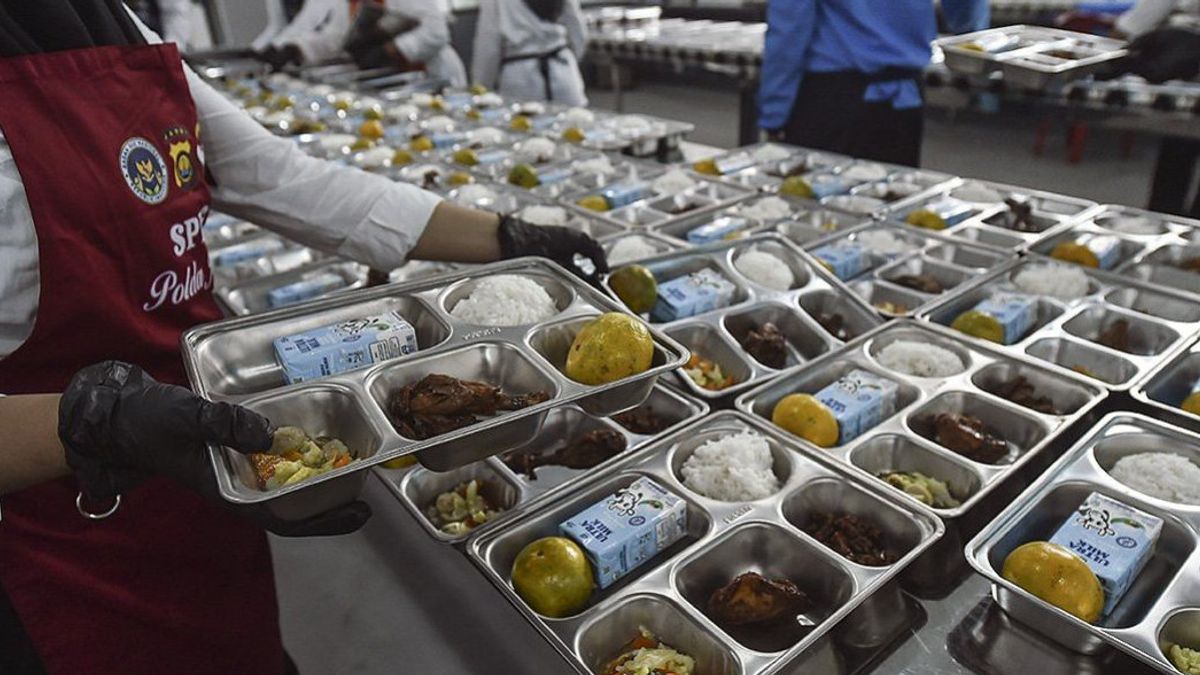


JAKARTA - The Free Nutritious Meal (MBG) program has shown a tangible form in moving the wheels of the economy at the grassroots level. With the infrastructure almost completed, this program has become a new focus for the UMKM sector and regional agriculture.
MBG as one of the drivers of the national economy is also recognized by the Economist Center for Strategic and International Studies (CSIS), Riandy Laksono. He assessed that the MBG program has great potential to strengthen the people's economy, provided that it is accompanied by an adaptive and efficient governance strategy.
Riandy revealed that the progress of the Nutrition Food Service Unit (SPPG) or MBG kitchen has reached 90 percent. From the target of 30 thousand units, as many as 27 thousand kitchens are ready to operate. This, according to him, is good news for labor absorption.
"The kitchen has been built and the people's economy has started to roll. This MBG is very attractive in helping the agricultural and trading sectors in traditional markets. This is a fiscal acceleration that has a direct impact on economic actors below," said Riandy, in his statement, Friday, May 8.
What Riandy said is reflected in one of the MBG kitchens from the Nutrition Program Service Unit (SPPG) in Kadiwano, West Sumba, East Nusa Tenggara (NTT). Thanks to the existence of the MBG kitchen, the local economic chain comes to life. Employment is created for local people, especially housewives, to empower local farmers.
Head of SPPG Kadiwano, Edwin Putra Kadege, said that the MBG kitchen he manages currently serves around 2,000 beneficiaries spread across 15 schools ranging from kindergarten (TK) to high schools (SMA).
Of course the need for raw materials is large. And this can be met through cooperation with local farmers. SPPG Kadiwano needs dozens or even hundreds of kilograms of vegetables such as beans, carrots, or mustard.
"So, we are empowering MSMEs (micro, small, and medium enterprises) around SPPG. With MBG, the benefits are not only for school children, but wider to the community," said Edwin.
To maintain the stability of stocks and prevent the accumulation of crops, SPPG also regulates the supply schedule every week. This is done so that the commodities planted by farmers can be absorbed optimally.
"Some grow carrots, some grow mustard, and some focus on bananas. So that it doesn't pile up. Because if it piles up, it's overwhelming too," he said.
The existence of the MBG kitchen is also a blessing for housewives (IRT). They are empowered to cook.
"The average person who works for us is a housewife who has never had the opportunity to work," said Edwin.
MBG Sustainability Amid Fiscal PressureTo ensure that this program runs in parallel with national financial (fiscal) stability, Riandy proposed a smart adjustment step. Instead of reducing the scope of the region or targeting only children from families of the lower middle class economy, he suggested adjusting the frequency of feeding as a solution to maintain the credibility of the budget.
"So that the budget remains healthy and the credit rating risk (Indonesia) is maintained, the government can take a middle ground by regulating the frequency, for example from 6 days to 3 or 4 days a week. This step is much safer than changing the total structure of the program that is already running, so that the economic benefits for kitchen workers and food suppliers are maintained," he explained.
In addition to budget efficiency, Riandy also emphasized the importance of maintaining the quality of nutrition as a long-term human capital investment. He encouraged the government to strengthen the monitoring mechanism in the field to ensure that every rupiah spent actually comes in the form of nutritious intake for students.
"The government needs to strengthen the pattern of random checks or field sidak to ensure that quality standards are maintained. Transparency and accountability in the management of the kitchen will be the key to the future success of MBG," he added.
In addition, although the impact on new labor productivity will be felt in the future, MBG is considered a good first step to improve the quality of life of future generations. Riandy believes that if managed with proper management, MBG can become part of a wider economic growth ecosystem.
"But again, don't expect this MBG to be able to turn the wheels of the economy up to 8%, it will be difficult to imagine, because to move the economy, new economic engines are needed, not only relying on the agricultural sector, so there needs to be other sectors that need to be boosted. so don't rely on MBG alone for growth strategies, so we are going to the farm," concluded Riandy.
The English, Chinese, Japanese, Arabic, and French versions are automatically generated by the AI. So there may still be inaccuracies in translating, please always see Indonesian as our main language. (system supported by DigitalSiber.id)
Most Popular Tags
#Prabowo Subianto #donald trump #Febrie Adriansyah #8791 #giias 2026Popular


