

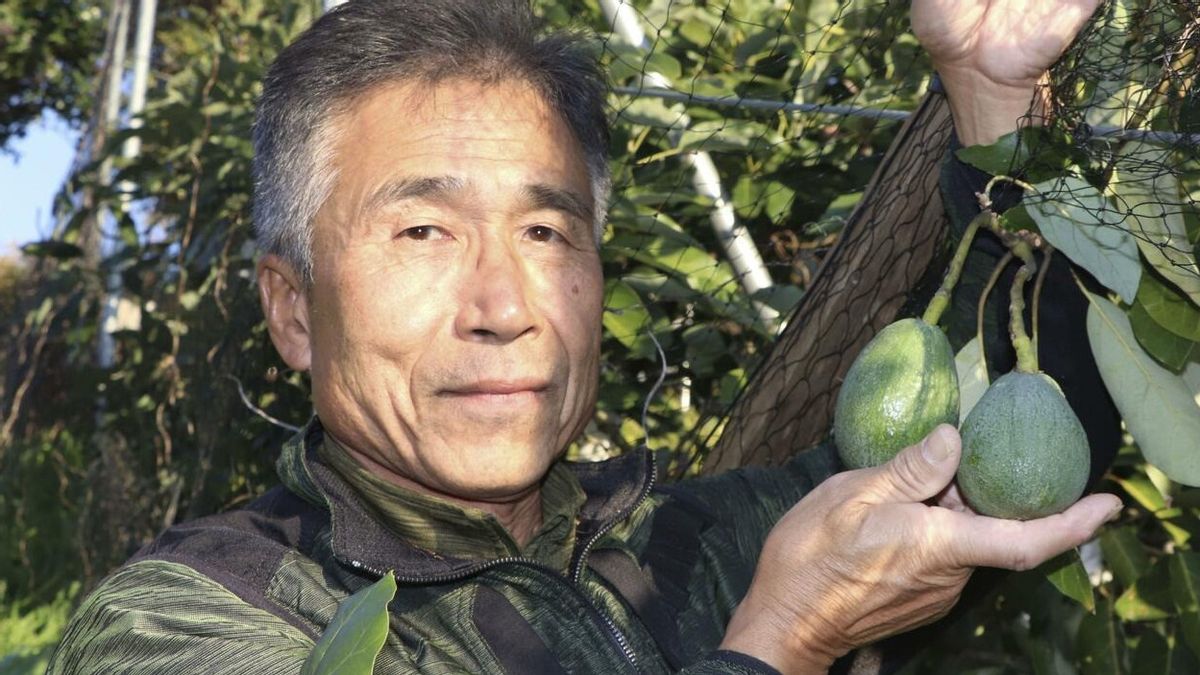


JAKARTA - Global warming is beginning to change the map of Japanese agriculture. The city of Matsuyama in Ehime Prefecture, which has long been known as a citrus center, is now slowly eyeing a new commodity: avocados.
As reported by Kyodo News, quoted Tuesday, May 4, the change was seen from Fuminori Arita's move. The 67-year-old farmer used to grow iyokan, a Japanese specialty citrus variety. About 10 years ago, he switched to avocados, a fruit he called "sensitive and difficult to grow.
It's just where the challenge is. "The joy when it succeeds is very big," said Arita. He started from the seed of city government assistance. Now, the avocados he harvests are sold for around 5,000 yen or 32 US dollars per kilogram.
Matsuyama is not just following trends. The city is reading the changing climate. Warmer temperatures make some areas less ideal for oranges, but are better suited for avocados.
Matsuyama avocado production began to grow since 2009. In the last decade, the harvest has jumped more than 12 times. From around 600 kilograms in fiscal year 2015 to around 7,300 kilograms in fiscal year 2024.
According to the Japanese National Research Organization for Agriculture and Food, the area suitable for mandarin oranges will gradually shift to the north. On the other hand, areas that are too warm for oranges can become new land for avocados.
The projection of the agency affiliated with the Japanese Ministry of Agriculture states that the area suitable for avocado cultivation in Japan can be expanded 2.5 times or more by the middle of this century.
For Japan, this is not just a matter of fruit. This is how farmers survive when the climate changes. When temperatures rise, crop choices shift. Oranges, which were once the pride of the region, are now starting to share the stage with avocados, the "butter from the forest".
Similar efforts are also underway in Shizuoka Prefecture, central Japan. The central government is preparing a subsidy program starting in fiscal year 2026 to encourage regions to grow commodities that are more suitable for high temperatures.
Changes are also seen in other areas. Aomori, known as an apple producer, has begun expanding peach production. Oita wants to increase the production of shine muscat grapes.
Tatsumi Shiba, a local agency official who provides agricultural guidance in Matsuyama, said avocado cultivation would be easier if the minimum temperature rose. "We hope to increase cultivation," Shiba said, quoted by Kyodo News. He also hopes that Matsuyama will one day be known as an avocado city.
The English, Chinese, Japanese, Arabic, and French versions are automatically generated by the AI. So there may still be inaccuracies in translating, please always see Indonesian as our main language. (system supported by DigitalSiber.id)
Popular


