

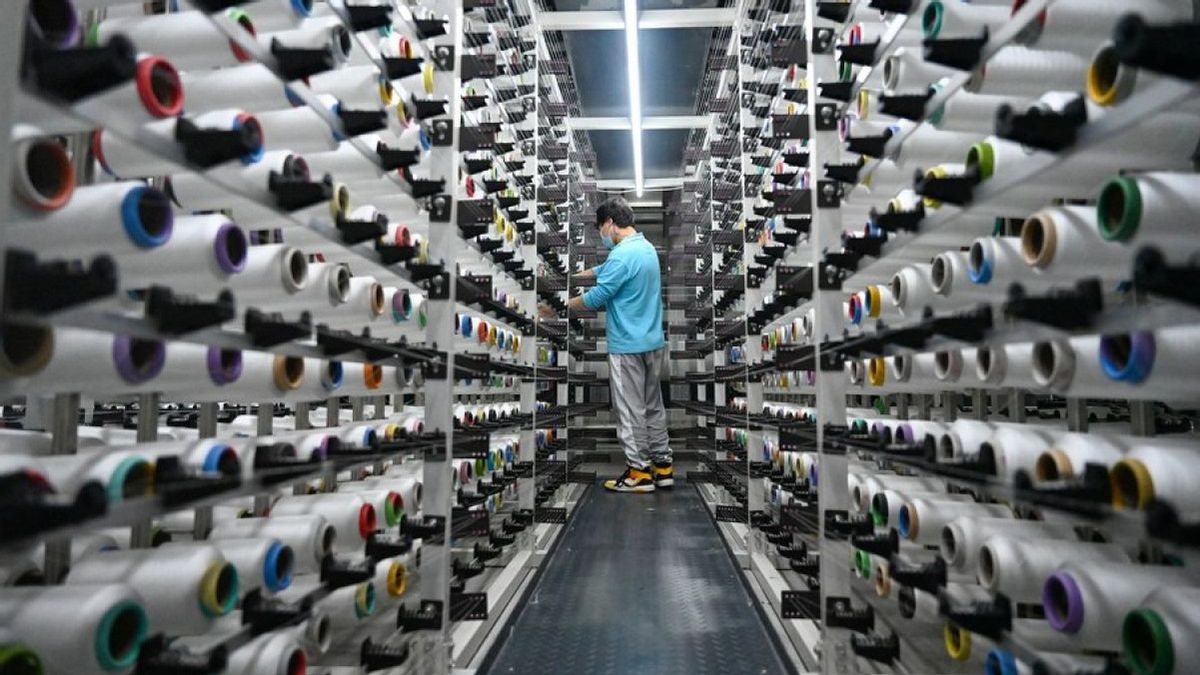


JAKARTA - The Directorate of Textile, Leather and Footwear Industries of the Directorate General of IKFT of the Ministry of Industry (Kemenperin) emphasized that the national textile and textile products (TPT) industry is still operating relatively stable.
However, the sector is faced with global dynamics that affect the price and availability of raw materials.
"We continue to monitor the fluctuations in global raw material prices that have an impact on the national textile industry by strengthening coordination to maintain the availability of raw materials and the smooth supply chain," said Minister of Industry (Menperin) Agus Gumiwang Kartasasmita in an official statement, Tuesday, April 21.
In a coordination meeting with industry associations and business actors, it was identified that the main pressure at this time comes from the increase in energy-based raw material prices that occur globally.
The domestic price of paraxylene (PX), for example, has increased by around 40 percent following the movement of international prices.
On the other hand, the supply of chemical raw materials such as monoethylene glycol (MEG) is still in a safe condition until April, although for the period after that it still requires further monitoring.
The increase in prices naturally impacts the cost structure along the production chain, from upstream to downstream industries.
This also affects the price of fabrics and intermediate products, as well as the cost of supporting components such as plastic-based packaging.
In addition, in some cases there was also an adjustment to export activities, including the return of goods due to global market dynamics.
Even so, the national industry has shown good adaptability.
Business actors continue to maintain production continuity through stock management, adjustment of procurement strategies, and strengthening coordination with raw material suppliers.
Domestic demand is also still showing activity, while export opportunities remain open in line with changes in conditions in competing countries.
Meanwhile, Director of Textile, Leather and Footwear Industries of the Ministry of Industry, Rizky Aditya Wijaya, said that in strengthening the industrial structure, the existence of rayon fiber as a product based on domestic natural resources is one of the important supports in maintaining the balance of the industry.
"In the midst of pressure on petrochemical-based raw materials such as polyester, the utilization of domestically produced rayon provides a competitive raw material alternative while strengthening the industry's independence," he said.
Rizky said that the synergy between natural fibers and synthetic fibers is part of the strategy for adapting the national industry in responding to global dynamics while maintaining the sustainability of production in the downstream sector.
Furthermore, Rizky revealed that some subsectors do require more attention, especially industries that depend on specific raw materials without substitution.
For example, the hygiene industry such as diapers (diapers) has a dependence on several key components, so the availability of each material is very crucial in maintaining production sustainability.
Therefore, the government together with industry players considers the current period as an important phase to observe the impact of the global dynamics.
Anticipation steps continue to be carried out, including through mapping of critical raw material commodities and early identification of potential risks, to ensure industry readiness to face various possibilities.
As part of efforts to strengthen policy responses, the Ministry of Industry is developing an integrated monitoring system to conduct real-time data-based monitoring and analysis.
In addition, various policy options are also being comprehensively studied, including the provision of fiscal incentives for strategic raw materials, energy efficiency support, and adjustments to trade policies to maintain the smooth supply.
The government also emphasized the importance of comprehensive policy synchronization, both in terms of tariffs, fiscal facilities, energy and trade instruments, in order to be able to support the balance of the industrial value chain from upstream to downstream.
"Our TPT industry has a strong foundation, both in terms of structure, domestic market and experience in facing various global cycles. With measured anticipatory steps and close collaboration, we are optimistic that this industry will continue to grow and become more resilient," he said.
The Ministry of Industry together with industry players conveyed their commitment to continue to maintain the stability of the supply of raw materials, strengthen the competitiveness of the industry, and ensure the sustainability of production in the short and medium term.
The English, Chinese, Japanese, Arabic, and French versions are automatically generated by the AI. So there may still be inaccuracies in translating, please always see Indonesian as our main language. (system supported by DigitalSiber.id)


