

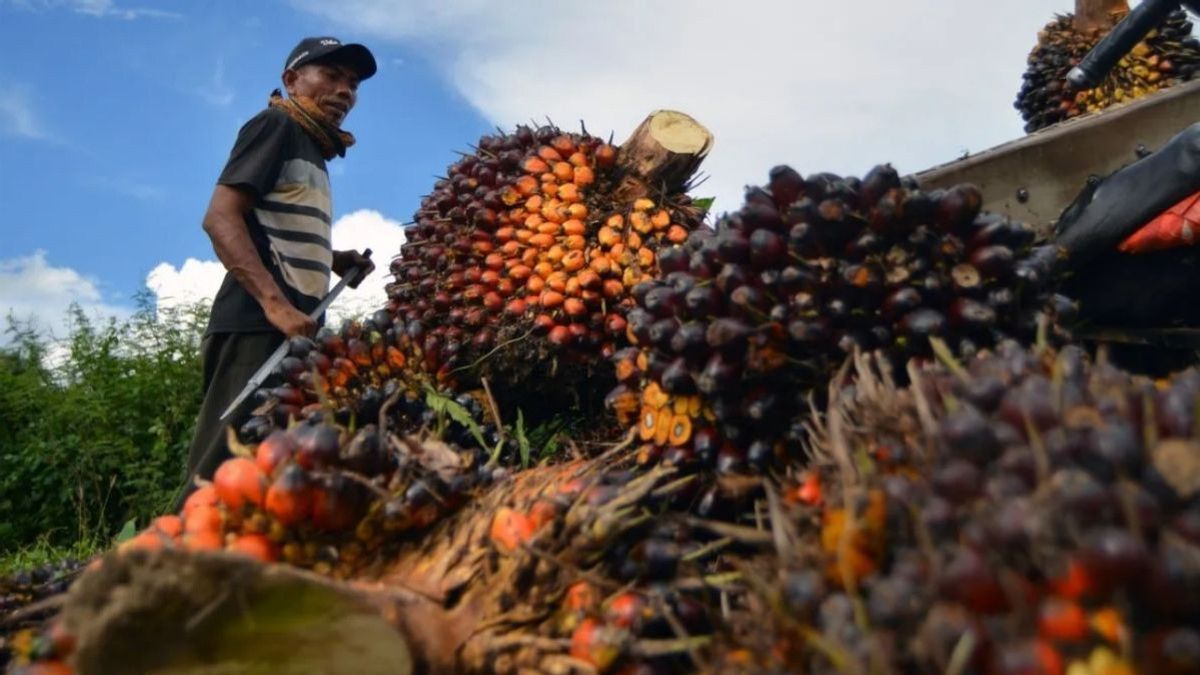


JAKARTA - The government through the Ministry of Industry requires palm oil entrepreneurs to have an Indonesian Sustainable Palm Oil (ISPO) certificate starting March 19, 2027.
"This means that the transition period that we have is less than a year to prepare all the supporting infrastructure and instruments so that the implementation of ISPO certification of the downstream sector can run optimally," said Acting Director General of Agro Industry, Ministry of Industry, Putu Juli Ardika, quoted from a written statement, Monday, April 13.
The obligation of the downstream industry to carry out certification is contained in Presidential Regulation (Perpres) Number 16 of 2025 concerning the Indonesian Sustainable Palm Oil Certification System, which is followed by its implementing regulations, namely the Minister of Industry Regulation (Permenperin) Number 38 of 2025 concerning Indonesian Sustainable Palm Oil Certification for the Palm Oil Downstream Industry.
The ministerial regulation will be effective on May 12, 2026 and will be mandatory for the downstream palm oil industry next year.
Putu said that the certification obligation was implemented because the export destination countries demanded transparency, sustainability, and traceability of the origin of raw materials for downstream palm oil industrial products.
According to Putu, the success of ISPO certification in the downstream sector is determined by the readiness of derivative regulations.
Including, the ISPO Certification scheme and the ISPO Certification Agency Accreditation Scheme.
It is known that the value of exports of palm oil and its derivatives reached 43.65 billion US dollars in 2025.
Palm oil derivatives dominate the total trade with a total of 93 percent.
Meanwhile, the value of imports was recorded at US$1.417 billion in the same year.
Thus, the trade balance surplus was recorded at US$ 43.23 billion.
Putu assessed that the achievement was proof of the success of the eradication policy in increasing added value and creating a multiplier effect for the national economy.
The number of palm oil derivative products increased to 208 types in 2025 from 2011 which only had 48 types.
The palm oil industry also contributes to the absorption of labor, with a total of 16.5 million people, both directly and indirectly.
Minister of Industry (Menperin) Agus Gumiwang Kartasasmita stated that the palm oil industry is one of the main contributors to the national agro industry.
He said the palm oil industry plays a strategic role in Indonesia's economy because of the production of 51.66 million tons of crude palm oil (CPO) in 2025 with an area of more than 16 million hectares (ha).
The English, Chinese, Japanese, Arabic, and French versions are automatically generated by the AI. So there may still be inaccuracies in translating, please always see Indonesian as our main language. (system supported by DigitalSiber.id)
Popular


