

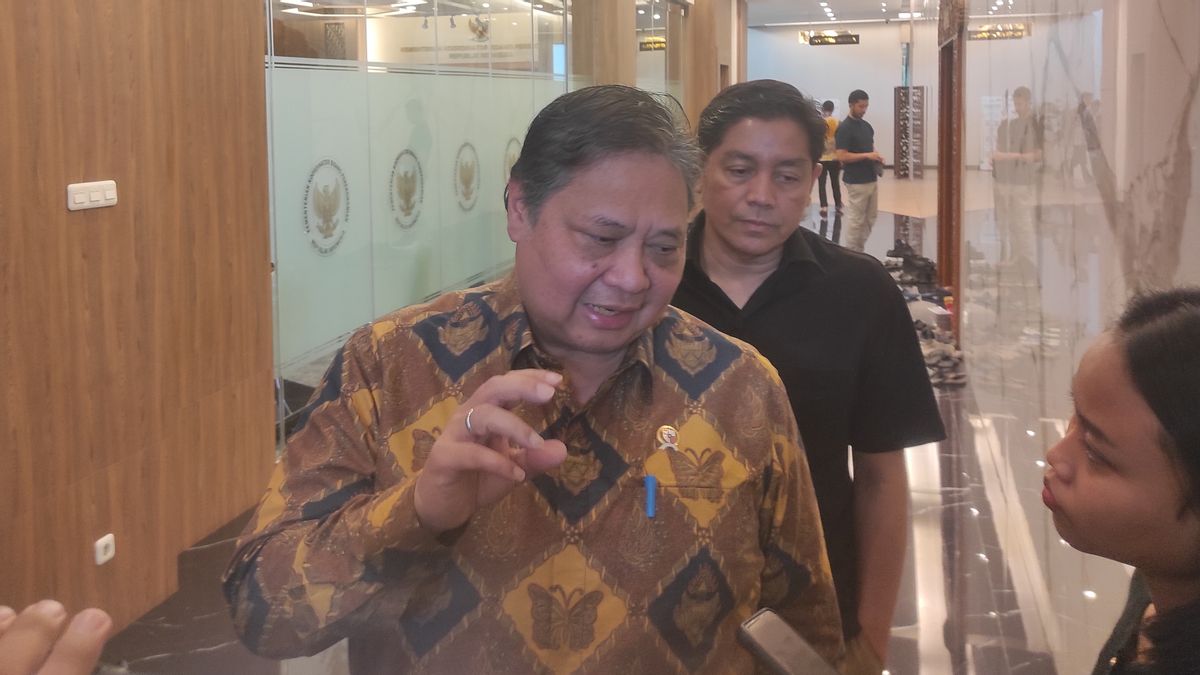


JAKARTA - Coordinating Minister for Economic Affairs Airlangga Hartarto revealed that the government also took strategic steps in managing state finances through prioritizing and refocusing the budgets of ministries and agencies.
He added that the budget was transferred from less priority spending items, such as official travel, meetings, non-operational spending, and ceremonial activities, to more productive programs and programs that have a direct impact on the community, including post-disaster rehabilitation and reconstruction in Sumatra.
"The government also continues to encourage the acceleration of spending by ministries and agencies as well as the refinement of spending through the optimization of the budget," he said.
Airlangga said the total potential budget that could be prioritized and transferred was estimated to be in the range of IDR 121.2 trillion to IDR 130.2 trillion.
"The potential for prioritizing and refocusing the budget of ministries and agencies is in the range of Rp. 121.2 trillion to Rp. 130.2 trillion," he explained.
He added that one of them is the policy of working from home (work from home/WFH) every Friday for the State Civil Apparatus (ASN) has the potential to generate savings in the state budget of up to Rp. 6.2 trillion.
This policy is implemented as an effort to reduce the consumption of petroleum (BBM) in the midst of global geopolitical dynamics.
The savings come from reduced compensation and fuel subsidies, as ASN mobility decreases due to the implementation of WFH.
"The potential savings from the WFH policy directly to the state budget is IDR 6.2 trillion in the form of savings on fuel compensation," he said.
In addition to savings in the state budget, Airlangga said the government also estimated the potential for a reduction in people's fuel expenditures to reach Rp. 59 trillion.
"Meanwhile, the total spending on public fuel has the potential to be saved as much as Rp59 trillion," he continued.
In addition, Airlangga explained, the use of official vehicles will be reduced by 50 percent, but this restriction does not apply to operational vehicles or electric-based vehicles.
"Mobility efficiency includes limiting the use of 50 percent of official vehicles, except for operations and electric vehicles, and encouraging the use of public transportation," he said.
Airlangga said the government also encouraged ASN to switch to using public transportation to increase efficiency and reduce fuel consumption.
"So reduce official vehicles and use public transportation as much as possible," said Airlangga.
In addition, Airlangga said efficiency was also applied to official travel, with a reduction of up to 50 percent for domestic travel and 70 percent for overseas travel.
"Then the efficiency of domestic and foreign official travel is up to 50 percent and abroad is up to 70 percent," he said.
Not only at the central level, Airlangga also conveyed that local governments were also urged to adjust the car-free day policy, including the possibility of adding the duration and coverage of road sections, according to the characteristics of each region.
He emphasized that further provisions regarding this matter will be regulated through a circular from the Ministry of Home Affairs.
"Especially for this area, there is an appeal for an increase in the number of days of duration and coverage of road sections in car free days according to the characteristics of each area and this will be regulated by the Minister of Home Affairs," he said.
The English, Chinese, Japanese, Arabic, and French versions are automatically generated by the AI. So there may still be inaccuracies in translating, please always see Indonesian as our main language. (system supported by DigitalSiber.id)


