

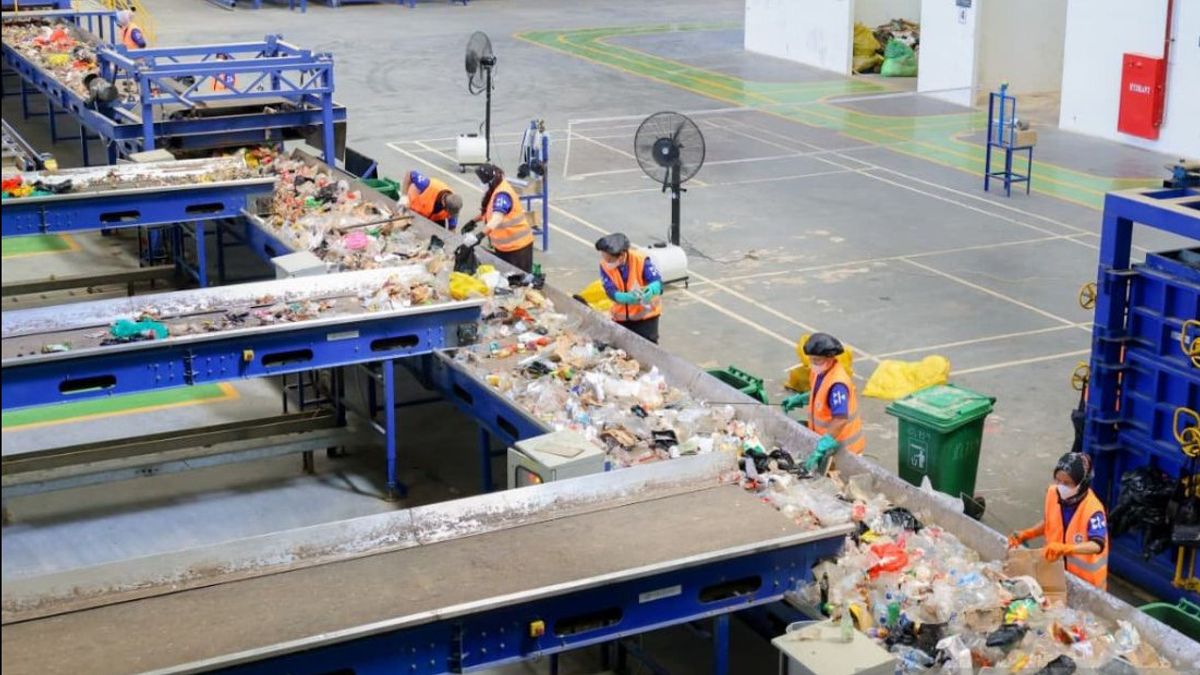


JAKARTA - The problem of waste in Indonesia is still a crucial problem that must be seriously addressed by the government.
For this reason, the Nusantara Capital City (IKN) is also preparing to anticipate this problem.
In conjunction with the series of welcoming the National Waste Care Day (HPSN) 2026, the IKN Authority began to gas-gas to orchestrate radical changes: transforming residual consumption into economic coffers through a circular economic ecosystem.
On Thursday, February 5, 2026, the Multifunction Hall of the Joint Office 3 became the center of the "Sorting Garbage Saving Gold" movement.
The agenda is a real implementation of the concept of Circular Economy where every gram of plastic has a trade-off against precious metals.
The aggressive steps of the IKN Authority are not taken without reason.
Based on data from the National Waste Management Information System (SIPSN) of the Ministry of Environment and Forestry, Indonesia produces around 68.5 million tons of waste per year from 2024-2025.
Of the total waste volume, 17 percent of it is plastic that is difficult to decompose.
In the IKN area itself, along with the massive development and increase in the population of ASN and construction workers, the volume of waste is predicted to continue to creep up.
However, unlike other areas that are still based on conventional landfills, IKN targets the minimization of residues to the lowest point.
The key to the "Cuan Sampah" strategy at IKN is the collaboration between digital technology and financial institutions.
Through the Forsepi and PT Pegadaian programs, IKN residents are invited not to throw plastic bottles into public garbage cans, but to deposit them to be converted into gold savings balances.
The General Chair of the Forum of Gold Friends of Waste Care Indonesia (Forsepi) Mirna Dewi Sukmawati explained that the approach aims to change people's psychology.
"We use this momentum as a space to unite the spirit and determination so that waste management at IKN can really be implemented well, so that there is no accumulation of waste," said Mirna, quoted from the official IKN website, Friday, February 6.
Support from the private sector has also accelerated the digitization of waste management at IKN.
Mayora Group through the National Circular Economy Movement (GESN) campaign handed over a Reverse Vending Machine (RVM) unit from Plasticpay to the IKN Authority.
The machine works like an ATM, residents insert plastic bottles and the machine automatically gives digital points that can be redeemed for electronic money.
Mayora Group Sustainability Director, Tunky Natanael Kurniawan, emphasized the corporate commitment in maintaining IKN as a sustainable city.
"Since 2021, we have consistently encouraged the circulation of the national economy. At IKN, we want to ensure that plastic waste is managed so that it can be economically beneficial, in line with the clean city principle carried out by the Authority," he explained.
Meanwhile, Deputy for Environment and Natural Resources of the IKN Authority Myrna Asnawati Savitri emphasized that technological infrastructure will not run without behavioral changes.
The momentum of HPSN 2026 is used as a space to unite the determination so that there is no accumulation of waste in the future.
"The key is to build the habit of managing waste consistently. I hope that from this meeting, the spirit of the community will grow to activate waste management practices in their respective environments," he added.
The English, Chinese, Japanese, Arabic, and French versions are automatically generated by the AI. So there may still be inaccuracies in translating, please always see Indonesian as our main language. (system supported by DigitalSiber.id)
Most Popular Tags
#Prabowo Subianto #donald trump #firearm #8791 #giias 2026Popular


