
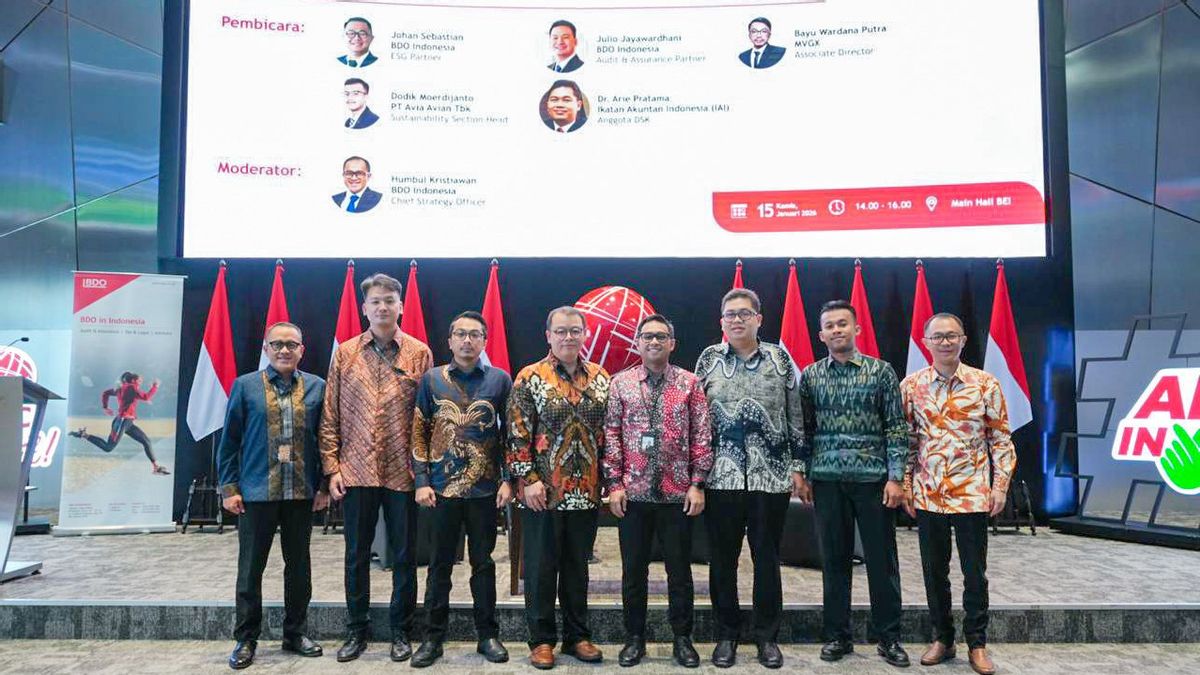


BDO Indonesia collaborated with the Indonesia Stock Exchange (IDX) to hold a technical discussion entitled "Preparing Quality Sustainability Reports: Technical Guidance for Integrating Global Standards and Local Regulations" on Thursday, January 15, at the BEI Main Hall, Jakarta.
This event was attended by representatives of listed companies, sustainability practitioners, and capital market stakeholders, and aims to provide practical guidance in preparing sustainability reports that are not only compliant with local regulations, but also in line with internationally recognized global standards.
As an effort to develop the quality of sustainability reporting information owned by listed companies, the IDX is committed to making efforts to increase the capacity of listed companies so that they can support the improvement of the quality of information and disclosure of sustainability consistently from year to year.
This improvement in reporting quality is expected not only to facilitate investors in making decisions, but also to become an important foundation for listed companies in managing performance, risk, and opportunities for sustainability and the creation of an integrated, efficient, and reliable capital market.
In line with this, BDO Indonesia CEO, Thano Tanubrata, emphasized that sustainability reporting is now part of the company's efforts to build long-term credibility.
"Reporting on sustainability is not just about producing one report, but is a process that requires organizational readiness, long-term commitment, and discipline in building data, systems, and governance that can be held accountable," said Thano.
Answering the Sustainability Reporting Challenge in Indonesia
Through this forum, BDO Indonesia hopes to share best practices while opening up a space for constructive dialogue between regulators, standard setters, practitioners, and listed companies to encourage the continuous improvement of sustainability reporting.
The series of discussions was opened with a technical discussion on the preparation of integrated sustainability reports, which was delivered by Bayu Wardanaputra, Associate Director of MVGX, who discussed practical guidelines for preparing integrated sustainability reports. He highlighted the main challenges of companies which still revolve around the availability and quality of data, cross-departmental coordination, the complexity of standards and regulations, and human resource readiness.
Bayu emphasized that sustainability reporting requires cross-functional collaboration from the early stages, including internal audit involvement before entering the independent assurance stage. He also emphasized the importance of applying double materiality to assess the financial impact on the business as well as environmental and social impacts, to increase the relevance of reports and mitigate the risk of greenwashing.
In terms of assurance, Julio Jayawardhani, Audit & Assurance Partner BDO Indonesia, explained that the adoption rate of sustainability reporting assurance in Indonesia is still relatively low, even though global investor demands for ESG credibility continue to increase.
"Assurance is an important step to ensure that sustainability information is reliably compiled and verifiable, as ESG disclosure is increasingly integrated with financial reports," he said.
In the panel discussion, Arie Pratama, member of the Sustainable Standards Board of the Indonesian Accountants Association, explained that PSPK 1 and PSPK 2 are designed to integrate sustainability information into the context of general purpose financial information reports. This approach complements current sustainability reporting practices with an outside-in perspective, so that investors can assess the impact of sustainability issues on business performance, risk, and prospects more comprehensively.
Meanwhile, from the practitioner's side, Dodik Moerdijanto, Sustainability Section Head of Avian Brands, shared the company's experience in building sustainability reporting supported by top management commitment, integrated data systems, and cross-functional internal controls. This approach shows that the quality of sustainability reporting is strongly determined by the overall readiness of the organization, not just the role of the sustainability unit.
Closing the discussion series, ESG Partner BDO Indonesia, Johan Sebastian, emphasized that strengthening internal control is the key to improving the credibility of sustainability reports.
"Sustainability data must be treated as a strategic asset of the company and supported by strong internal controls so that reports are not only compliant with regulations, but also relevant and trusted by investors," he said.
Through this forum, BDO Indonesia emphasizes its commitment to continue to accompany companies in improving the quality of sustainable reporting that is transparent, credible, and in line with global regulations and standards, to support the strengthening of Indonesia's sustainable capital market.
The English, Chinese, Japanese, Arabic, and French versions are automatically generated by the AI. So there may still be inaccuracies in translating, please always see Indonesian as our main language. (system supported by DigitalSiber.id)
Popular


