

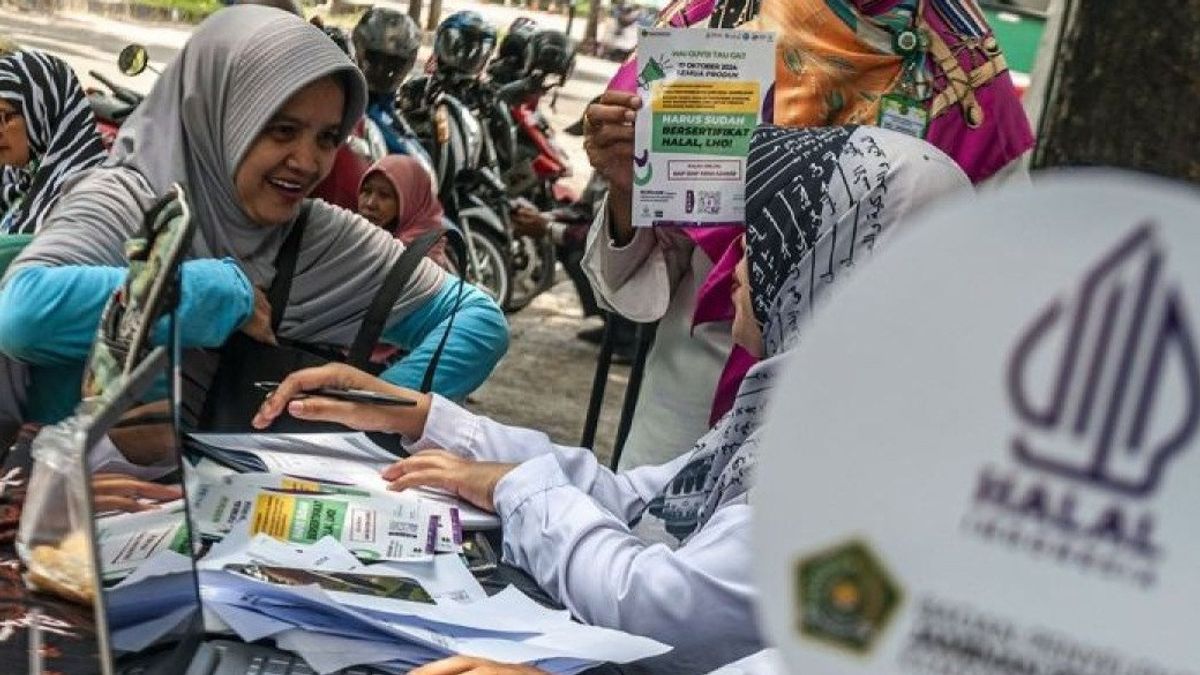


JAKARTA - The Halal Product Assurance Organizing Agency (BPJPH) together with the Ministry of Industry (Kemenperin) has finalized preparations for the implementation of the 2026 Halal Obligation policy.
"The synergy between BPJPH and the Ministry of Industry is one of the keys to ensuring that the implementation of halal obligations runs effectively without hindering the distribution of products and public services," said BPJPH Head Ahmad Haikal Hasan, quoted by Antara.
Furthermore, Haikal said the mandatory halal policy is a constitutional mandate in Law Number 33 of 2014 concerning Halal Product Guarantee (JPH) and Government Regulation Number 42 of 2024 concerning the Implementation of the Halal Product Guarantee Sector.
"The obligation of halal certification is a mandate of the law that must be carried out with full responsibility," said Haikal.
He said the state must be present to guarantee protection for the public in consuming and using products, as well as providing legal certainty for business actors.
"In addition, it also provides economic added value for business actors in producing and trading halal products," he said.
Haikal added that the success of the implementation of Halal Obligation 2026 in October depends heavily on cross-ministry and agency synergies, including in product supervision and system harmonization.
Meanwhile, the Chief Secretary of BPJPH Muhammad Aqil Irham said that he emphasized the importance of common understanding of policies, including related to product classification and the use of the Harmonized System Code (HS Code) in supporting the implementation of halal requirements.
Similarly, the Deputy for Partnership and Standardization of Halal BPJPH Abd Syakur assessed that this approach is also aimed at providing clarity for business actors in fulfilling halal certification obligations in accordance with applicable regulations.
"Standardization and harmonization of product types through the harmonization system code (HS Code) are important instruments so that there is no difference in interpretation in the field. With clear classification, the certification, supervision, and control of products can run more effectively and integrated," he said.
The English, Chinese, Japanese, Arabic, and French versions are automatically generated by the AI. So there may still be inaccuracies in translating, please always see Indonesian as our main language. (system supported by DigitalSiber.id)
Most Popular Tags
#Prabowo Subianto #donald trump #firearm #8791 #giias 2026Popular


