

JAKARTA - Indonesia must strive to improve the quality of human resources (HR) in the industrial sector amid the intense competition in the global industry.
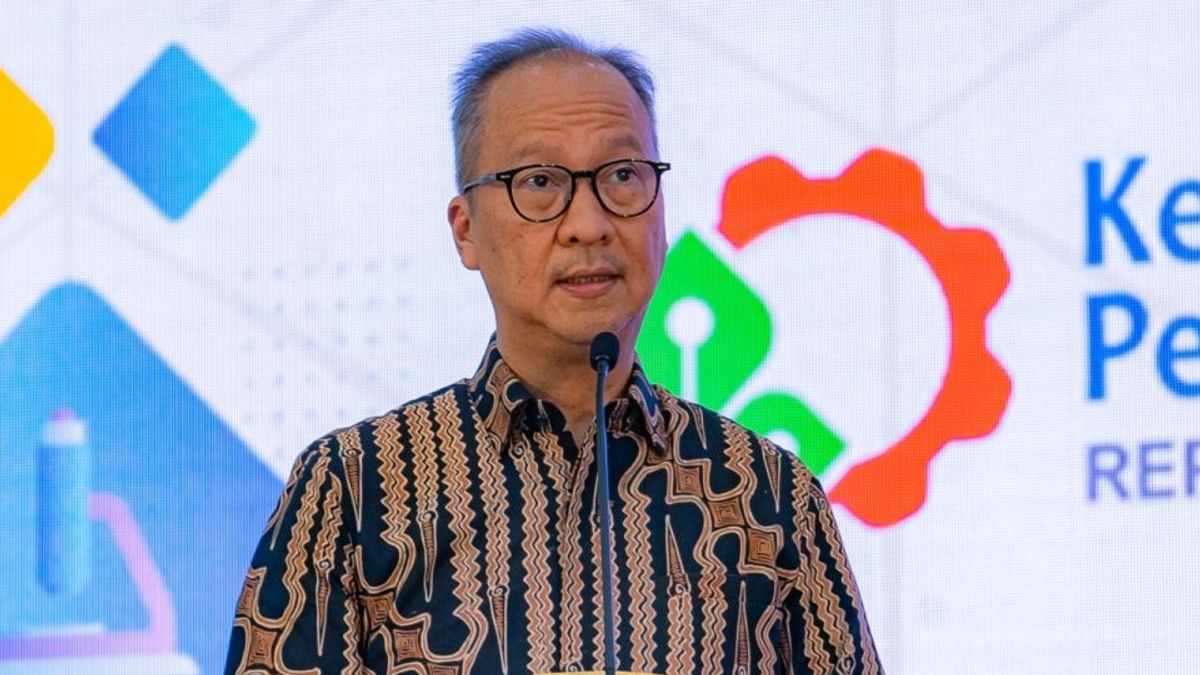
Minister of Industry (Menperin) Agus Gumiwang Kartasasmita said it is necessary to strengthen human resources to encourage the competitiveness of the national industry and ensure that Indonesia is able to compete in the global supply chain.
To make this happen, the Ministry of Industry (Kemenperin) places vocational education as a strategic pillar to produce competent and ready-to-work talents.
"The government places vocational education as a strategic pillar in realizing industrialization inclusive, adaptive and innovation-based. Vocational campuses must produce competent talents, be ready to work and be able to develop industrial added value," Agus said in a written statement, quoted Wednesday, December 10.
According to him, strengthening the vocational ecosystem is important in the midst of global dynamics, technological developments and industrial needs for human resources that have specific skills.
"Vocational education not only prepares labor, but also motors that drive innovation, entrepreneurship and sustainability of the national industry," he said.
Similarly, the Head of the Industrial Human Resources Development Agency (BPSDMI) of the Ministry of Industry, Doddy Rahadi, assessed that polytechnics have a role to play in forming superior human resources.
He gave an example, the Yogyakarta ATK Polytechnic has a strategic position as the only skin and footwear technology education institution in Southeast Asia.
"The Yogyakarta ATK Polytechnic must be a center of excellence and also a reference for the industry in the process of removing the skin, the design of footwear and skin products to the design of derivative products," he said.
"The graduates are not only ready to work, but are able to create products with high economic value. Cheap raw skin, but when processed into quality products, the value can be billions of rupiah. This is about the ability to create added value," he continued.
In fact, Doddy underlined the importance of technology adoption, including AI and digitization, in the applied learning and research process.
"Vocation is an industrial backbone. Graduates must be qualified and felt by the industry. We must continue to learn, utilize technology, including AI to increase national excellence," he explained.
Doddy assessed that BPSDMI is focused on developing competent industrial human resources through vocational education, training, competency certification and apprenticeship.
Currently, BPSDMI manages 11 polytechnics, two community academies, seven industrial training centers and nine SMKs in various regions.
Strengthening education at the Yogyakarta ATK Polytechnic is supported by various industrial standard facilities, including chemical laboratories, microbiology, polymers, fission testing, design, waste treatment and industrial showcase 4.0.
The Yogyakarta ATK Polytechnic has also developed the PIDI 4.0 Satellite, including training on the use of Artificial Intelligence (AI) in skin quality examination for students and IKM actors.
"Digital transformation cannot be postponed. We brought 4.0 technology directly to the workshop, so that students and IKM have the latest practical capabilities," said Yogyakarta ATK Polytechnic Director Sonny Taufan.
In addition, strengthening entrepreneurship is carried out through technical factory and industrial business incubation which has created various startups in the shoe, skin and recycled plastic material sectors.
In the field of research, the ATK Polytechnic conducts applied research in the field of environmentally friendly and sustainable sole materials.
"Our research is directed to support the green, efficient and future-oriented industries," he explained.
As for the efforts to expand the social impact of vocational education, the Yogyakarta ATK Polytechnic was also chosen as a shoe designer for the People's School program initiated by the Ministry of Social Affairs (Kemensos).
SEE ALSO:
-
 | EKONOMI
OJK Dorong Akses Pembiayaan UMKM lewat Pemeringkat Kredit Alternatif
10 Desember 2025, 10:04


Program tersebut dirancang untuk meningkatkan akses pendidikan sekaligus memfasilitasi kebutuhan dasar siswa dari keluarga rentan, melalui penyediaan perlengkapan sekolah terjangkau dan berkualitas.
"Ini merupakan bentuk kontribusi nyata kami dalam mendukung program sosial pemerintah sekaligus memberi pengalaman riil bagi mahasiswa dan dosen dalam merancang produk relevan dengan kebutuhan pasar," jelasnya.
SEE ALSO:
-
| EKONOMI
OJK Dorong Akses Pembiayaan UMKM lewat Pemeringkat Kredit Alternatif
10 Desember 2025, 10:04
The program is designed to improve access to education while facilitating basic needs for students from vulnerable families, through the provision of affordable and quality school supplies.
"This is a form of our real contribution in supporting government social programs as well as providing real experiences for students and lecturers in designing products relevant to market needs," he explained.
The English, Chinese, Japanese, Arabic, and French versions are automatically generated by the AI. So there may still be inaccuracies in translating, please always see Indonesian as our main language. (system supported by DigitalSiber.id)
Most Popular Tags
#Prabowo Subianto #donald trump #firearm #8791 #giias 2026Popular