

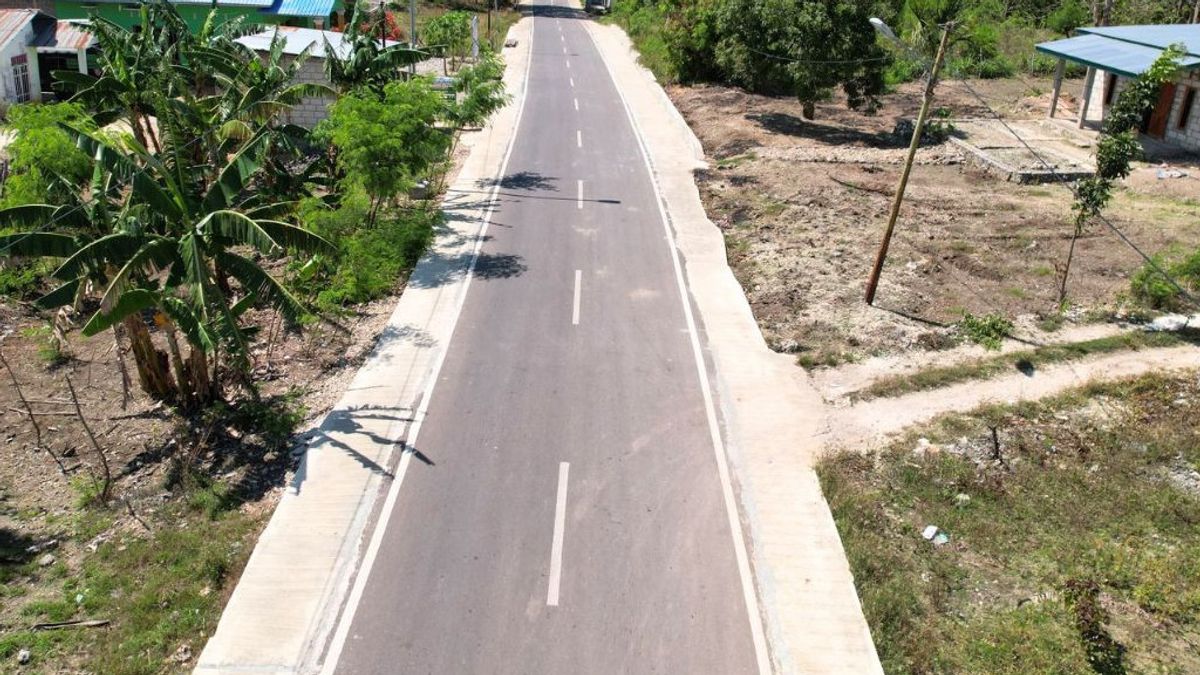


JAKARTA - The Ministry of Public Works (PU) has gradually begun to work on regional road handling in accordance with Presidential Instruction (Inpres) No. 11 of 2025 concerning the Acceleration of Increasing Regional Road Connectivity.
The Regional Road Inpres Program (IJD) as part of the government's efforts to improve connectivity between regions and improve the quality of regional roads and strengthen the national supply chain, in order to support food security.
"The Presidential Instruction of Regional Roads according to the President's direction is focused on supporting food security. So, the thematic thing is this year is more or less food security," said PU Minister Dody Hanggodo in Jakarta, quoted on Saturday, November 1.
Dody explained that the 2025 IJD program was carried out in stages through increasing regional road connectivity. Phase 1 covers 234 activities with a total length of 711.02 kilometers of roads and 148.42 meters of bridges and involves more than 14,333 local workers.
While the IJD Phase 2 consists of 193 activities, covering 567.73 kilometers of roads and 6.8 meters of bridges, which absorb more than 8,562 local workers.
"The IJD program not only improves roads, but also opens new economic access. Stable road infrastructure will facilitate the distribution of agricultural products, accelerate logistics mobility and grow new economic centers in the regions," he said.
SEE ALSO:
-
 | EKONOMI
Kementerian PU Sebut Pembangunan Irigasi Berjalan Lambat lantaran Banyak Data Bermasalah
01 November 2025, 10:30 -
 | BERITA
Longsor Jalan Banjarbaru-Batulicin, PUPR Kalsel Timbun Jalan-Pasang Rambu-rambu Lalin
31 Oktober 2025, 15:37 -
 | EKONOMI
Menkop Pede Percepatan Operasionalisasi Kopdes Bakal Bantu Pengendalian Inflasi
27 Oktober 2025, 19:27
The presence of the IJD is targeted to be able to reduce the road availability backlog in Indonesia. Currently, the national road level has reached 95.22 percent, while provincial and district/city roads are still at 69.64 percent.
Through the IJD Program, the government is committed to reducing this gap by directing more than 70 percent to support national food areas, while the rest is focused on developing the tourism, industrial and transmigration sectors.
It is hoped that, with increased efficiency in distribution of foodstuffs and production products, the regions can strengthen the foundation towards national food self-sufficiency and more equitable economic growth throughout Indonesia.
The English, Chinese, Japanese, Arabic, and French versions are automatically generated by the AI. So there may still be inaccuracies in translating, please always see Indonesian as our main language. (system supported by DigitalSiber.id)
Most Popular Tags
#Prabowo Subianto #donald trump #Febrie Adriansyah #8791 #giias 2026Popular


