
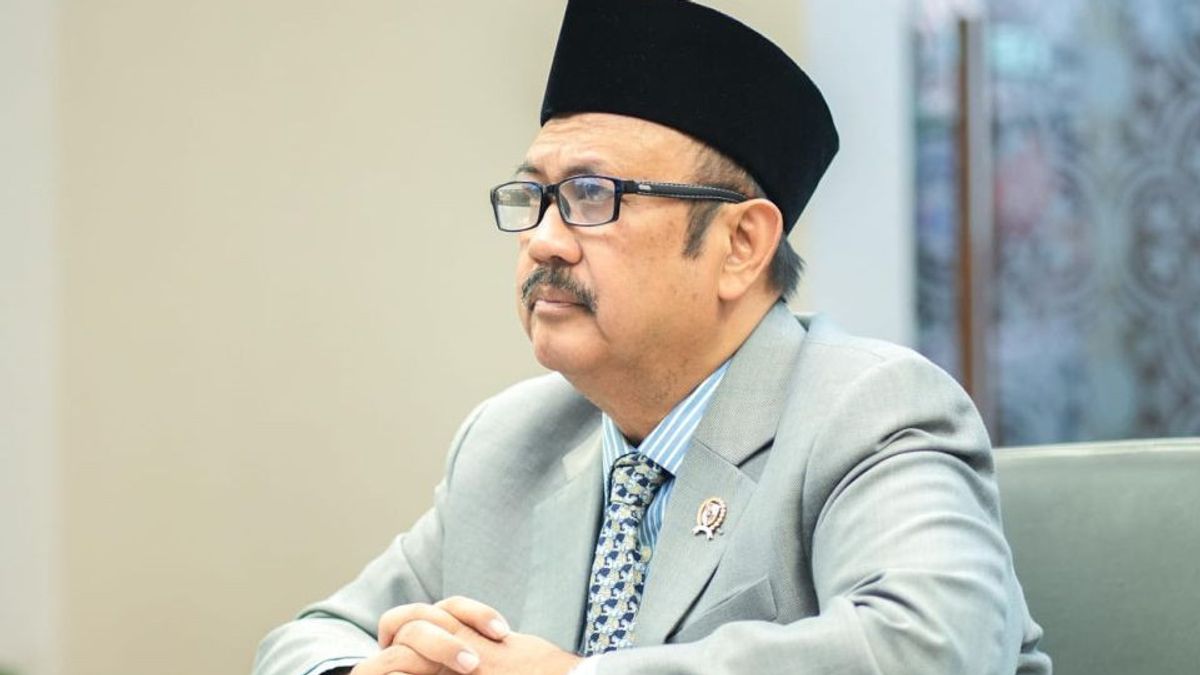


JAKARTA - Minister of National Development Planning/Head of the National Development Planning Agency (PPN/Bappenas) Rachmat Pambudy said that increased productivity must be accompanied by ecosystem improvements.
"Productivity is not just knowledge, it's a mindset. It's not just a mindset, it's a culture. It's not just a culture, it's a habit. It's not just a habit, this (must be practiced). Not only practice, but ecosystem, our structure," he said in the launch agenda of the National Productivity Master Plan Document at the Bappenas Building, Jakarta, quoted by Antara, Tuesday, October 7.
On this occasion, he questioned why Indonesians are more productive, diligent, and orderly, if they live in other countries. If they used to litter in Indonesia, for example, but it could become cleaner if they lived in certain countries.
According to Rachmat Pambudy, one of the main factors that causes changes in behavior is the strength of the ecosystem or structure, so that they become more obedient.
The head of Bappenas is also surprised about the need for up to millions of computer shopping in Indonesia, but no special factory has yet assembled the goods domestically.
"So it's not that we are not productive, we don't have any partiality to be productive. There is no willingness yet to be productive," he said.
For the Minister of VAT, efforts to be productive and independent can take the example of Indonesian President Prabowo Subianto when he was still Minister of Defense (Menhan) for the 2020-2024 period.
Although there is not enough ecosystem to produce cars, he continued, the President proves that Indonesia is capable of producing a four-wheeled vehicle called Maung made by PT Pindad.
Therefore, he hopes that the National Productivity Master Plan can be a guide for stakeholders to improve the ecosystem so that it can be formed in its entirety.
"The key to economic growth is productivity," he said.
SEE ALSO:
-
 | EKONOMI
IFG Tunjuk Leonardo Henry Gavaza jadi Direktur Keuangan PT Askrindo
22 November 2024, 20:47
Referring to the 1980-1990s period, when Indonesia was said to be very productive, it was because the ecosystem encouraged it to be productive, reflected in high economic growth and low and maintained inflation.
It was noted that Indonesia's economic growth average reached 8.1 percent during the 1968-1979 period. Entering the 1980-1990s decade, Indonesia's economic growth even touched 9.88 percent, which was influenced by export diversification policies, food self-sufficiency, and banking, financial, and trade deregulation, thus providing convenience in investment.
For Total Factor Productivity (TFP) in 1993, Indonesia had reached 1.4, above China which was only 1.39, Malaysia 1.24, India 0.94, and Vietnam 1.19. As for 2022, TFP Indonesia fell to 1.05, defeated by Vietnam 1.17, Malaysia 1.69, South Korea 2.09, India 2.18, and China 2.52.
The English, Chinese, Japanese, Arabic, and French versions are automatically generated by the AI. So there may still be inaccuracies in translating, please always see Indonesian as our main language. (system supported by DigitalSiber.id)
Popular


