

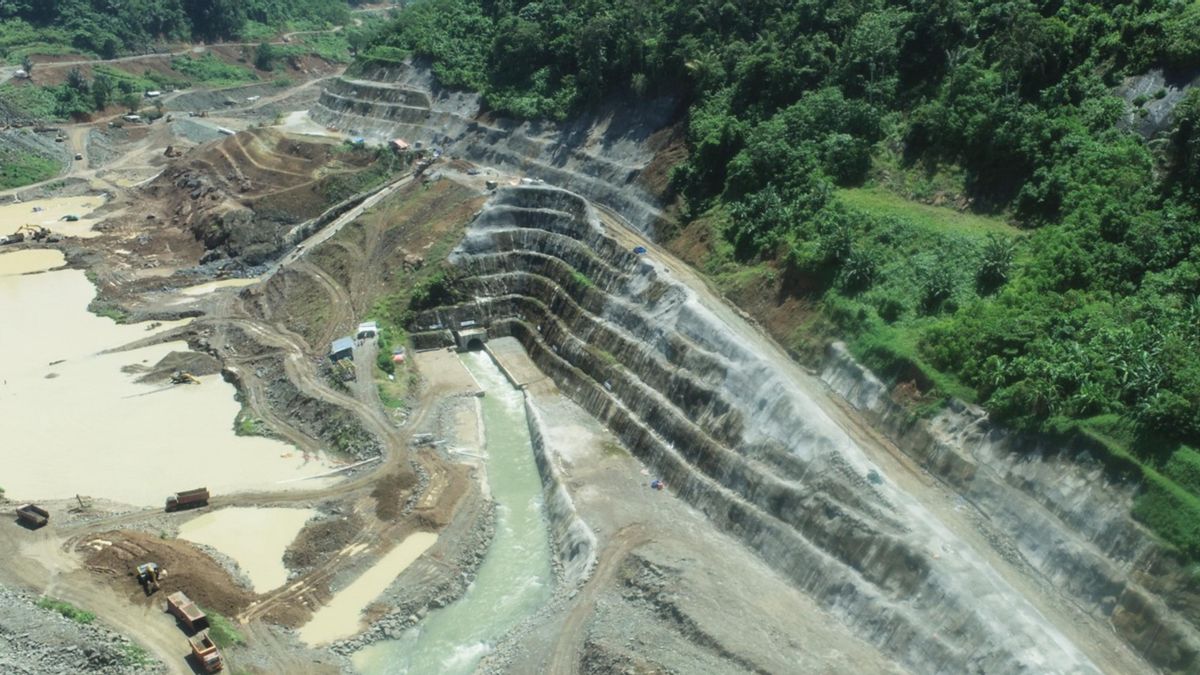


JAKARTA - The construction of the Budong-Budong Dam, which is located in Topoyo District, Mamuju Regency, West Sulawesi (Sulbar), continues to be completed. As of the end of August 2025, the progress of the construction of the first dam in West Sulawesi has reached 63.11 percent and is targeted for completion in 2027.
Minister of Public Works (PU) Dody Hanggodo said the dam construction was part of the government's long-term commitment to strengthening water security, supporting food security through increasing agricultural productivity and reducing floods.
"The Budong-Budong Dam is designed not only to control floods and provide raw water, but also to increase agricultural productivity (use) to support the national food self-sufficiency program launched by President Prabowo Subianto," said Dody in a written statement, Tuesday, September 9.
The dam, which is included in the list of national strategic projects (PSN), has an effective capacity of 47.25 million cubic meters, so that it can be used to supply irrigation water, raw water, flood control while supporting hydro-powered power plants (PLTMH).
Later, the Budong-Budong Dam will be used to support the development of the Budong-Budong irrigation area (DI) covering an area of 3,047 hectares (ha) and has a raw water potential of 410 liters per second.
In addition to irrigation and raw water supply, the construction of the dam is also very much needed to reduce flooding with disaster-prone areas, such as Budong-Budong, Topoyo and Karossa sub-districts, up to 330.87 cubic meters per second and have a potential for PLTMH of 0.60 MW.
SEE ALSO:



The construction of the Budong-Budong Dam construction has been started since December 8, 2020. The Central Mamuju Regency area has been passed by seven rivers, namely the Budong-Budong, Lumu, Karama, Karossa, Benggaulu, Kamansi and Panggajoang rivers, which flow from hilly areas in the east to the coastal areas of the West and empties in the waters of the Makassar Strait.
The Budong-Budong Dam was built by stemming the Salulebbo River which is a tributary of the Budong-Budong river.
The English, Chinese, Japanese, Arabic, and French versions are automatically generated by the AI. So there may still be inaccuracies in translating, please always see Indonesian as our main language. (system supported by DigitalSiber.id)
Popular


