

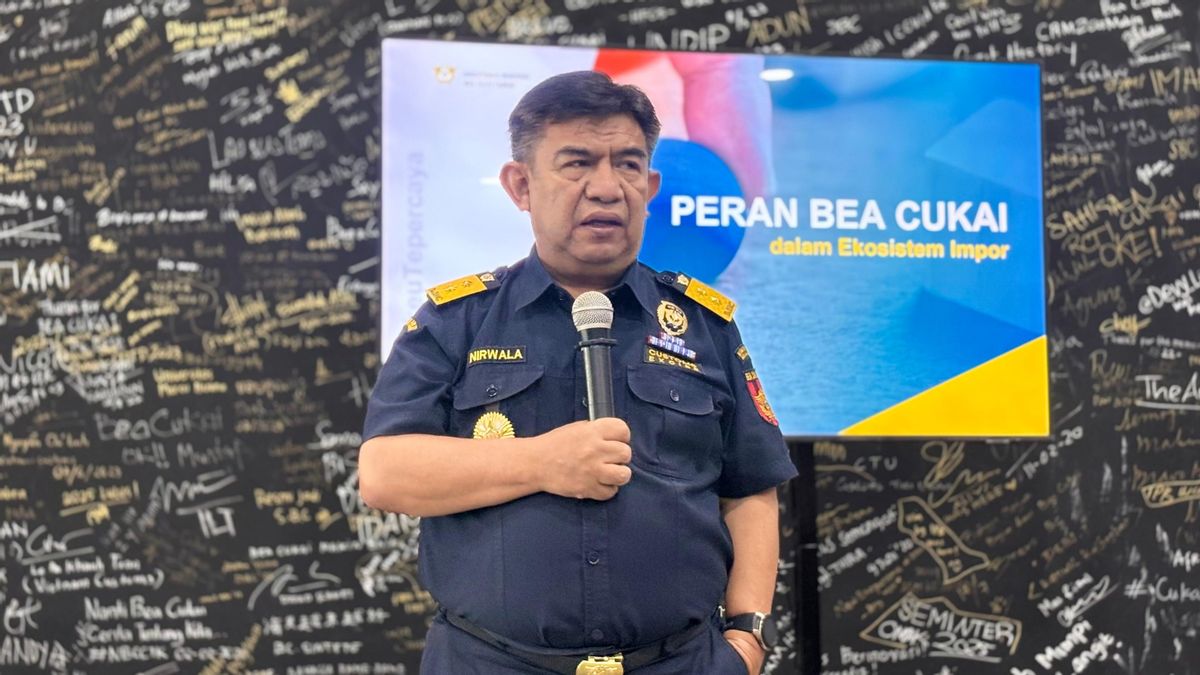


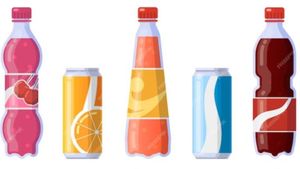
JAKARTA - The Directorate General of Customs and Excise (DJBC) has opened its voice regarding the plan to apply excise duty on packaged sweetened drinks (MBDK).
Director of Communication and Guidance for Customs Service Users Nirwala Dwi Heryanto explained that this policy not only targets bottled drinks, but also includes products in the form of concentrate and powder.
He gave an example, including Pocari Sweat in the form of concentrate and Nutrisari as instant powder drinks and excise imposition will be based on sugar levels after the product is dissolved according to the recommended dose.
Nirwala emphasized that the form of the product, whether liquid, concentrat, or powder, does not exempt excise duty if it contains sugar at a certain level.
"So what is called a sweetened drink in packaging, including concentrate, plusappropriation will still be the size of sugar in the milliliter of water. If the concentrate, for example, is like Pocari Sweat, which in the form of a Nutrisari sachet of all kinds is affected. Thedar will be if it is diluted according to the dose, how much? That's it," he said in Media Briefing at the Customs Headquarters, Thursday, September 4.
Meanwhile, he explained that traditional drinks that contain sweeteners are not included in excise objects.
However, it has not been explained in detail the type of traditional drink in question.
"No traditional drink. So the definition of excise duty must be clear, some are released, some are not collected," he said.
However, Nirwala conveyed that the implementation process still needed to be discussed with Commission XI of the DPR RI, as well as the preparation of derivative regulations such as Government Regulation (PP) and Regulation of the Minister of Finance (PMK).
He added that the drafting of this regulation will be carried out with the cross-ministerial team to determine product criteria that will be subject to excise, including considering the impact on the industrial sector.
"So the law will have to have a PP (Government Regulation) preparation, because the preparation of the PP means that there must be an initiative and then later there will be a committee between ministries so that everything related to the MBDK will be invited to all," he said.
"Because when we talk about PP later, it must be clear what the limits on excise goods are, what are they like, that's all? It's like plastic in the past, of course, at that time the Ministry of Industry was against it Because with plastic, with the plastic imposed on plastic, the industry automatically doesn't develop as expected, right," he added.
Furthermore, Nirwala stated that the implementation of this policy would also take into account the economic conditions and dynamics of national politics.
He gave an example of the discourse on the imposition of MBDK excise that has been rolling since the last few years, as is the case with the plastic excise which has been planned since 2017.
"Yes, of course, it's like MBDK, right? It's not just this year (the discourse of imposition). It's been 2-3 years since it's been in, plastic and even 2017, right? That's certainly going to consider everything. Especially from the economy. Continue to include the political conditions of all kinds. Yes, that will be taken into account, "he said.
According to him, the amount of excise tariffs will only be determined after the target for state revenue from the excise sector is set in the State Revenue and Expenditure Budget (APBN).
SEE ALSO:
-
 | EKONOMI
Resmi, Pemerintah Batalkan Implementasi Cukai Minuman Berpemanis di 2025
17 Juni 2025, 18:23 -
 | EKONOMI
Dampak Cukai Minuman Berpemanis, Perlindungan Kesehatan atau Beban Baru
19 Februari 2025, 20:08 -
 | EKONOMI
Cukai MBDK Mulai Berlaku Semester II-2025, Kemenperin: Kami Belum Dengar
13 Januari 2025, 17:05

Dia menyampaikan penentuan tarif tersebut akan mempertimbangkan aspek kesehatan masyarakat, kondisi industri, serta target penerimaan negara.
“Nanti ditentukan dulu target penerimaannya berapa? Terus baru dihitung untuk mencapai target itu gimana caranya. Ini nanti bicara kan bersama kan? Dengan tetap mempertimbangkan tadi faktor kesehatan, faktor industri-nya, faktor penerimaannya gitu kan. Jadi, diketok dulu APBN-nya baru fix oh berapa sih targetnya, iya kan? Baru dari situ,” jelasnya.
SEE ALSO:
-
| EKONOMI
Resmi, Pemerintah Batalkan Implementasi Cukai Minuman Berpemanis di 2025
17 Juni 2025, 18:23 -
| EKONOMI
Dampak Cukai Minuman Berpemanis, Perlindungan Kesehatan atau Beban Baru
19 Februari 2025, 20:08 -
| EKONOMI
Cukai MBDK Mulai Berlaku Semester II-2025, Kemenperin: Kami Belum Dengar
13 Januari 2025, 17:05
He conveyed that the determination of the tariff would consider aspects of public health, industrial conditions, and state revenue targets.
"Later, how much is the revenue target determined? Then it is calculated how to achieve the target. This will talk together later, right? By still considering the health factor, the industrial factor, the revenue factor is right. So, the APBN is fixed first. Oh how much is the target, right? Just from there, "he explained.
The English, Chinese, Japanese, Arabic, and French versions are automatically generated by the AI. So there may still be inaccuracies in translating, please always see Indonesian as our main language. (system supported by DigitalSiber.id)
Popular


