
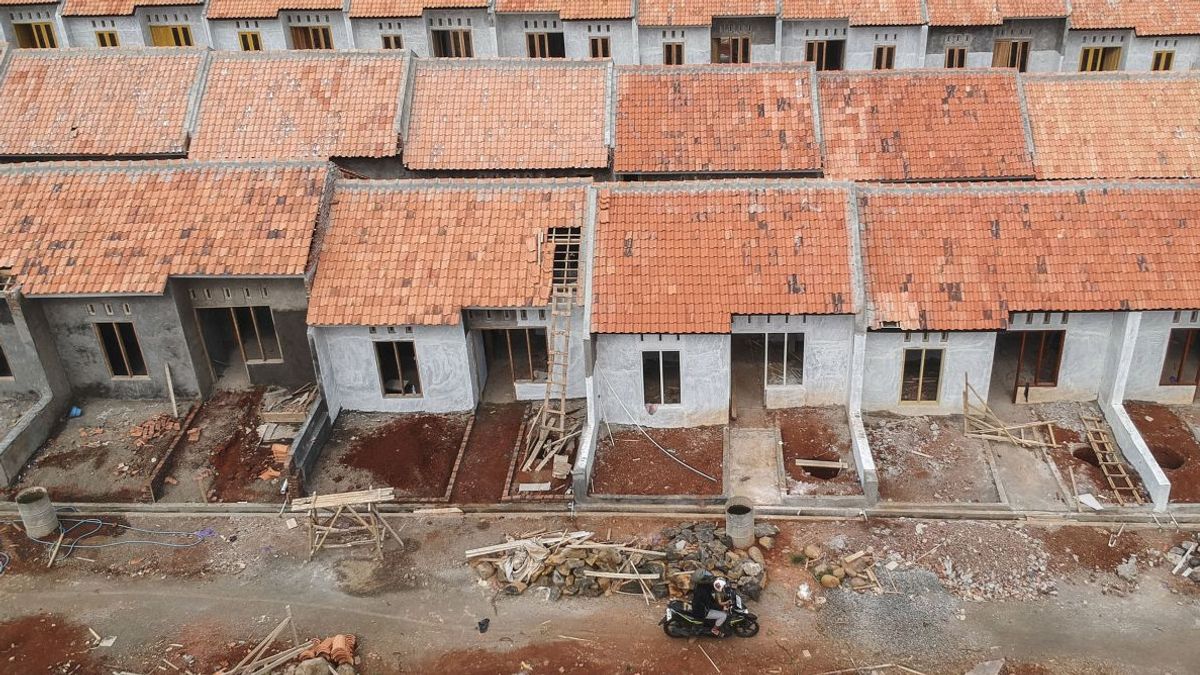


JAKARTA - Like a saying, prepare an umbrella before it rains. As soon as we as humans, we must prepare ourselves for all possibilities and uncertainties. This expression and signal was conveyed by Deputy Minister of Housing and Settlement Areas (Wamen PKP) Fahri Hamzah at the Regional Conference (Musda) XI REI DKI Jakarta 2025 which was held Thursday, August 7, 2025 at the JS Luwansa Hotel, Jakarta.
The activity, which was attended by a number of housing business actors, was entitled Optimizing the Role of REI DKI Jakarta in Realizing the Procurement of Decent Housing in the Urban City. Deputy Minister of PKP Fahri Hamzah stated that the Ministry of PKP's plan was related to the provision of 3 million houses.
The big idea of Prabowo's government through the Ministry of PKP is to accelerate the fulfillment of the needs of livable houses, especially for low-income people (MBR), so that people who work in the informal sector can also benefit from housing programs in Indonesia in the form of building flats, self-help houses, public and commercial houses, as well as special houses.
In front of the participants of the DKI Jakarta REI Musda, Deputy Minister of PKP Fahri Hamzah, said that the administration of President Prabowo Subianto has allocated a fairly large budget in fulfilling the construction of 3 million houses in the 2026 RAPBN with the focus of the 2026 Housing Priority Program as follows:
1. Provision of healthy, safe, and comfortable housing; 2. banking support and the business world;3. Ownership of a decent and affordable MBR house;4. Ecosystem housing that is in harmony between supply and demand.
The good news was conveyed by President Prabowo Subianto at the State Speech on August 17, 2025. The budget allocation plan of Rp 57.7 T is certainly good news for the wider community and businesses in the property and housing sectors.
This strategic program is intended to overcome housing backlogs that require the handling or intervention of government policies so that housing backlog numbers experience a decline in the years to come.
It should be realized that the handling of housing backlog requires the collaboration of all stakeholders in the housing sector, starting from the central government, local governments, developers, banks, the community and the private sector. Technically, the housing ecosystem was built by three industrial power entities, namely construction, infrastructure, and property.
On the occasion of MUSDA REI DKI Deputy Minister of PKP Fahri Hamzah conveyed that there will be a Government plan to form a Housing BUMN to accelerate the program of providing 3 million houses which will be accelerated by establishing a Housing SOE as off-taker in housing development, especially in urban areas. Through state-owned Housing, the government intends to accelerate the provision of livable houses through the implementation of innovative housing supply schemes. This is done by increasing partnerships and collaboration between stakeholders.
The critical question is where is the role and position of developers (developers) as business actors? In fact, developers will continue to play an important role in terms of providing housing supply (supply) which will later cooperate with state-owned enterprises or special agencies appointed by the government to absorb or buy housing built by developers or private parties through cooperation between state-owned Housing (BUMN) and the private sector.
In essence, housing development is best practices or more a knowledge and competence of developers or industry players. We agree that the government's main task is not to turn itself into a real estate developer. However, it is further becoming a policy designer and implementing a series of rules that can drive the economy in a sustainable manner, encouraging entrepreneurship and market power.
The idea of forming a state-owned housing company immediately sparked public discussions, especially developers who are members of the DKI Jakarta REI and a number of media crews with two basic questions that need to be answered.
First, does the government have enough funds to finance the purchase of housing to be carried out by the state-appointed BUMN? However, this has been answered in the 2026 RAPBN as previously stated.
Second, what is the mechanism for cooperation between private parties, in this case REI members, for example with SOEs as off takers?
In a discussion with the Deputy Minister of PKP, it was answered that apart from being off taker, this BUMN Housing will offer private parties to build housing units according to community needs. Development locations, sizes and types of housing will be determined by the government which will be implemented by the Housing BUMN.
Another question is how much will the house cost be agreed on, is it still using policies that have been in effect for Very Simple Homes (RSS) and Housing Financing Liquidity Facilities (FLPP)?
Of course there are still many technical issues that must be found to solve between state-owned Housing and business actors so that this collaboration runs well and smoothly which in the end can make Prabowo Government's campaign promise successful to provide decent housing to citizens.
It is realized that the housing and property sector has a significant chain impact (multiplier effect) on the economy, contributing around 14-16 percent to Gross Domestic Product and about 9.3 percent of the total tax revenue or IDR 185 trillion per year. The housing sector is also recorded to contribute to Regional Original Revenue (PAD), which is around 31.9 percent of the total PAD.
Citing data from the Central Statistics Agency (BPS), DKI Jakarta is among the top 10 provinces with the lowest house ownership rate in Indonesia until 2023, with a percentage of 56.57 percent. Followed by North Sumatra (71.48 percent), and West Sumatra (72.61 percent). This is an opportunity as well as a challenge to present a habitable house for all levels of society, including Jakarta.
Badminton=
The author is Chandra Rambey, Deputy Chair of International Research and Relations of DPD REI DKI Jakarta & CEO of PT Provalindo Nusa
The English, Chinese, Japanese, Arabic, and French versions are automatically generated by the AI. So there may still be inaccuracies in translating, please always see Indonesian as our main language. (system supported by DigitalSiber.id)
Popular


