

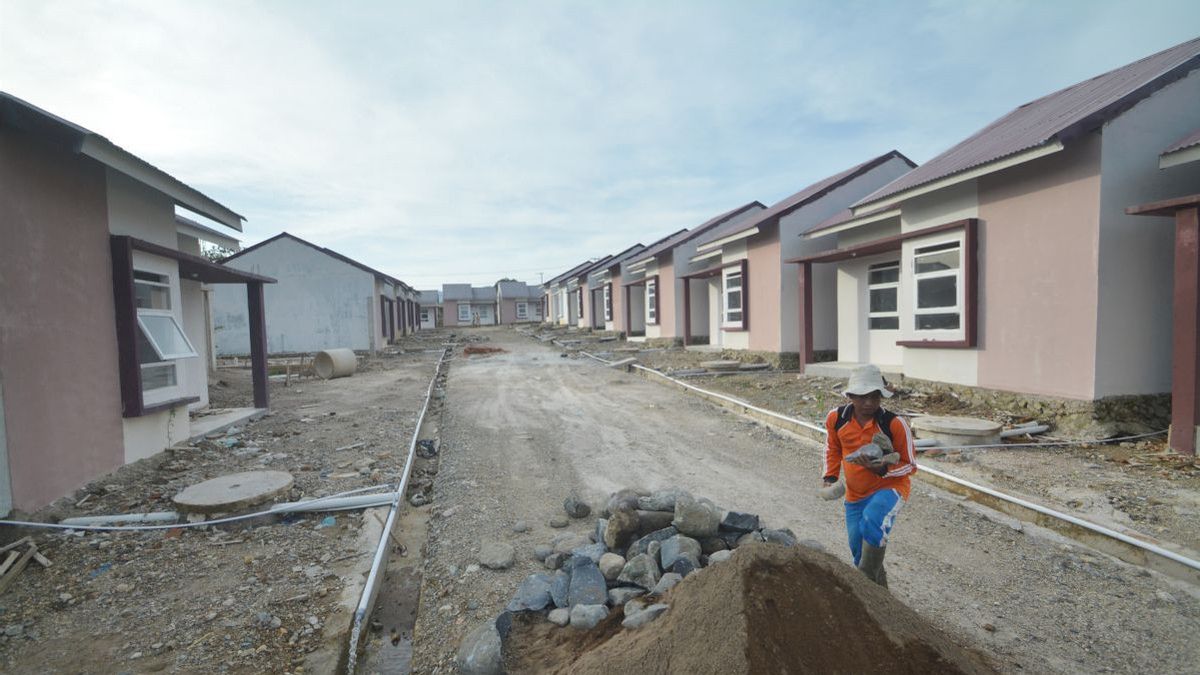


JAKARTA - The People's Housing Savings Management Agency (BP Tapera) conveyed a number of challenges in the housing sector that have not been resolved to date.
Commissioner of the People's Housing Savings Management Agency (BP Tapera) Heru Pudyo Nugroho said, there are at least four challenges that are still the government's homework to be resolved immediately.
Here are the four challenges:
1. Regarding the housing backlog
To date, the housing backlog has recorded 6.98 million households. Not only that, there are still 29.56 million households who still live in uninhabitable houses (RTLH).
"The challenge was that maybe we were still facing a backlog of 6.98 million households, 29.56 million households still living in uninhabitable houses. Well, later the approach will be different," said Heru at the BP Tapera Sarasehan event entitled "Building Collaboration and Synergy Between Institutions in the Success of the 3 Million House Program" in Jakarta, Thursday, July 17.
According to Heru, President Prabowo Subianto's 3 Million House Program could be a solution to overcome the backlog problem.
"So, the 3 Million Houses Program that was built was approximately 1 million, the 2 million were repairs for uninhabitable houses in order to overcome this backlog, which was 29.56 million households living in RTLH," he said.
2. Regarding the source of mortgage financing, it is not yet competitive
It is known, until now there is still a property mismatch for housing financing. This means that currently, the housing sector still relies a lot on financing from banks.
Meanwhile, said Heru, most of the banking funds are third-party funds in the short term.
"Meanwhile, the mortgage is long-term financing, 10 years, 15 years and even 30 years. Well, there is a maturity mismatch there which is still a challenge," he said.
In addition, Heru explained, the high interest rate is also a challenge for low-income people (MBR) to be able to own a house.
"Then the KPR interest rate is still high, which of course is a challenge in how MBR has limited purchasing power to be able to get a house. From there the government program is present, namely FLPP," explained Heru.
3. People's purchasing power access inequality
According to Heru, the increase in house prices is not accompanied by an increase in people's income. Thus, the ability of people to buy houses is very small.
"The increase in house prices is higher than the increase in income, yes, this is also a challenge. We will continue to review this," said Heru.
He considered that the government needed to review the actual price of houses per region in 2023. Given that there is an increase in inflation every year.
"We will need to review the automata later on adjusting the price of the house, of course, it is related to the latest data from the Central Statistics Agency (BPS)," he said.
4. Demographical transition to urban
Heru said the level of urbanization to urban areas was not in line with the availability of land.
So, he said, in the future the concept of housing in urban areas will be directed to urban housing. This means that the approach is no longer a landed house, but rather a direction to a vertical house.
SEE ALSO:
"But, most of our people's culture is still the mindset of the house, yes, it has to be kicked out on earth, not up. This is also a challenge in the future, if in urban areas, yes, like it or not, the mindset must live in a vertical house," explained Heru.
Therefore, he continued, President Prabowo Subianto's 3 Million House Program is believed to be a solution to solve these problems.
"Pak Prabowo wants to solve the problems of this people's housing, because it is the mandate of the Law with a more active program, a more massive program that can be directly felt by the people, namely through the 3 Million Houses Program," he concluded.
The English, Chinese, Japanese, Arabic, and French versions are automatically generated by the AI. So there may still be inaccuracies in translating, please always see Indonesian as our main language. (system supported by DigitalSiber.id)


