


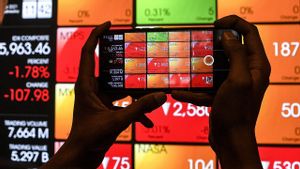
JAKARTA - The Composite Stock Price Index (JCI) is projected to be sluggish after the Eid holiday. Moreover, during the Eid holidays there was disruption in the global stock market due to several sentiments such as the imposition of the reciprocal tariff of the President of the United States (US) Donald Trump against various countries.
According to Head Customer Literacy and Education Kiwoom Sekuritas Indonesia, Oktavianus Audi, this tariff is enforced in relation to Indonesia's non-oil and gas trade surplus with the US which reached 16.84 billion US dollars, with a total surplus of Indonesia for 2024 of 31.04 billion US dollars.
"So we see the impact will be significant on: export producers, CAD swelling and so depreciation of Rupiah," he told VOI, Tuesday, April 8.
Another sentiment, Audi said, is that the weakening of energy commodity prices, especially crude oil, after OPEC+ announced plans to increase oil production by 440,000 barrels per day starting May 2025.
In addition, Audi said Indonesia's flagship commodity prices, such as coal, fell to 97 US dollars per ton, copper which fell 9 percent, CPO which fell again below MYR 4,300 per ton, and nickel which was depressed to below the psychological level of 15,000 US dollars per ton.
Audi added that like a warning from the Federal Reserve, in which Jerome Powell in his speech previously expressed concern about the economic slowdown and rising US inflation that could increase the potential for global economic turmoil.
"The impact of the BI rate is likely to be in line, so the cost of funds will remain high which will slow the activity of issuers and the economy," he explained.
Audi predicts the market will begin to respond to these impacts on the opening day of the stock exchange after the Eid holiday where the Composite Stock Price Index (JCI) is expected to tend to weaken with psychological support in the range of 6,000-6,100 and resistance at the level of 6,600-6,670.
"Even if on April 8, the JCI has a psychological response, then we see a bearish scenario of 5,700-5,750 levels. Foreign pressure also has the potential to continue as economic uncertainty increases," he said.
According to him, market concerns regarding the slowdown in GDP growth have also increased, even Nomura Asia cut Indonesia's growth projection to 4.7 percent yoy from the previous 4.9 percent yoy for 2025 due to the impact of US reciprocal rates.
In addition, Audi said that the pressure on the rupiah continued, and even touched the level of Rp. 16,700 on April 4.
In terms of regulators, Audi said the IDX is expected to carry out a trading stop in the event of a fairly large market pressure on April 8. In addition, the implementation of intraday short selling can be postponed, as happened in Taiwan when the market corrected around 10 percent, by limiting short selling.
Under these conditions, Audi said investors were advised to take defensive steps by wait and see until the release of the performance in the first quarter of 2025, and if the issuer's performance, especially the blue chip, remains resilient, it can begin to accumulate shares at a discounted price.
SEE ALSO:
-
 | EKONOMI
Usai Libur Panjang, IHSG Diprediksi Tertekan Imbas Sentimen Negatif Tarif Trump
08 April 2025, 07:07 -
 | EKONOMI
Pengamat Prediksi IHSG Anjlok Hingga 3 Persen Akibat Tarif Impor Trump
03 April 2025, 11:57
Then, Audi said that investors can diversify assets to risk-free and safe havens instruments such as government and gold bonds.
"If there is a position, especially in big caps shares, you can hold the HOLD by waiting for the averaging down momentum, and avoiding issuers with debts in large US dollars (>50 percent total debt), especially with DER >1x," he said.
Until now, Audi said that the defensive sector is expected to be quite resilient in its stock price movements, especially outside the banking sector for long-term accumulations such as sectors that are recommended to be considered including non-cyclical health, utilities, and consumers.
The English, Chinese, Japanese, Arabic, and French versions are automatically generated by the AI. So there may still be inaccuracies in translating, please always see Indonesian as our main language. (system supported by DigitalSiber.id)
Most Popular Tags
#Prabowo Subianto #donald trump #firearm #8791 #giias 2026Popular


