


JAKARTA - The idea of stopping the spread of modern minimarket businesses in rural areas, which was discussed by the Minister of Villages and Regional Development (Mendes PDT) Yandri Susanto, is considered risky by some circles.
This issue first surfaced in November 2025 when Commission V of the DPR held a meeting with Mendes PDT Yandri, one of whose discussions was about the expansion of minimarkets to remote areas of villages.
During the meeting, Yandri claimed that the very massive expansion of minimarkets could threaten the development of the Red and White Village Cooperative (KDMP). According to him, the development of KDMP will not run optimally if the expansion of minimarkets is not regulated.
"What are we building Kopdes for, but Alfamart and Indomaret or the like are rampant? Yes, that means yes, not apples to apples, actually, if they are very big and very monopolized so far, yes, of course it will be a threat to Kopdes," he said.
"I agree with the road Kopdes, Alfamart is enough to get there, there are more than 20,000 Alfamart and Indomaret. And it's amazing that it's rampant, he's again, he's again, he's again. That's right. His wealth is too much for this Republic, "continued Yandri.
This discourse was again echoed by Mendes Yandri in February 2026. He asked that the permit for minimarkets not be given. This policy needs to be taken in order to protect village grocery traders who are losing out on competition due to the expansion of modern retail.
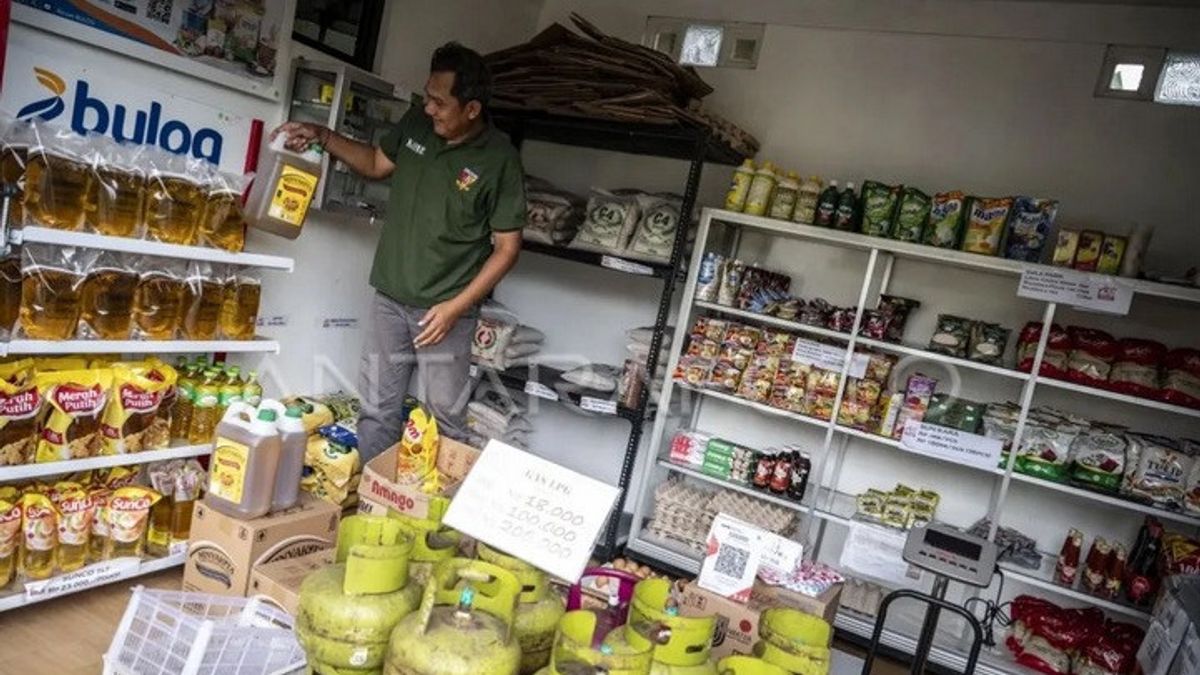
Threat to Small BusinessesThe Executive Director of the Center of Economic and Law Studies (CELIOS) Bhima Yudhistira sees the existence of KDMP as a threat to small businesses in villages, such as UMKM stalls and fertilizer agents.
Modern minimarkets, such as Alfamart and Indomaret, according to Bhima, are not competitors of KDMP because in modern minimarkets they do not sell all subsidized products such as subsidized fertilizers. He actually sees the potential for problems between KDMP and UMKM stalls and village-level fertilizer agents.
Another concern is the difference in selling prices at KDMP and local stalls. Bhima said KDMP could offer cheaper prices because it got the goods directly from the main distributor, while local stalls had to go through a longer supply chain, so their selling prices were higher.
That way, local stalls are under economic pressure. "This is a predator to small businesses in the village. It is impossible for stalls to get cheap prices compared to Kopdes because the supply chain is different," Bhima told VOI.
Bhima added that the purpose of this policy looks like hindering the expansion of modern minimarkets, even though the negative effects are more felt on traditional stalls which are actually victims of price competition.
He gave an example, KDMP received goods directly from the main distributor. Subsidized products such as oil, fertilizer, or 3 kg LPG are purchased by KDMP at a low price, because they are at the first level of the supply chain.
Meanwhile, local stalls get goods from distributors at level four or five. Local stalls have to go through several intermediaries, so that the purchase price is higher and their profit margins are smaller. As a result, KDMP can sell cheaper, while stalls find it difficult to compete.
Instead of empowering MSMEs, according to Bhima, this situation has the potential to disrupt the local economic balance and make the village economy more dependent on the KDMP.
"Kopdes is just a cover to reduce the expansion of modern minimarkets. In fact, the high-risk effect is actually in informal stalls. The government should calculate how many stalls and pharmacies have gone bankrupt because of kopdes," he continued.
Violating the Right to WorkIn the midst of discussions about slowing down the expansion of modern retail, Minister of Cooperatives and SMEs Ferry Juliantono made another statement. He emphasized that the government does not plan to stop the expansion of modern retail, but only regulates it, especially in rural areas.
However, the difference in statements between officials has created confusion and has the potential to disrupt the investment climate, according to the Riau University economist, Dahlan Tampubolon.
"If one official talks about A, the other talks about B, this raises questions. Investors need legal certainty and policy consistency. Don't let the narrative that develops make it a mess," said Dahlan.
The discussion of stopping modern retail operations is also not a simple matter. Dahlan reminded, in the 1945 Constitution, Padal 28D paragraph 1 guarantees fair legal certainty for every citizen. In addition, Article 33 of the 1945 Constitution does not give the mandate for the state to shut down legitimate private business actors for the interests of certain business entities.
"Indomaret and Alfamart operate with official permits, pay taxes, and absorb hundreds of thousands of workers. If there is a policy of forced closure without legal basis and compensation, it has the potential to violate the right to work," he explained.
Dahlan also touched on the provisions in Law Number 5 of 1999 concerning Prohibition of Monopoly Practices and Unhealthy Business Competition. If the policy is carried out by restricting or eliminating certain business actors in order to give exclusive space to other parties, then it can be considered contrary to the principle of healthy business competition.
Dahlan also highlighted that the narrative of "people's economy versus big corporations" is indeed easy to accept emotionally. However, public policy, cannot be built only on sentiment.
"Modern retail is not solely owned by large financiers. Many outlets are owned by local investors through partnership schemes. If it is closed, the impact will also be felt by the local community," he said.
The English, Chinese, Japanese, Arabic, and French versions are automatically generated by the AI. So there may still be inaccuracies in translating, please always see Indonesian as our main language. (system supported by DigitalSiber.id)
Most Popular Tags
#Prabowo Subianto #donald trump #Febrie Adriansyah #8791 #giias 2026Popular


