
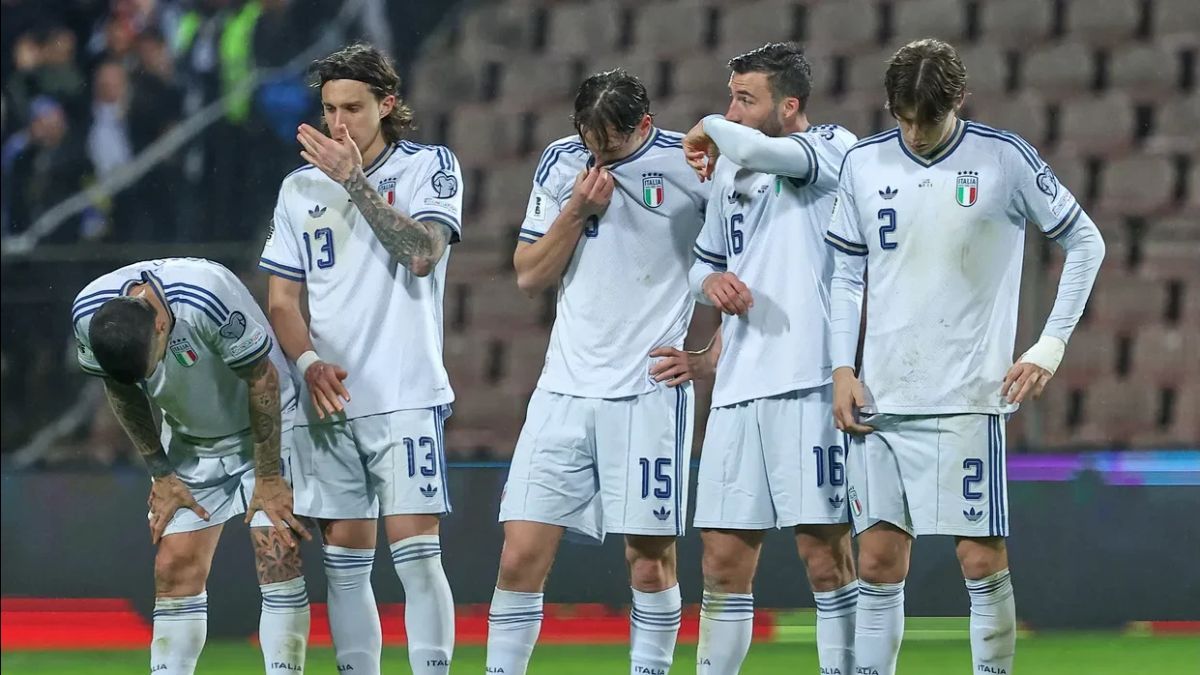


JAKARTA - The Italian National Team became the only World Cup champion who failed to advance to the final round for three consecutive periods following the defeat of Bosnia Herzegovina in the playoff.
Esmir Bajraktarevic's goal in the penalty shootout ensured Bosnia advanced to the world's biggest football event for the second time in their history. Edin Dzeko and his colleagues then joined Group B with hosts Canada, Qatar, and Switzerland.
On the other hand, for Italy, that night at the Bilino Polje Stadium, Zenica, was a recurring nightmare for the third time in a row.
Italian defender Leonardo Spinazzola said with tears in his eyes, "I've been in the national team for nine years and I've never played in the World Cup. It's terrible. For Italy. For all of us."
None of Spinazzola's teammates spoke to reporters after the match, including captain Gianluigi Donnarumma. Anger and disappointment were one. Meanwhile, coach Gennaro Gattuso said this loss was "very painful" and "a hard blow to digest".
Italy is the only country in the top 19 in the world who are absent from the 2026 World Cup main round. In addition, for the first time, the team that has ever won the championship failed to appear at the World Cup for the third time in a row.
In fact, before this, Italy was the Mecca of football. The Serie A competition was even called the best league in the world in the 1990s to 2000s, with a number of stars, both from within and outside the country.
But since becoming champions for the fourth time at the 2006 World Cup, the Gli Azzurri's achievements have suffered a sharp decline. Italy had to go home first after failing in the group stage of the 2010 and 2014 World Cups.
Italy then failed to advance to the 2018 final round held in Russia. And, although they had lifted the Euro 2020 trophy after beating England in the final, Italy continued to have difficulties on the international stage.
Proven by their failure to appear in the Qatar World Cup two years later.
Player Academy and Stadium Modernization FailThere are many factors that are said to be the cause of the decline of Italian football. One of them is the coaching of players who in recent years have indeed become a latent problem in Italy.
Julien Laurens, European football expert, told BBC Sport: "The academies in Italy don't produce enough players, or players ready to play in the first team. The way they spend money is also not what we are used to seeing from Italian clubs."
In addition, many Italian clubs have also failed to modernize their stadiums. This certainly has an impact on commercial revenue. Former Juventus and Italy striker Alessandro Del Piero has also touched on this issue.
The declining income of Serie A clubs chose to bring in foreign players who started to pass their prime, and were recruited for free such as Luka Modric and Kevin De Bruyne.
This series of problems makes the Italian club no longer able to field a competitive team, especially at the European level. In the last 16 years, no Italian team has won the Champions League.
This season, Atalanta became the only representative of Serie A to advance to the last 16, before being crushed 10-2 by Bayern Munich in two legs.
"The problem? The stadium. We know you have to do better off the pitch (to improve) that. The system of coaching young players is also (better)," Del Piero said, talking about the problems of Italian football before the lapa.
Who should be responsible?So, who should be responsible for the decline of Italian football?
Back to August 2010. A week after the Azzurri finished in the middle of the group stage of the World Cup, which was filled with Paraguay, Slovakia, and New Zealand, Arrigo Sacchi was appointed as the junior national team coordinator and Roberto Baggio occupied the technical sector at the FIGC. He was tasked with studying and disseminating the best training for the development of coaches and players.
Sacchi, who won the European Cup twice as AC Milan coach, urged Italian clubs to invest in their academies while trying to shift the focus on the younger age group on results and tactics, to give individuals more room to have fun and hone their instincts.
Baggio, one of Italy's legendary former strikers, worked with around 50 collaborators to compile a 900-page document entitled "Updating the Future".
He proposed an ambitious overhaul of the talent development pipeline, including standardizing the scouting method, a more structured talent search network, and a shared digital database to measure player ability.
But he decided to resign in January 2013, because his project was said to have not worked at all after a year.
Repeated FailureAlessandro Del Piero could not hide his disappointment after Italy was confirmed to fail in the 2026 World Cup.
"The first time (failed) in 2018 we were surprised, the second time it felt like a nightmare, and this is the third one that started to feel embarrassing," said Del Piero.
"We are a very big force and finding ourselves here for the third time is really amazing," he continued.
Regarding the effort to produce young players, Del Piero found a fundamental problem in development. According to him, Italian football is too rigid in telling young players what to do, so this kills their creativity,"
"They are good at carrying out instructions, but once they get out of the system, they make mistakes and are labeled as bad players. This is not true," Del Piero continued.
Three consecutive failures are clearly a huge blow for Italy. And, the saddest thing about Italy's latest failure is that this is no longer the end of the glory days, but rather a sad song that is played over and over again.
The English, Chinese, Japanese, Arabic, and French versions are automatically generated by the AI. So there may still be inaccuracies in translating, please always see Indonesian as our main language. (system supported by DigitalSiber.id)
Most Popular Tags
#Prabowo Subianto #donald trump #firearm #8791 #giias 2026Popular


