
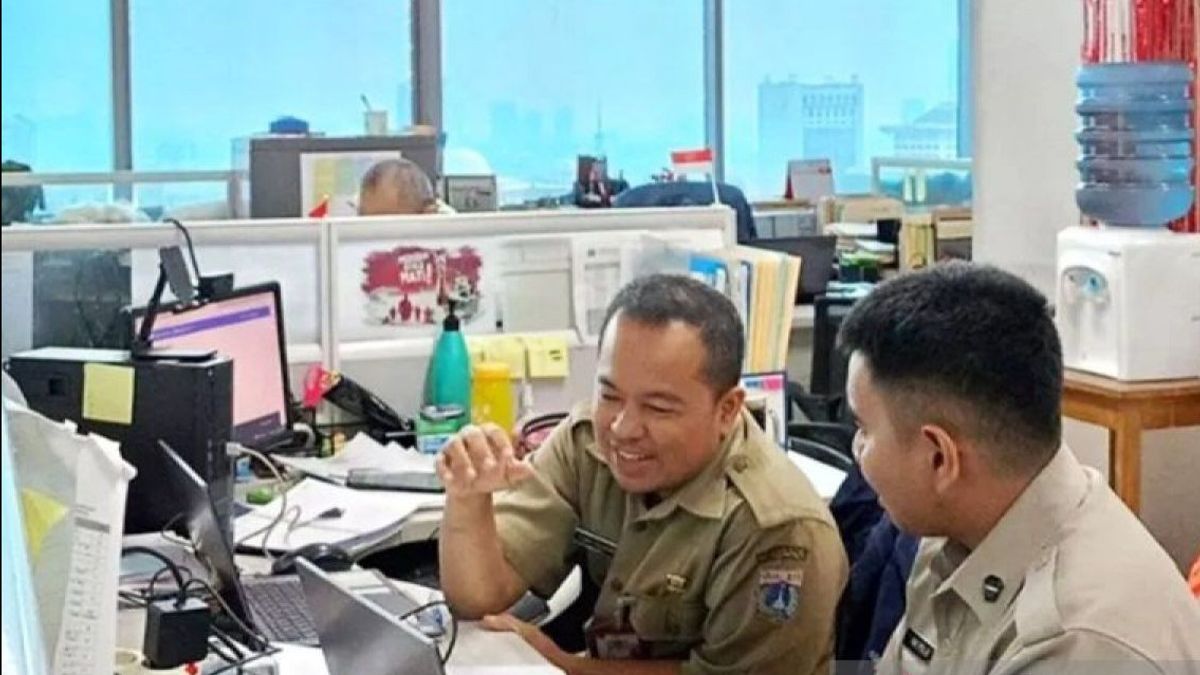


JAKARTA - The government plans to implement a work from home (WFH) policy for state civil servants (ASN) and the private sector for one day in a row. This is done to save fuel oil (BBM) use in the midst of uncertainty in global energy supply.
Since the conflict between the United States-Israel and Iran broke out, world oil prices have jumped sharply to reach the level of 100 US dollars to 117 US dollars per barrel. Based on the 2026 State Budget, every increase in oil prices of 1 US dollar per barrel increases the state's revenue by around Rp3.5 trillion. But at the same time it increases state spending by around Rp10.3 trillion. For information, in the 2026 State Budget simulation, the oil price is set at 70 US dollars per barrel.
This means that, net of this, the deficit could widen by around IDR 6.8 trillion for every increase of USD 1 per barrel.
Minister of Energy and Mineral Resources (ESDM) Bahlil Lahadalia also said that two Pertamina tanker ships were still unable to leave the Strait of Hormuz. Negotiations are still ongoing, said Bahlil.
On this basis, the government is discussing the implementation of WFH for ASN and private sector workers for one day a week starting next April.
Coordinating Minister for the Economy Airlangga Hartarto said this decision is aimed at reducing fuel consumption and work mobility. President Prabowo Subianto, according to him, also assessed the efficiency of WFH as quite significant because it could reduce about a fifth of the usual energy consumption.
Meanwhile, Minister of Finance Purbaya Yudhi Sadewa said that the implementation of WFH has the potential to save 20 percent of fuel consumption. How far will the WFH policy for ASN and private sector workers be effective in saving fuel consumption?
Full Challenge PolicyThe Director of the Center for Economic and Law Studies (CELIOS) said that the policy was not necessarily effective and could not be directly called to save 20 percent of fuel consumption. The government, said Huda, should first understand who consumes fuel.
"ASN employees, for example, will implement WFH once a week, how many ASN? Do they all use private vehicles?" said Huda when contacted by VOI.
Not to mention the private sector, which is the largest consumer with high employee mobility. In addition, logistics services that are indeed mobile every day.
"Then, schools will implement similar things, yes, parents will still have to work if they are in the private sector. So it is not effective either that the WFH policy is carried out to significantly reduce fuel consumption," he continued.
Similarly, Gadjah Mada University Energy Economics Observer, Fahmy Radhi, assessed that the WFH policy of one day a week would not be effective in saving fuel consumption.
The soaring world oil prices will certainly have a significant impact on the Indonesian economy. So this has an impact on the swelling of fuel subsidies in the state budget, raising prices in the country due to rising import prices or services, so that in the end it lowers people's purchasing power until the rupiah exchange rate weakens.
However, to face this challenge, it is not as easy as directing all ASN and private workers to work from home for one day a week consistently because it means changing the behavior of workers.
In addition, this policy is feared to be used by workers to implement work from anywhere (WFA) at tourist attractions because they can enjoy the long weekend.
"So fuel consumption cannot be significantly saved," he said.
Budget reallocationThis work scheme was actually implemented during the COVID-19 pandemic in 2020. After the pandemic, a number of institutions still enforce it on certain days. The WFH policy during the pandemic was successful, because at that time there was a forced variable, namely so that you are not infected with covid.
"While the forced variable does not exist in WFH now. Without it, it is very difficult to implement consistently," said Fahmy.
Fahmy also said that the one-day WFH policy for private workers working in the manufacturing sector has the potential to reduce work productivity. For workers in the transportation sector, including online motorcycle taxi services, small and medium enterprises (SMEs) stalls are also threatened with declining income if the one-day WFH policy is implemented.
On this basis, Fahmy asked the government to consider carefully the discourse on the WFH policy, by calculating it in a teliticost and benefit.
"Don't let the implementation of WFH provide benefits (benefits) for saving fuel subsidies, but other sectors that have to bear the cost," he asked.
On the other hand, Nailul Huda said there were several options that the government could take. First, accelerate the energy transition from fossil fuels to renewable energy (EBT). The momentum of rising world oil prices, according to Huda, should be a foothold to accelerate the use of EBT. Starting from industries that still use a lot of solar oil.
Second, require officials and ASN employees to use public transportation based on buses or trains to go to work.
"This will actually be economical and not cut the public service flow. Third, transfer MBG funds to fuel subsidies to maintain people's purchasing power," said Huda.
The English, Chinese, Japanese, Arabic, and French versions are automatically generated by the AI. So there may still be inaccuracies in translating, please always see Indonesian as our main language. (system supported by DigitalSiber.id)
Most Popular Tags
#Prabowo Subianto #donald trump #firearm #8791 #giias 2026Popular


