


JAKARTA - The statement of the seventh President of the Republic of Indonesia Joko Widodo (Jokowi) regarding the proposal to return the Corruption Eradication Commission Law (UU KPK) as it was before being revised in 2019 is considered an attempt to wash hands.
The discussion of returning the KPK Law to the format before the 2019 revision has resurfaced. This happened following the sharp spotlight on the performance of the anti-corruption agency because it was considered to have experienced a split.
The Chairman of the KPK for the period 2011-2015, Abraham Samad, said that the revision of Law Number 19 of 2019 concerning the KPK was the basis of the systematic paralysis of the eradication of corruption as well as the starting point for the amputation of the anti-corruption agency's authority.
"I said, if you want to see the KPK again, you can return the KPK law as it was before," said Abraham.
Meanwhile, responding to Abraham Samad's statement, Jokowi publicly stated that he agreed if the KPK rules were improved. "Yes, I agree, it's good," Jokowi replied after watching the Liga 1 match between Persis Solo against Madura United at the Manahan Stadium, Solo, Friday (13/2/2026).
However, Jokowi's statement became a spotlight. The statement of the former Mayor of Solo, Governor of DKI Jakarta, and the 7th President of the Republic of Indonesia is considered an attempt to wash his hands over the weakening of the KPK that has occurred.
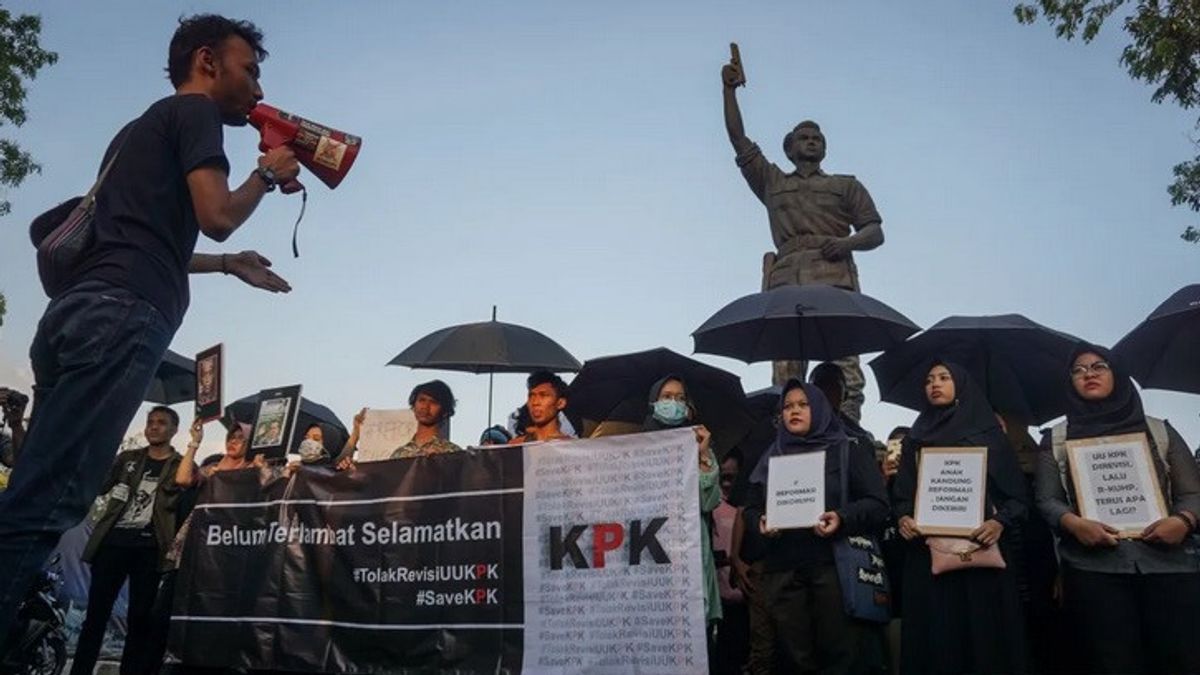
Rapid RevisionThe KPK Law was revised in 2019, when Jokowi was still serving as an active president. Before it was passed in September 2019, the discussion of revising the KPK Law was rejected by various parties, ranging from professors, academics, community coalitions, to the KPK itself because it was considered to be able to kill the anti-corruption institution.
The revision of the KPK Law also seems to have been completed in a hurry. Since it officially became a DPR initiative bill, the revision of the KPK Law was only discussed for 13 days until it was finally passed.
Some of the points of revision of the KPK Law that have been in the spotlight are that the anti-corruption agency is included in the executive or government branch of power, although it is stated to remain independent. All KPK employees also change their status to state civil servants (ASN) who are subject to regulations in the field of state civil servants.
The KPK in carrying out its duties and powers can conduct wiretapping. However, the implementation of wiretapping can be carried out after obtaining permission from the KPK Supervisory Board, an institution formed from the results of the revision.
The KPK as a law enforcement agency is an integral part of the integrated criminal justice system in Indonesia. Therefore, the KPK must synergize with other law enforcement agencies in accordance with the criminal procedure law applicable in Indonesia.
Another point, the KPK is authorized to stop investigating or prosecuting corruption cases whose investigations and prosecutions are not completed within a maximum period of one year. The KPK must also seek permission from the KPK Supervisory Board, hand-in-hand operations (OTT), seizure, and search.
The then-chairman of the KPK, Firli Bahuri, then held a national insight test in the process of transferring the status of KPK employees to ASN as a follow-up to the revision of the law. This national insight test is also what later became the excuse for the KPK leadership to remove as many as 57 investigators and investigators, including Novel Baswedan, Harun Al Rasyid, and Yudi Purnomo Harahap.
Contributors to the weakening of the KPKAlmost seven years later, Jokowi stated that the revision of the KPK Law in 2019 was an initiative of the DPR. He also emphasized that he did not sign the law which was then passed by the DPR together with the government.
"Yes, at that time the DPR's initiative was revised. But I didn't sign," he said.
If the KPK Law is returned to the rules before the 2019 revision, Jokowi said, its implementation is to adjust to the applicable provisions, one of which is the provision on the election of the KPK chairman.
Jokowi's statement regarding the revision of the KPK Law which occurred in 2019, when he was the number one person in Indonesia, became controversial. Head of the Legal and Investigation Division of Indonesia Corruption Watch (ICW) Wana Alamsyah assessed that the statement was full of paradoxes and as an attempt to wash his hands of past mistakes.
Jokowi, said Wana, is actually one of the biggest contributors to the weakening of the KPK whose revision process is very short.
"The revision process is very short, about 13 days," said Wana in a written statement received by VOI.
On the same occasion, Wana also revealed the reason why Jokowi was the biggest contributor to the weakening of the KPK.
First, on September 11, 2019, Jokowi issued a Presidential Letter (Surpres) which delegated the Minister of Law and Human Rights and the Minister of PAN-RB to represent the executive side to discuss the revision of the KPK Law with the DPR.
"This step marks the official involvement of the executive branch in the legislative process," he said.
Second, former President Jokowi did not issue a Government Regulation in Lieu of Law (Perppu) when there was a major protest in September 2019.
"In fact, constitutionally, the president has the right to do this," said Wana.
Similarly, the Indonesian Anti-Corruption Society (MAKI) also highlighted Jokowi's attitude who agreed to want to return the old version of the KPK Law. MAKI Coordinator Bonyamin Saiman assessed that Jokowi merely wanted to seek attention, because the revision of the 2019 KPK Law occurred thanks to the contribution of the former Solo Mayor.
"To the honorable Mr. Joko Widodo, the 7th President of the Republic of Indonesia, please do not make excuses for the KPK Law issue which was clearly changed during his time, namely in 2019," said Boyamin, quoted by Kompas.
The English, Chinese, Japanese, Arabic, and French versions are automatically generated by the AI. So there may still be inaccuracies in translating, please always see Indonesian as our main language. (system supported by DigitalSiber.id)
Most Popular Tags
#Prabowo Subianto #donald trump #firearm #8791 #giias 2026Popular


