


JAKARTA - How far is the existence of People's Schools able to alleviate extreme poverty in Indonesia?
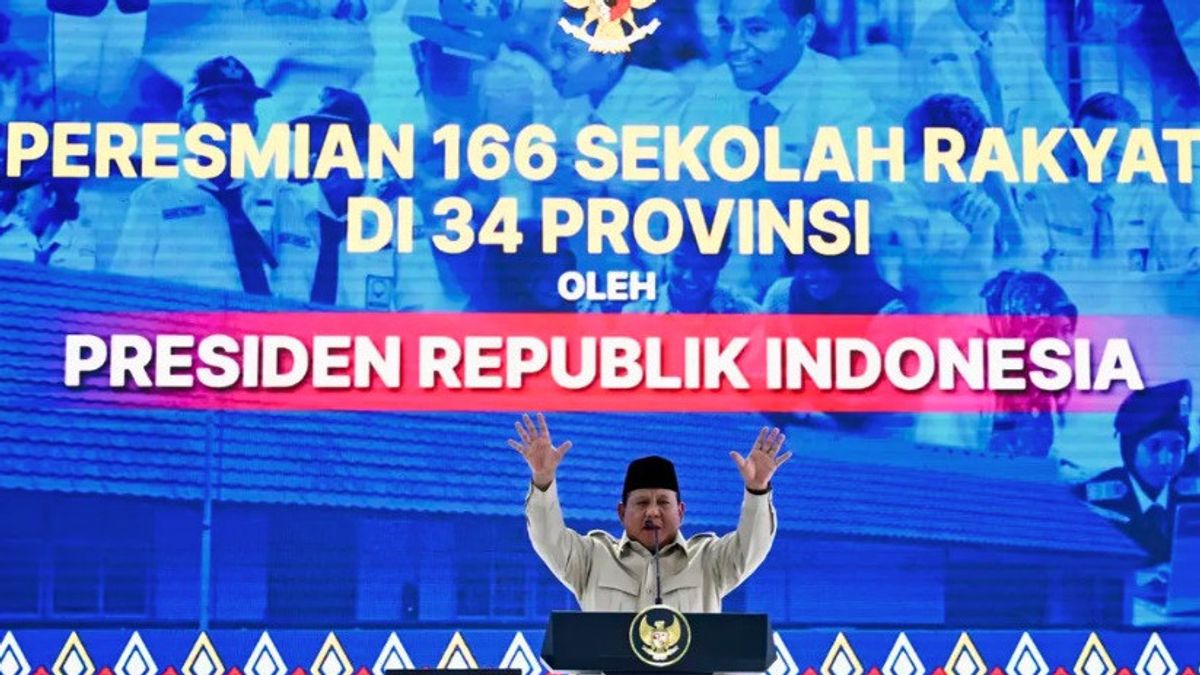
President Prabowo Subianto has inaugurated 166 People's Schools spread across 131 regencies/cities in 34 provinces on January 12, 2026, marking a new stage in the state's presence reaching groups who have been left behind in formal education.
The People's School is one of President Prabowo's flagship programs and was inaugurated after some of them began operating in mid-2025.
In the inauguration, a number of members of the Red and White cabinet were present, including Social Minister Saifullah Yusuf, Secretary of State Minister Prasetyo Hadi, Minister of Basic and Secondary Education Abdul Mu'ti, and Minister of Higher Education, Science, and Technology Brian Yuliarto.
Saifullah said that the People's School was designed to cut the chain of poverty.
"Usually poor people, their children are poor. We have to change and not give up. Those who are classified as the invisible people, we often do not see and feel their suffering. Therefore, we reach out to children from the least able families," said Saifullah.
The Problem of the Classic School DropoutThe People's School program in an effort to break the chain of poverty is also in line with President Prabowo Subianto's instructions. The President wants children from poor and extreme poor families to be educated at the People's School. In addition, his family is also empowered and his house is repaired.
The Minister of Social Affairs, Saifullah, explained that in July 2025, 60 People's Schools had started operating. In the following month, People's Schools in 30 other locations began to run. People's Schools increased again in the following two months. In total, there are now 166 People's Schools operating.
The People's School accommodates 15,954 students. A total of 2,218 teachers and 4,889 education personnel are involved in the People's School.
At the inauguration event, Prabowo said his target was to establish 500 People's Schools by 2029. In addition, he also expressed his desire that each People's School could accommodate up to 1,000 students.
Of the approximately 15 thousand students of the People's School that exist now, about 60 percent of their parents work as daily wage laborers, construction workers, agricultural workers, fishermen, grass collectors, and scavengers.
Generally, parents of students from People's Schools have irregular income and are below IDR 1 million per month. About 300 percent of students have never been to school, while almost 300 students have dropped out of school.
It is undeniable that education in Indonesia still faces the classic problem of children dropping out of school so that they cannot continue their education.
The 2024 Human Welfare Indicator released by the Central Statistics Agency (BPS) shows that the dropout rate in the 2023/2024 school year increased compared to the 2022/2023 school year at all levels of education, except for SMA which decreased slightly.
Coordinating Minister for Social Empowerment Muhaimin Iskandar revealed that as many as 422,629 children from extreme poor families (desil 1) did not go to school. Meanwhile, the number of school-age children aged 7-18 years who have not or no longer go to school reaches around 6.1 million children or around 7 percent of the total population of school-age children in Indonesia.
Data from the 2024 National Socio-Economic Survey (Susenas) shows that the desil 1 group (the poorest families) has a school-age child rate almost four times higher than the highest desil. Many are stuck at the elementary or junior high school level, some others are unemployed at school age due to family economic pressures.
Governance QuestionedEducation activist Darmaningtyas appreciates the free and quality education program for the lower middle class. However, he reminded the government to think about the People's School institution.
Currently, there is a duality of education managed by the Ministry of Education and Religion. The existence of People's Schools managed by the Ministry of Social Affairs and Garuda Schools (flagship schools) managed by the Ministry of Science and Technology adds to the complexity of management and the national education system (sisdiknas).
If the People's School is further regulated, Darmaningtyas hopes that the policy will not conflict with the national education system. Rather than being complicated by legal issues, he proposed that the governance of the People's School education would still be handled by the Ministry of Education, while the task and function of nurturing and developing children's character in boarding schools would be handled by the Ministry of Social Affairs.
In addition, Darmaningtyas also reminded that funding for the People's School and Garuda School, which cut other education funding, would disrupt the existing education ecosystem.
The existence of the People's School is also expected not to forget the existing national education system, both in state and private schools. Especially, considering that these private schools have A, B, C, and D classifications.
Schools with grades C and D, according to Darmaningtyas, should be intervened to become People's Schools and accommodate children from families who are unable to afford it. However, this requires budget, teacher assistance, and managerial assistance. Educational management is still under the Ministry of Education.
"Intervening in these small private schools makes everyone not have to start from scratch. In addition, this intervention also saves small private schools that when the state does not have money have contributed to educating the nation," said Darmaningtyas.
The English, Chinese, Japanese, Arabic, and French versions are automatically generated by the AI. So there may still be inaccuracies in translating, please always see Indonesian as our main language. (system supported by DigitalSiber.id)
Most Popular Tags
#Prabowo Subianto #donald trump #2026 World Cup #Febrie Adriansyah #8791Popular


