
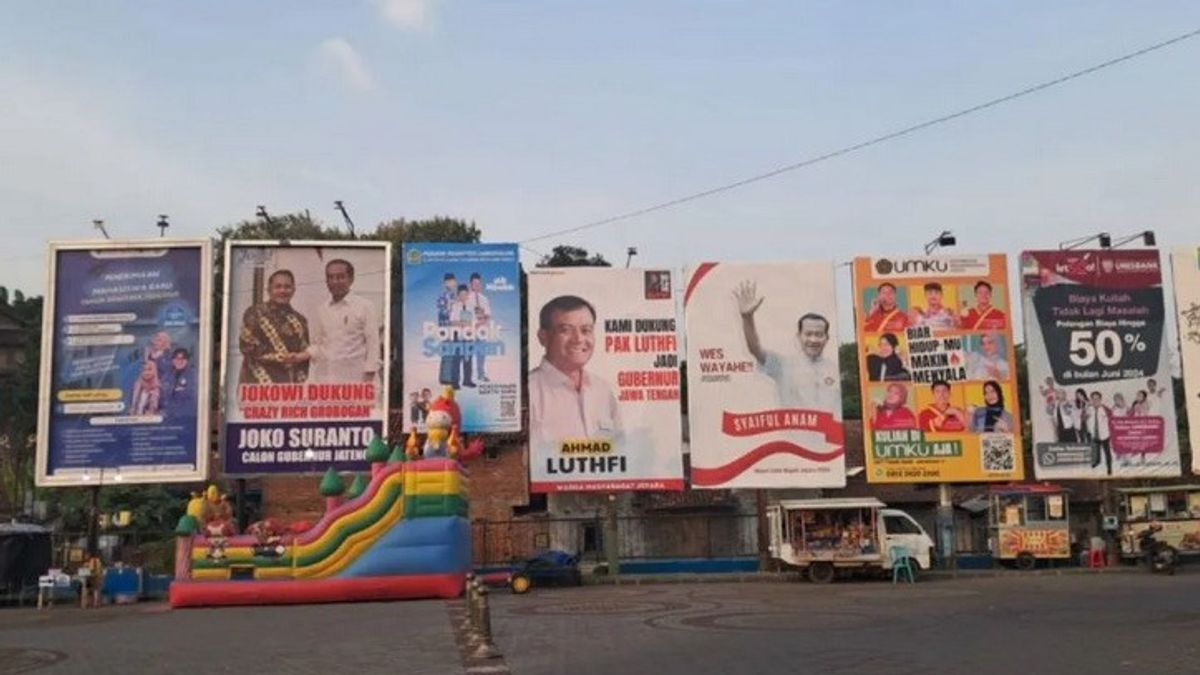


JAKARTA - The discourse to restore the mechanism for the election of regional heads (pilkada) by the Regional Representative Council (DPRD) is increasingly emerging. However, the reasons that a number of parties have raised about the high direct cost of the pilkada are considered illogical.
This discourse was proposed by the General Chair of the National Awakening Party (PKB) Abdul Muhaimin Iskandar in July 2025. This idea continues to roll, and was again conveyed by the General Chair of the Golkar Party, Bahlil Lahadalia, in front of President Prabowo Subianto during the Golkar Party's 61st anniversary on December 5.
Then, the Gerindra and PAN parties have also expressed support for the proposal.
Budget is not a measure ofRegional heads are directly elected by the people through the gubernatorial election, which has been in effect since the issuance of Law Number 32 of 2004 concerning Regional Government. After 20 years have passed, suddenly there is a discourse that the gubernatorial system will return to the pre-reform era.
The most frequently cited reason for the DPRD's desire to return to the gubernatorial system is that direct elections by the people are considered to require high costs and are marked by many practices of money politics. Thus, political elites believe that the DPRD's gubernatorial can overcome these two problems.
However, the staff of the advocacy division of Indonesia Corruption Watch (ICW) Seira Tamara said that the discourse was unfounded and contained worrying logic. At least there are three reasons that make Seira call the reason for the election by the DPRD to save the budget is not appropriate.
First, the costs incurred by the state for the implementation of the regional elections cannot be seen as a form of waste that then legitimizes the elimination of public participation in elections. When compared, the grant funds from the APBD for the implementation of the 2024 Regional Elections, which are estimated to amount to Rp. 37 trillion, are still smaller than the cost of holding the 2024 General Election, which reached Rp. 71.3 trillion.
"If the size of the budget is a benchmark, should the presidential and legislative elections, which are also held directly, also change their mechanisms?" said Seira, in a statement received by VOI.
Second, Seira said, the direct election by the people is actually carried out to minimize transactional practices that have occurred a lot when the regional head was previously chosen by the DPRD.
So, in a nutshell, it is not the direct implementation of the election that gives rise to the practice of political money. But the direct election is actually presented to overcome political money that occurs in a closed and minimal accountability when the DPRD has the authority to choose the head of the region.
"Returning the mechanism of the regional election by the DPRD means deliberately putting the election of the regional head in a mechanism that is definitely more detrimental," he said.
Political Transaction Space Potentially IncreasesSeira assessed that the government had never presented a thorough study on how the DPRD could produce qualified regional heads. Because, in addition to the bad history regarding the implementation of the election by the regional legislature, DPRD members are also not immune from corruption.
According to ICW records, throughout 2010-2024 there were 545 members of the DPRD who were entangled in corruption cases. This means that the DPRD's election does not necessarily eliminate the practice of money politics and has the potential to increase the space for political transactions that cannot be supervised by the public.
Third, the political financing ecosystem that contributes to the occurrence of the political corruption circle.
Since the early stages of the pilkada, parties often demand mahar that must be deposited by the candidate pair to secure the party's support ticket. Party support does not refer to the candidate's competence, but rather leans on popularity that can facilitate the collection of votes.
The large capital that has been spent at the beginning makes the desire to win the contest even higher. As a result, the collection of campaign funds from various parties including businessmen and other big financiers must be carried out.
When the regional head is elected, large costs must still be incurred. Among them are dues to the party, paying debts to financiers, to preparing costs for the contestation in the next period. This is what often makes regional heads entangled in corruption cases.
"With all these problems, the idea carried by the government clearly does not target the improvement of the civil service system and political financing as a whole," said Seira.
He added that what the government is doing now is simplifying the problems that are within the realm of the system and the management of the election to the extent of the high costs required.
"In fact, democracy is never cheap, and the people's participation in determining their leaders is not a burden that should be bargained," he said.
Without serious efforts to see the real problem, said Seira, then the government has neglected the interest to protect the sovereignty of the people.
"Furthermore, the government is actually facilitating the occurrence of transactional politics which has an impact on the destruction of the quality of democracy in the upcoming local elections," Seira concluded.
The English, Chinese, Japanese, Arabic, and French versions are automatically generated by the AI. So there may still be inaccuracies in translating, please always see Indonesian as our main language. (system supported by DigitalSiber.id)
Most Popular Tags
#Prabowo Subianto #donald trump #firearm #8791 #giias 2026Popular


