
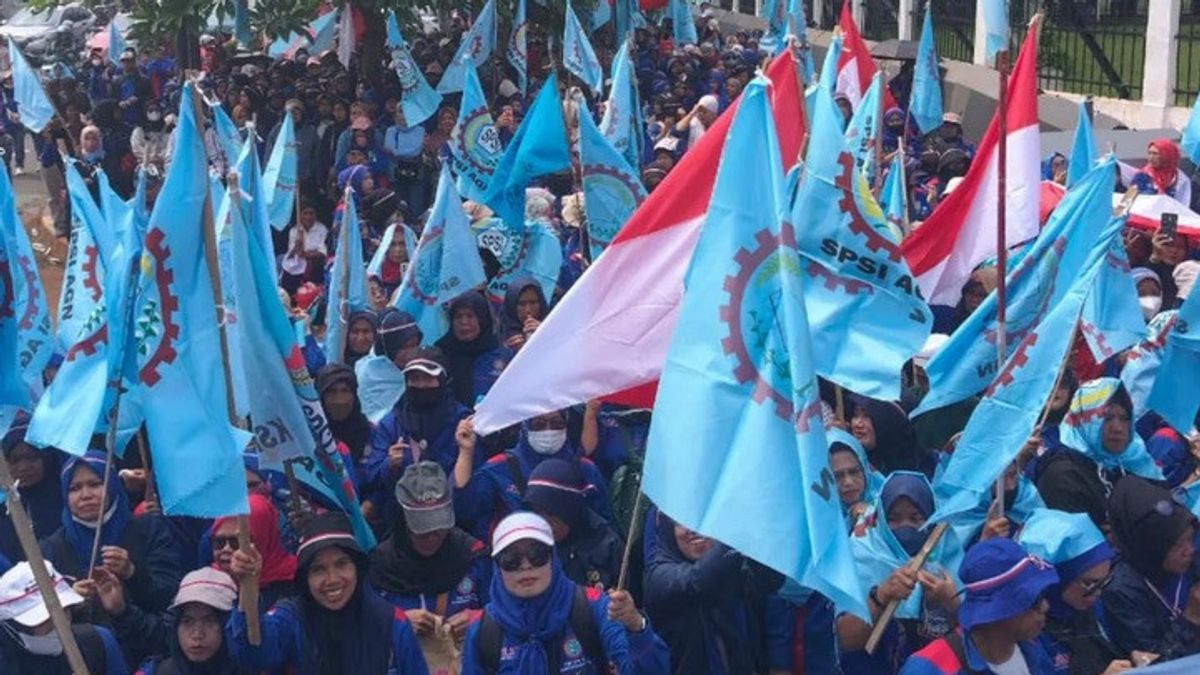


JAKARTA - President Prabowo Subianto has signed a Government Regulation (PP) on the latest remuneration. This will be the reference for determining the increase in the 2026 Provincial Minimum Wage (UMP).
Minister of Manpower Yassierli said that one of the important points in the PP Pengupahan is related to the calculation of the minimum living needs (KHL). All the results of the study were reported to President Prabowo Subianto and became part of the preparation of the draft government regulation (RPP) before it was determined.
"Mr. President also heard directly the aspirations of trade unions, labor unions, including from various parties. And, finally, he set a formula that became a reference in the PP Pengupahan," said Yassierli in Jakarta, Wednesday (17/12/2025).
The idea of wage increases, which are generally carried out at the end of the year, often presents a cross-opinion between workers and employers. On the one hand, workers want a significant increase, but on the other hand, employers often object to workers' demands.
The labor group, which is part of the Confederation of Indonesian Workers' Unions (KSPI), insists on demanding a 6.5 percent to 10 percent increase in the UMP for 2026.
The figure, said KSPI President Said Iqbal, is based on calculations of inflation, economic growth, to certain indices. If it is not approved, Said Iqbal threatens that there will be a national strike by workers.
Meanwhile, entrepreneurs represented by the Indonesian Business Association asked for a fair formula in calculating wage increases. "The hope is that this year's UMP decision will not be surprising, but really fair for employers and workers," said Apindo Chairman Shinta Kamdani.
Formula for Determining UMP 2026The Ministry of Manpower itself has explained the formula for determining the 2026 UMP.
"After considering the input and aspirations of various parties, especially from the Workers' Union / Trade Union, finally the President decided that the wage increase formula was equal to annual inflation (year on year) plus economic growth multiplied by the coefficient of alpha0.5 - 0.9," said Kemnaker.
Alfa is a certain index that describes the contribution of labor to economic growth with a certain value within a specified range, in this case 0.5-0.9.
With such a formula, the determination of UMP 2026 will be different from 2025. In 2025, UMP was set to rise simultaneously by 6.5 percent throughout Indonesia.
The demand for a wage increase of up to 10 percent more than the workers is based on the condition of the Indonesian economy which has not improved. Food prices continue to skyrocket, not to mention transportation costs, electricity, fuel, education, and health continue to increase.
President of the All Indonesia Workers Association Mirah Sumirat in his written statement said that the delay in determining the wage policy should result in a more just policy that favors workers. But in reality, the resulting wage increase is still minimal and far from the expectations of workers.
For information, the announcement of the determination of the 2026 remuneration policy should have been decided in November 2025.
With the current formula, Mirah assessed that the minimum wage increase without controlling the cost of living would be useless and would not have a real impact on workers' welfare.
Non-transparent calculationDirector of Economics Center of Economic and Law Studies (CELIOS) Nailul Huda highlighted the formula for the increase in the 2025 UMP which was just signed by President Prabowo Subianto. In the latest policy, said Huda, it is actually very possible for UMR/P to grow 6.5 percent upwards, but not all areas feel it.
"Suppose by using an economic growth of 5.4 percent, inflation of around 2.5 percent, Alfa at 0.8 percent, according to the formula for wage increases is inflation + (Economic growth x alpha), then the minimum wage growth becomes 6.82 percent.
"However, the problem is that not all provinces have economic growth above the national economic growth. This means that the growth of UMR/P will mostly be below 6.5 percent," said Huda when contacted by VOI.
Huda gave an example of DKI Jakarta, with an economic growth of 4.96 percent, with an alpha of 0.7 and an inflation of 2.67 percent, so that the growth of the UMR is only in the 6.1 percent range. Wage growth can be higher with a higher alpha. The problem, continued Huda, is the determination of the value of the alpha which is not transparent.
"How do we calculate the contribution of workers to economic growth? Is the consumption of workers from the economic sector also calculated? Which workers are counted? Formal or informal?" said Huda again.
"Everything is not transparent so that it can cause division. If you remove alpha, then for workers it will be very profitable," he said.
For this reason, Huda emphasized that the calculation of minimum wage increases should not use alpha. Because, the policy of determining the value of alpha can be a transactional policy.
He also said that wage increases were not something employers had to fear because, in essence, provincial minimum wage increases could increase household consumption.
"When household consumption increases, the economy runs optimally. Economic growth can run significantly," he said.
"The business actors who have increased demand are also the ones who benefit. Naturally, they can increase expansion and open up employment," said Huda in conclusion.
The English, Chinese, Japanese, Arabic, and French versions are automatically generated by the AI. So there may still be inaccuracies in translating, please always see Indonesian as our main language. (system supported by DigitalSiber.id)


