
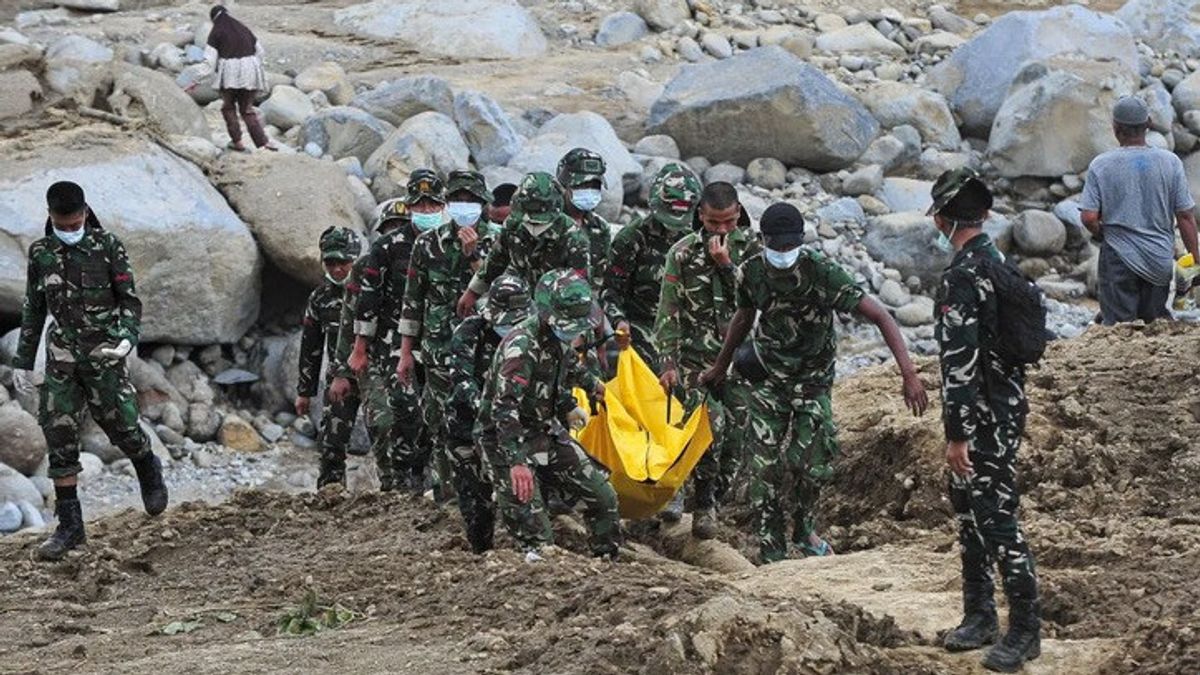


JAKARTA Studies from the Center of Economic and Law Studies (Celios) project that the ecological disaster in Sumatra in November 20025 resulted in an economic loss of IDR 68.67 trillion.
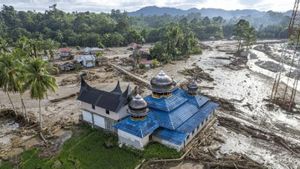
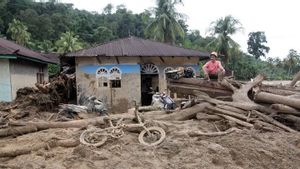
Flash floods and landslides that occurred in North Sumatra, West Sumatra, and Aceh are still a broad concern. The government has not yet determined the status of a national disaster even though the death toll has reached more than 700.
The National Disaster Management Agency (BNPB) noted that the death toll in disasters and landslides in Aceh, North Sumatra, and West Sumatra as of Tuesday (2/12/2025) increased to 744 people.
On their official website, the missing victims reached 551 people in three affected provinces. Meanwhile, 2,600 people were injured in this disaster. The number of residents affected by the large floods in Aceh, North Sumatra, and West Sumatra reached 3.2 million people.
Disasters in the form of flash floods and landslides that occurred in North Sumatra, West Sumatra, and Aceh can be seen as a long accumulation of development policies that place economic growth above ecological safety.
The government is considered slow in providing assistance. Not only that, the central government's side with the regions was also questioned because they did not provide national disaster status even though the victims were more than 700 people.
The government's decision not to determine the status of a national disaster has received sharp attention from various circles including the Executive Director of Celios, Bhima Yudhistira.
He assessed that the central government's steps to refuse to determine the status of this national disaster could not be separated from fiscal limitations at the end of 2025.
Since the beginning of the government, President Prabowo Subianto has intensified budget efficiency. As a result, the posture of state spending has changed drastically. According to Bhima, the results of efficiency that has already entered a number of other priority programs such as Free Nutrition Food (MBG), have narrowed the emergency response post.
"The budget is over the year and the efficiency results have already been included in programs such as MBG. As a result, the budget for disaster response has decreased significantly," said Bhima.
According to Bhima, the government is more busy with populist policies and is negligent about the ecological crisis. This can be seen from the jumbo budget given to MBG next year. Prabowo's flagship program received a budget of IDR 335 trillion or around 8.72 percent of state spending of IDR 3842.7 trillion.
Bhima also compared the MBG budget with other institutions that deal with the impact of disasters due to deforestation and the climate crisis as is currently experiencing by Sumatra.
SEE ALSO:
-
 | BERNAS
Pak Prabowo, Perkebunan Kelapa Sawit Tak Mungkin Menggantikan Fungsi Hutan Hujan
02 Desember 2025, 23:00 -
 | BERNAS
Kampus di Korea Selatan Tolak Calon Mahasiswa Pelaku Perundungan, Bisakah Indonesia Meniru?
02 Desember 2025, 08:00

The MBG budget was recorded to be 125 times larger than the budget for the Meteorology, Climatology and Geophysics Agency (BMKG) of Rp2.67 trillion, 240 times larger than the Basarnas which amounted to Rp1.4 trillion, and 680 times more than the budget for BNPB which was only Rp490 billion.
"Ironically, these institutions actually handle the impact of disasters due to deforestation and the climate crisis. The important sector is budget shortages, while short-term consumption programs are swelling," said Bhima.
The budget efficiency imposed by the central government also weakens the capacity of regional responses, especially in dealing with ecological disasters and the impact of environmental damage.
Many regions, he said, finally bear their own burden because the budget for transfers and emergency funds was also affected by cuts.
"Learning for 2026, the MBG budget of IDR 335 trillion must be cut and returned to expenditure posts affected by efficiency, including disaster response funds to regional transfer funds," said Bhima.
The ecological disaster in Sumatra also has a major impact on the economy. The results of the modeling Celios state that the national economic losses from this disaster are projected to reach Rp68.67 trillion.
This figure includes damage to residents' houses, loss of household income, damage to road and bridge infrastructure facilities, and loss of agricultural land production inundated by floods and landslides.
Sesifically, according to Celios, Aceh Province is projected to suffer a loss of IDR 2.2 trillion, North Sumatra is projected to lose IDR 2.07 trillion, and West Sumatra IDR 2.01 trillion.
An ecological disaster was triggered by land conversion due to deforestation of palm oil and mining. Illegal logging that has been carried out over the years has cost Indonesia 11 million hectares of primary forest in the last 22 years, according to Global Forest Watch (GFW) records.
In the period 2001-2024 Aceh lost 860 thousand tree cover, or equivalent to 17 percent of the tree cover area in 2000. Still referring to GFW data, from 2001 to 2024, North Sumatra lost 1.6 million tree cover or the equivalent of 28 percent of the total tree cover area in 2000. The number is tandemed with tree cover obtained in 2000-2020, which is 390 thousand ha. The same thing happened in West Sumatra, which lost 740,000 tree cover in the 2001-2024 period, equivalent to 19 percent of the total tree cover in 2000.
Celios assessed that the biggest damage occurred in areas where many giant companies were operating bases, whose profits were enjoyed by a handful, while their ecological costs, such as floods, landslides, failed to harvest borne by the public.
For example, the contribution from mines and palm oil is not proportional to the losses caused by the disaster caused.
Aceh lost IDR 2.04 trillion, higher than the Non-Tax State Revenue (PNBP) of the Aceh mine IDR 929 billion until August 31, 2025. The Contribution of Revenue Sharing Funds (DBH) for Oil Palm Plantations in Aceh Province was IDR 12 billion in 2025 and Minerba was IDR 56.3 billion, much smaller than the loss of IDR 2.04 trillion due to flooding.
To that end, Celios urged a moratorium on mining permits and expansion of oil palm plantations. It's time to move to a more sustainable economy, a restorative economy.
"Without a change in economic structure, ecological disasters will repeat itself with much greater economic losses," Celios said in a statement.
The English, Chinese, Japanese, Arabic, and French versions are automatically generated by the AI. So there may still be inaccuracies in translating, please always see Indonesian as our main language. (system supported by DigitalSiber.id)
Most Popular Tags
#Prabowo Subianto #donald trump #firearm #8791 #giias 2026Popular


