
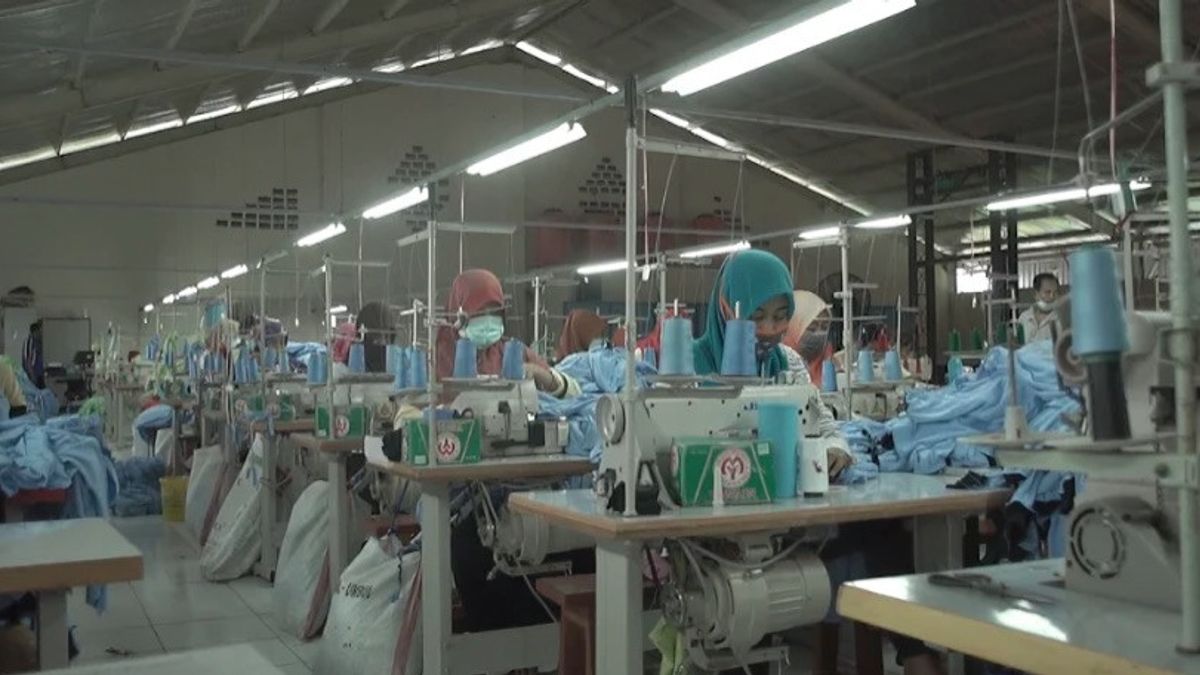


JAKARTA The wave of layoffs (PHK) has again hit the Indonesian footwear industry. Recently, PT Victory Chingluh Indonesia in Pasar Kemis, Tangerang, Banten is said to have laid off 2,804 employees as part of the company's efficiency.
Until now, there has been no official statement from the company that is the supplier for the Nike international sports brand. However, the Director of Textile, Skin and Footwear Industry Rizky Aditya Wijaya admitted that he had received a report related to layoffs at PT Victory Chingluh Indonesia. A report from the Indonesian Footwear Association (Aprisindo) revealed the possibility of moving factories from Tangerang to Cirebon.
The transfer of company locations has occurred in recent years. Previously, a number of companies also left West Java and chose to move factories to Central Java.
Throughout 2019-2022, 28 labor-intensive factories in West Java moved to Central Java. Then throughout 2023, there were about five labor-intensive factories leaving West Java. Then in 2024 there are rampant layoffs in West Java.
The phenomenon of factory relocation to Central Java does not only occur in West Java and Banten, but also in Jakarta. This is illustrated by the incident in the Nusantara Bonded Area (KBN). One by one the factories have started to relocate their production from the area.
The trend of moving factories from Banten, Jakarta and West Java to a number of areas in Central Java is said to be due to differences in the provincial minimum wage in the two areas.
For information, the 2025 Banten UMP is set at IDR 2,905,119, while the Central Java UMP is IDR 2,169,348. Jakarta is listed as the province with the highest UMP, which is IDR 5,396,760.
Executive Director of the Center of Economic and Law Studies (CELIOS) Bhima Yudhistira did not deny that the UMP in Central Java is the allure of investors to relocate their factories to the region.
However, in addition to wages, the high number of illegal levies or extortion in the old industrial area can also be the cause of companies choosing to move to Central Java. In Central Java, said Bhima, the problem of extortion is much lower.
SEE ALSO:
-
 | BERNAS
Ledakan di SMAN 72 Jakarta: Tindakan Radikal Tak Selalu Dipicu Amarah Korban Perundungan
11 November 2025, 13:00


"Then the development of new industrial areas is also massive in the Kendal, Brebes and Batang areas. There is a focus on developing industrial infrastructure in Central Java and it attracts factory relocation," explained Bhima.
The phenomenon of the transfer of companies from West Java and Jabodetabek to Central Java has also attracted the attention of senior economist Bambang Brodjonegoro. He considered, this should be a concern if the local government does not want to lose its investors.
"The local government must try if, for example, they don't want an increase in the UMP which is too big, making entrepreneurs move to other areas," he said.
Bambang said that the percentage increase in the UMP actually reflects the performance of each region in managing inflation. That is why local governments must be able to maintain a balance between the need for wage increases and the company's ability to pay for them.
"Regional inflation must be maintained and it can later create a balance," he continued.
Chairman of the DKI Jakarta Indigenous Entrepreneurs Association (HIPPI) Sarman Simanjorang said, there were many other factors and considerations when the company decided to relocate the factory to Central Java. He also did not deny that the cheap UMP was one of the considerations.
But apart from the UMP, other considerations for companies to relocate usually also consider whether new areas are conducive to doing business. Then easy licensing issues, security, comfort, and the transportation sector are also considered.
"So many say the factor they are relocating, so it's not just because of the UMP but there are other factors. For example, Central Java has a large market share. Because Central Java is one of the provinces that has the largest population as well as Java," said Sarman.
According to data from the Directorate General of Population and Civil Registration (Dukcapil) of the Ministry of Home Affairs, the population of Central Java in June 2022 was 37.49 million people. Of these, as many as 25.99 million people (69.34 percent) of these residents are the productive age group (age 15-64 years).
Central Java also has 11.5 million people including the unproductive age group, with details of 8.48 million people (22.62 percent) who are not yet in the productive age group (0-14 years) and 3.02 million people (8.05 percent) are in the age group. unproductive (65 years and over).
With this population data, the dependence ratio (dependency ratio) of Central Java is 44.23 percent in June 2022. This means that every 100 people of productive age bear 44-45 people of unproductive age.
"So that factor affects and considers a company to relocate in this case," Sarman added.
He also sees the work culture in the Central Java region as one of the factors affecting relocation. Because, companies that want to make a move must already have a survey of certain criteria to enter the local area.
"Because by relocating the factory, it means that you have to buy land or rent for a long time and you have to build a factory, for example, supporting infrastructure is quite large compared to their costs," he said.
The English, Chinese, Japanese, Arabic, and French versions are automatically generated by the AI. So there may still be inaccuracies in translating, please always see Indonesian as our main language. (system supported by DigitalSiber.id)
Most Popular Tags
#Prabowo Subianto #donald trump #firearm #8791 #giias 2026Popular


